

Red carpet economics
South African universities cannot afford to only hire South African scholars

Published last week on Our Long Walk: A firm budget | The Cape Town Cycle Tour | Coming up: Join me this Friday at 13h10 as I interview Tyler Cowen live! Paid subscribers are welcome to send their questions for Tyler to me. Please consider a paid subscription.

‘South Africans must be prioritised in employment opportunities.’ That was the Minister of Higher Education and Training at a recent parliamentary committee sitting. Foreign academics are welcome, he added, but only to fill genuine shortages, and only when aligned with the Critical Skills List.
The Portfolio Committee chairperson has gone further. As News24 reports, he wants the department to provide a list of all foreign nationals at South Africa’s 26 universities who do not have scarce skills qualifications. Individual universities have been given until 18 March to supply the information.
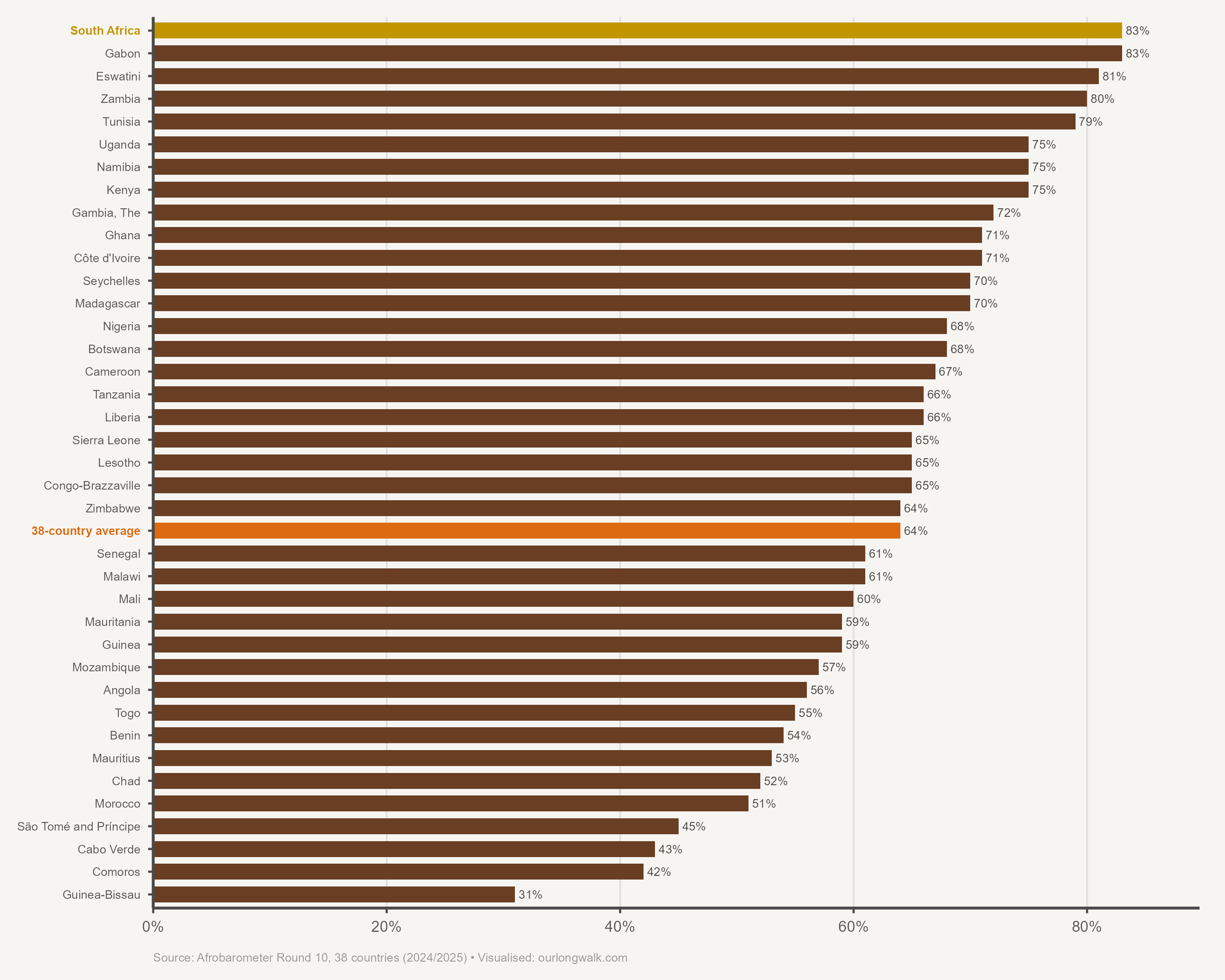
It is not hard to see why politicians feel emboldened. According to the latest Afrobarometer survey, 83 per cent of South Africans say the government should allow fewer or no job seekers from other countries to enter – tying with Gabon as the highest figure across all 38 African countries surveyed in 2024/2025. In a country with mass unemployment, that line wins easy applause.
But for universities, the question should not be about who feels comforted today. It should be about what makes us smarter tomorrow.
Here’s why it matters. The ‘locals first’ instinct rests on a pivotal assumption: that a university is just another labour market, where every foreign hire necessarily displaces a local one. For some kinds of work, that picture is roughly right. For how science is actually produced, it is almost exactly wrong.
Think of it this way. A lab, a department, a research group – these are not rows of isolated desks. They are webs of complementary skills. We are used to thinking about employment as a Monopoly board: one player’s gain is another’s loss. Research is closer to Catan: new roads open new settlements; the board itself expands.
A little history helps. Medieval universities were international by design. Students crossed borders routinely, often entering as teenagers, and qualifying to teach could take a decade of study. Latin was the technology that allowed scholars to move freely between cities. When the Black Death hit and universities faced sudden demographic collapse, Bologna actively recruited foreign professors. Even in a world of slow travel, universities survived by looking outward.
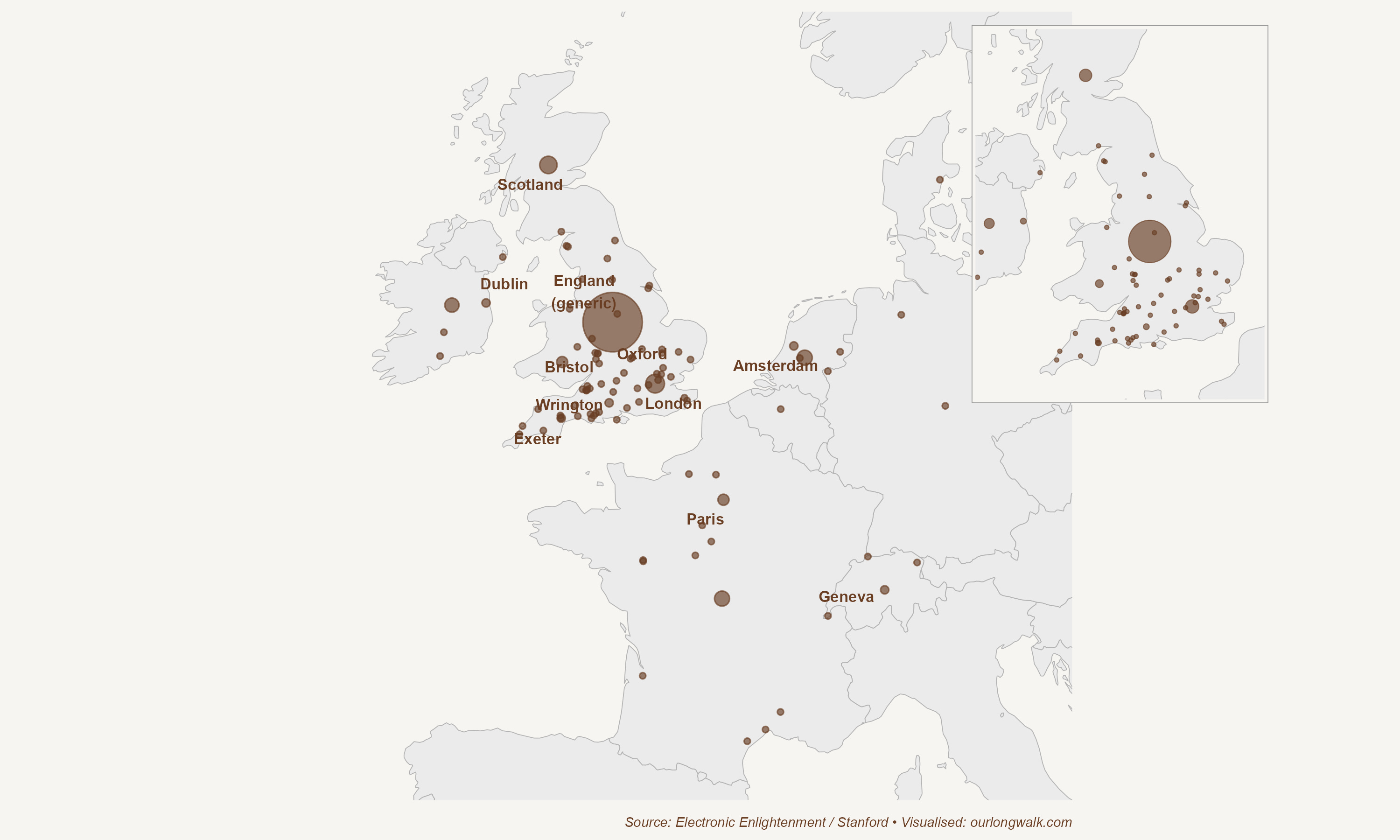
The early modern Republic of Letters took the same logic further. Scientific progress depended on cross-border exchange – letters, manuscripts, visits, and patronage – despite political and religious walls. John Locke captured this spirit when he described scholarship as a ‘commonwealth of learning’. The map above, drawn from a Stanford dataset on Locke’s correspondence, shows just how international that commonwealth was. His 335 correspondents stretched from Ireland and Scotland across to the Netherlands, France, Switzerland and beyond. A remarkable web for a world without email.
Which brings us back to the present. That pattern – openness driving discovery – is not just a quaint historical fact. It is basic economics. Knowledge is what economists call ‘non-rival’: my learning does not diminish yours. Better still, in research, one person’s insight often raises everyone else’s productivity. A superb supervisor improves multiple students. A strong experimentalist sharpens the theorists around her. A well-connected collaborator changes what projects are even possible.
In short: foreign appointments in science are rarely zero-sum.

The recent economics literature has quantified these effects. In a new American Economic Review paper, Terry and co-authors estimate that a one per cent immigration shock increases local patenting by about 1.65 per cent.1 That is hard to square with a displacement story. Immigration, on average, expands innovative output. Embed those gains in a growth model and the authors find that without the post-1965 rise in immigration to the US, per-capita income would be roughly five per cent lower in the long run. Put differently: restricting talent does not just reshuffle who holds existing posts. It slows the rate at which new ideas – and new jobs – arrive.
Bernstein and colleagues help explain why. Immigrants are about sixteen per cent of US inventors but produce roughly 23 per cent of patents.2 When you account for spillovers – the boost an outstanding researcher gives to those around them – immigrants are responsible for around 36 per cent of aggregate innovation, with more than half of that coming through positive effects on local-born inventors.
This is the mechanism most public debates miss. A high-performing immigrant does not only add her own output. She lifts the output of everyone nearby.
A related misconception is that limiting foreign hiring ‘keeps opportunities at home’. Glennon’s research shows that firms respond by moving work abroad. When US companies could not secure an H-1B visa – a skilled-worker permit – they created roughly 0.42 jobs in foreign affiliates for each unfilled position.3 Universities are not multinationals, but the same process applies. Talent is mobile. Make a research system unwelcoming and the frontier work happens somewhere else; the best talent – students and staff – moves elsewhere.
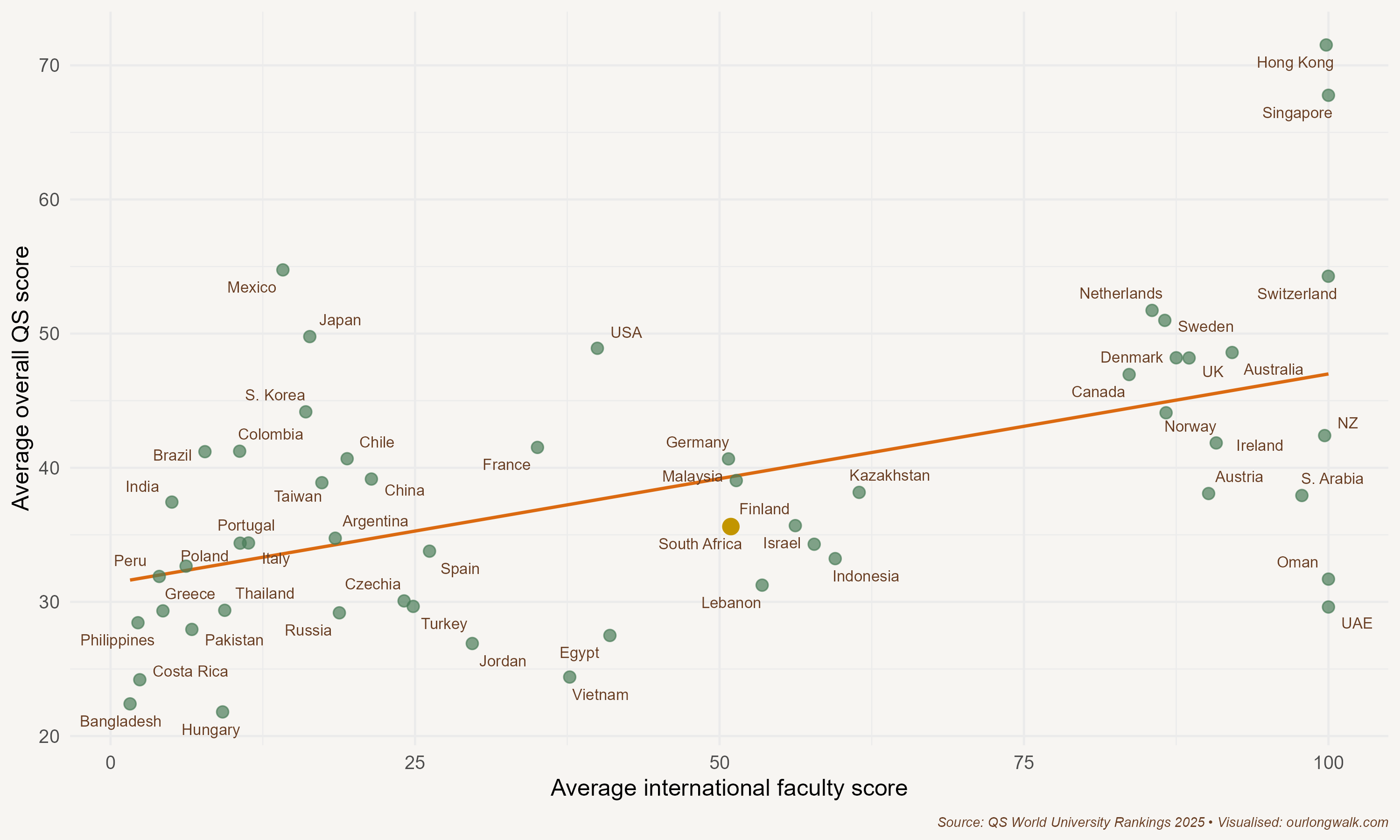
The cross-country data tells a similar story. When you plot national university rankings against the share of international faculty, using QS data for countries with more than five million people, the pattern jumps out. Countries whose universities attract more foreign scholars tend to rank higher. Sweden, Switzerland, the Netherlands, Australia and the UK all cluster in the top right, with both high international faculty scores and high overall rankings. Countries that are more closed sit lower and to the left. South Africa lands around the middle on both dimensions.
This is why the committee’s reliance on a Critical Skills List is, at best, incomplete. Skills lists are built for shortage occupations: we need more nurses, more engineers. But research is not built by filling generic buckets; it is built by assembling excellence. A small number of scholars, at the very top, produce a wildly outsized share of publications, citations and impact. The distribution has fat tails.
As I explained here, sport is almost always a good analogy. ‘Striker’ is not a scarce skill; there are thousands of them. But if you want to win, you buy Erling Haaland – not because you lack a striker, but because Haaland changes what your entire team can do. Research hiring works the same way. ‘Economist’ is not scarce. A top economist – one who publishes in the best journals, wins competitive grants, builds teams and graduates strong doctoral students – is very scarce.
Of course, none of this means open season. The Minister is right to stress evidence, lawful processes and data quality. The committees are right to worry about non-compliance. But there is a difference between enforcing the rules and lowering the ambition of the university.
So what should we ask of universities instead of ‘prove a shortage’? Two better questions. Will this appointment measurably raise the quality of research and innovation? And will it build local capacity over time – through teaching, postgraduate training, co-authorship, mentoring and lab development?
‘South Africans must be prioritised’ may be a political necessity. But it cannot become a numbers game or, worse, a game of drawing up lists of names. We cannot afford to settle for a mediocre local appointment when a brilliant foreign scholar is available; and we cannot afford to assume a foreign passport implies brilliance. The right question is not where you are from. It is whether you have the ideas – and the track record – that will help us produce better science.
Terry, Stephen J., Thomas Chaney, Konrad B. Burchardi, Lisa Tarquinio and Tarek A. Hassan. 2026. “Immigration, Innovation, and Growth.” American Economic Review, 116 (3): 828–61.
Bernstein, Shai, Rebecca Diamond, Abhisit Jiranaphawiboon, Timothy McQuade, and Beatriz Pousada. The contribution of high-skilled immigrants to innovation in the United States. No. w30797. National Bureau of Economic Research, 2022.
Glennon, Britta. "Skilled immigrants, firms, and the global geography of innovation." Journal of Economic Perspectives 38, no. 1 (2024): 3-26.
The current entanglement between politics and academia & research is concerning.
Looking at the current United States administration, which has severely impacted many federal scientists and is engaged in legal battles with major universities to advance its populist agenda at the expense of research output (China now invests more in scientific research than the United States).
Good research and academia have always been a net benefit to society. I hope these attitudes towards academia remain a relic of the 2020s.
If we as a country (government!) can't even develop or stick to good practice and merit-based employment with regard to its own governmental employees, how on earth can they be expected to develop anything else than brainless policies for higher education hiring, where merit and real competence and research skills and experience are of paramount importance??? But, then, by artificially pushing down competence wherever the government can, it facilitates the hiding of the mass incompetence among too many of those employed by them as a government. How long before the 30% pass mark is also dictated to our tertiary institutions? Introducing what is very much like quotas for the employment of academics, will be a move in that direction. Lower the bar and even useless and incompetent and outright lazy employees can pretend that they "perform well". Push standards into the ground and they can even pretend to be "exceptional"...