


Published last week on Our Long Walk: Rainbow 2.0? | The new heavy plough | Check out my new bookshop! | Thank you for subscribing. Please consider a paid subscription.

In a charcoal drawing by William Kentridge, a devastated landscape stretches under a sullen sky. The ruins of war are sketched in smeared greys and blacks; amid the wreckage, a severed head – borrowed from Géricault’s Guillotined Heads – looms as a grotesque monument. Scrawled across the scene are the words “This is a Fair Idea of Progress.” The caption drips with irony. Here “progress” is not growth or innovation but destruction. Kentridge, whose work so often excavates colonial and apartheid histories, underlines the lunacy of triumphalist narratives by showing how easily they mask barbarity. The Kaboom! series from which this drawing comes was created around the centenary of World War I; fittingly, it exposes the war’s forgotten African victims and mocks Europe’s pretensions of a civilising mission.
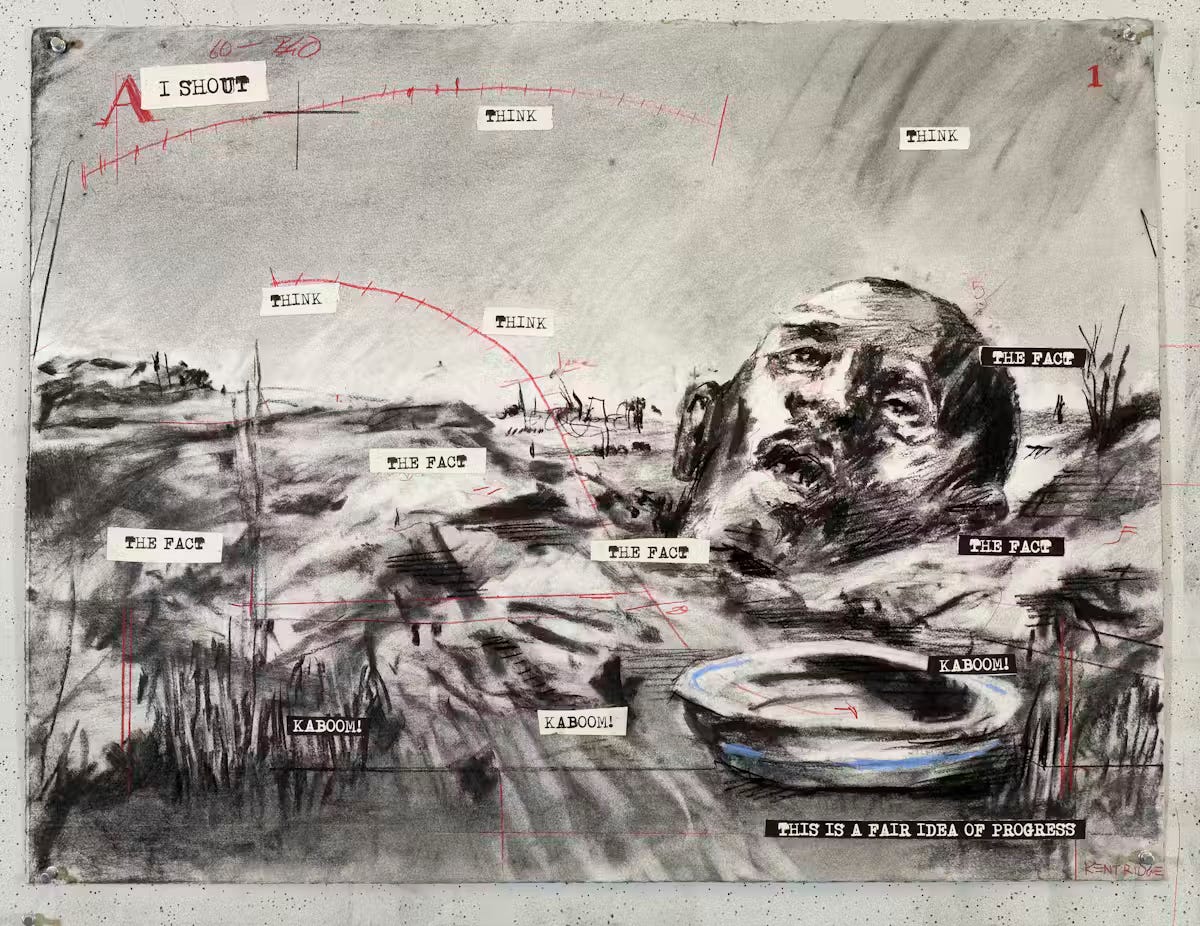
But the ironic tone of “This is a Fair Idea of Progress” is not only Kentridge’s. It exemplifies a broader tendency in South African art and literature. Instead of painting inspiring tomorrows, artists hold up a mirror to past and present failures. Progress, in this cultural milieu, is something to be questioned, deconstructed, even scoffed at – rarely something to be envisioned with hope.
This critical outlook has deep roots. South African creative expression, forged in colonial dispossession and apartheid, has understandably honed a keen satirical edge. Painting, sculpture, drama, and novels have been weapons to expose injustice and moral failure. Yet the very strength of this tradition – its unflinching honesty – can become a weakness when imagination is needed. After political freedom, how does a society dream of material betterment? Who draws the blueprints of a prosperous future?
South African literature has produced internationally acclaimed writers, from Nobel laureates to cutting-edge science fiction authors. What they share, however, is a reluctance to imagine a shining future. Time and again, their works focus on the weight of history, the persistence of moral failure, or the coming of dystopia – with few sustained visions of how the country might materially improve.
J.M. Coetzee’s novels are a case in point. Across multiple works, Coetzee presents societies stuck in ethical quagmires or decline rather than on the brink of renaissance. Waiting for the Barbarians (1980) is an allegory of a stagnant empire terrified of change; Life & Times of Michael K (1983) follows a man fleeing a war-torn society into rural solitude; and the post-apartheid tragedy Disgrace (1999) depicts a nation where progress – racial reconciliation, economic or moral uplift – seems agonisingly elusive. In Coetzee’s literary world, improvement is fleeting or false; the future appears as something to endure, not to shape.
Other major writers echo this pessimistic or critical bent. Zakes Mda, for example, sets up an explicit confrontation between progress and tradition in The Heart of Redness (2000). A rural Xhosa community is divided over plans to build a casino and tourist resort. The “Unbelievers” champion development, lured by jobs and modern amenities like electricity. The “Believers” resist, fearing the destruction of cultural heritage and a future of menial service. Mda continually shifts between the present and the legendary 1856 cattle-killing, when a prophetess’s promise of miraculous salvation led to mass starvation. Once cattle were slaughtered in a catastrophic wager on freedom from colonial rule, he says, now land and tradition are sacrificed for another kind of deliverance: a glittering mirage of progress.
Writers who venture into speculative fiction or satire tend toward dystopia or dark allegory. Lauren Beukes’s Moxyland (2008) imagines a near-future Cape Town dominated by omnipresent corporate surveillance and biotechnology. Rather than imagine technology empowering a better life, Moxyland extrapolates today’s inequalities into tomorrow’s high-tech oppression. Ivan Vladislavić, known for his inventive takes on Johannesburg, similarly avoids idealised futures. His work dwells on memory, fragmentation, and the absurdities of transition: characters catalogue the detritus of urban renewal or struggle to find meaning in post-apartheid flux. Damon Galgut’s The Good Doctor (2003) turns a remote rural hospital into a metaphor for post-apartheid disappointment; his Booker-winning The Promise (2021) echoes a similar note, its title dripping with irony – a pledge of a better life that remains unfulfilled across decades.
Even nonfiction is rarely optimistic. Recent books documenting state capture, corruption, and whistleblowers are, by design, books about how close the country came to the precipice. Jonny Steinberg has made a career of interrogating South Africa’s post-apartheid realities – crime, poverty, AIDS, xenophobia – through nonfiction narrative. Works like Midlands, The Number, Three-Letter Plague, and A Man of Good Hope are gripping and humane, but they train a spotlight on present social ills rather than future solutions. What hope exists lies in individual resilience, not in a grand vision of national progress.
Since the days of protest literature, the author’s job has been, in Nadine Gordimer’s words, “to describe a situation so truthfully that the reader can no longer evade it.”1 This ethical dedication to realism, coupled with a rejection of sweeping national narratives, has produced a literary culture that excels at moral and social critique but which strains to imagine large-scale, positive transformation. Elleke Boehmer calls is a “compulsive contemplation of pain and yet more pain.”2
Few writers offer blueprints of progress. Few articulate what a thriving South Africa might look like – how its people might overcome poverty and become more prosperous, innovative, or free. Instead, imaginative energy is poured into cautionary tales and anti-utopias. Fiction tends to ask, “What if it all goes wrong?” rather than “What if we finally get it right?”
That said, the critical reflex is not unique to South Africa. Across the twentieth century, dystopian fiction increasingly defined how the future was imagined. This Margaret Atwood attributes to the steady failure of one “utopia” after another, making it “difficult to place faith in the construction of utopias, literary or otherwise.”3
Previous centuries, by contrast, were “cluttered up” with utopias. Not all utopian visions translated benignly into reality, but the act of imagining progress helped expand what societies believed to be possible and provided cultural fuel for material advancement. A striking historical example comes from an unlikely source: a series of engravings published in 1588. Virginia Postrel highlights the Renaissance book Nova Reperta as an early celebration of human advancement. It contains nineteen engravings, each showcasing a relatively recent invention or discovery – the magnetic compass, the printing press, the harnessing of wind and waterpower, and more. These images collectively “made the argument for progress by showing rather than telling.”
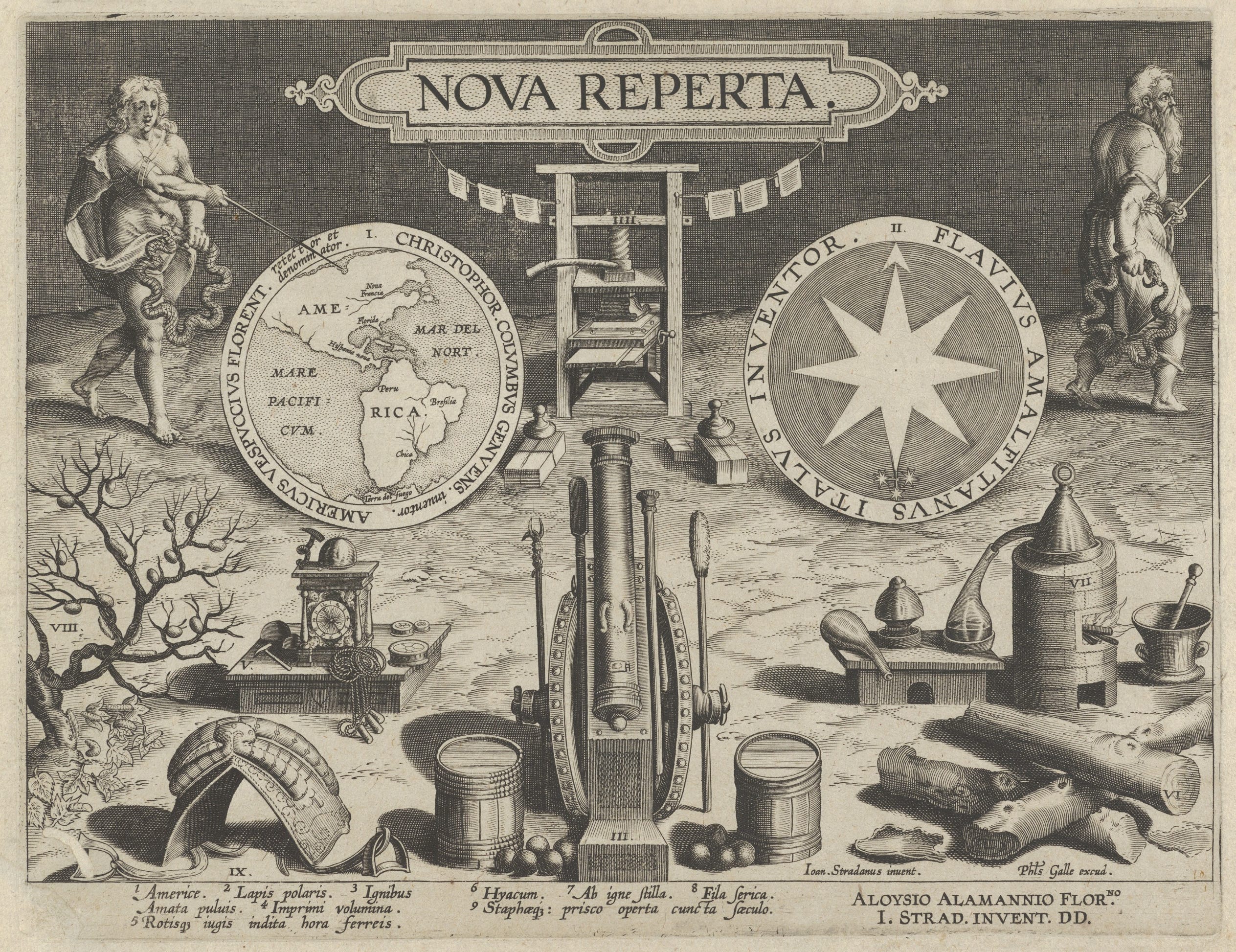
The title page is rich in symbolism: the Future gestures toward the map of the Americas while the Past turns away; between them stand emblems of modernity like a printing press and a cannon. The message is clear – the present has surpassed antiquity. What is remarkable is the tone. Stradanus (the artist) portrays “a world of sociable work and material plenty”. Artisans and labourers appear as ordinary protagonists of improvement. Art here is not merely critiquing power or satirising folly; it is actively valorising innovation.
A recent research paper hints that language itself can be a barometer – and perhaps a driver – of a society’s orientation toward progress. A 2025 study by Almelhem et al. in the Quarterly Journal of Economics asks whether British culture started to manifest a belief in progress before the Industrial Revolution. Analysing 264,443 English-language books printed in England between 1500 and 1900, from sermons and scientific treatises to novels and newspapers, they track shifts in the language of science, religion, political economy, and “progress” (betterment, improvement, and related terms).
Their findings are striking. First, the language of science and religion separates around the mid-eighteenth century: scientific writing becomes more secular and forward-looking. Second, books at the nexus of science and political economy become markedly more progress-oriented during the Enlightenment. Third, industrial language – especially where it overlaps with applied science and economic life – becomes increasingly associated with progress-believing vocabulary. Their evidence suggests that the rhetoric of improvement diffused well beyond elite salons, into applied texts aimed at people who made and fixed and built.
The study is quantitative and broad-brush. It does not delve into individual novels or artworks, nor does it claim that literature or painting caused economic growth. (Works of fiction appear in the corpus, but are not analysed as “imagination” in a literary sense.) Yet the implications are suggestive: before people change their world, they often must change their words. A society that repeatedly talks itself into improvement, invention, and betterment makes room for material transformation. The absence of such rhetoric can, conversely, become a cultural drag.
Culture, then, is not a mere mirror of material conditions – it can be a motor. This is an idea Deirdre McCloskey has emphasised in her work on the rise of commercial society. In an essay on Shakespeare and bourgeois life, she argues that artistic and literary culture helped legitimise commerce, innovation, and the pursuit of betterment. Through imagination, people learn new norms; “novels and plays and poems … show people how to live in a society of change.”
That insight sharpens the South African problem. If literature can teach a society to embrace change, then a canon dominated by irony and despair may inadvertently teach the opposite. By continually highlighting corruption, folly, and failure, art and literature may reinforce a message that grand improvements are suspect or futile. The point is not to demand propaganda, or to pretend that progress is painless. It is to recognise that imagination matters. A society tends to get the future its storytellers can imagine for it – and it is hard to build what cannot be pictured.
None of this is to suggest that South African artists bear responsibility for economic outcomes, nor that they should churn out naive utopias. The critical lens on the past and present is vital; it keeps society honest about its failures. But cultural imagination also has another role: to expand the horizon of possibility and legitimise hope. Just as Nova Reperta gave Europeans permission to say, “We are inventors in a new age,” perhaps South Africa needs voices that dare to say, “We can be better off – and here’s what that might look like.”
A good example is one of Antjie Krog’s earliest poems, written while she was still at school. At the time, it caused a great stir and was even read on Robben Island.
MY BEAUTIFUL LAND
Look, I am building myself a
land where skin means nothing,
just your understanding.
Where no goat face in Parliament
shouts to keep verkramp
things permanent
Where I can love you
And lie next to you in the grass
without saying ‘yes’ in
church.
Where we can play the guitar
at night and sing
And bring jasmines for each
other.
Where I don’t have to feed you
poison if a strange voice calls
in my ear.
Where no divorce court can
dim my children’s eyes.
Where White and Black, hand
in hand,
Will bring peace and love to
my beautiful land.
So who are South Africa’s cultural entrepreneurs today, and what visions of the future are they offering? In an era when the country must find a path to broad-based prosperity, perhaps a new kind of cultural figure is needed – the artist as architect of possibility, the storyteller as builder of hope.
South Africa needs art that doesn’t just mourn what was lost, but sketches what could be built. It needs paintings that can portray thriving schools, modern workshops, connected communities – not as propaganda, but as earnest imaginings of a better reality. It needs drama and film that grapple with the moral ambiguities of change while still affirming that change can be necessary and, sometimes, good.
Defending utopia, JC Hallman reminds us that “the choice is not between utopia and some fool’s proposition that not trying is a better form of trying.”4 South African artists should embrace this truth: that hope and critique are not opposites.
South Africa’s next chapter will be written not only in budgets and laws, but in the hearts and minds of its people, guided by what they dare to envision. Our long walk to freedom will not be complete until it is also a long walk to prosperity – and we will only get there if first we can dream it.
This is an edited and translated version of my monthly column, Agterstories, on Litnet. To support more writing like this, consider becoming a paid member.
Cited in Paulina Grzeda, 2013. “Magical Realism: A narrative of celebration or disillusionment? South African literature in the transition period.” Ariel: A reivew of international English literature, 44 (1): 156.
Elleke Boehmer, 2012. “Permanent Risk: When crisis defines a Nation’s writing.” In Trauma, Memory, and Narrative in the Contemporary South African Novel, Ewald Mengel and Michela Borzaga (eds). https://doi.org/10.1163/9789401208451_003.
Margaret Atwood, “Dire Cartographies: The Roads to Utopia.” In Other Worlds: SF and the Human Imagination. New York: Doubleday, 2011.
JC Hallman, In Utopia: Six kinds of Eden and the search for a better paradise. New York: St Martin’s Press, 2010
Massively gripping!
We must let go of the mindset that says ‘if it bleeds, it leads’