


Published last week on Our Long Walk: Twenty years at Stellenbosch | Should you buy the Bitcoin dip? | Thank you for subscribing. Please consider a paid subscription.
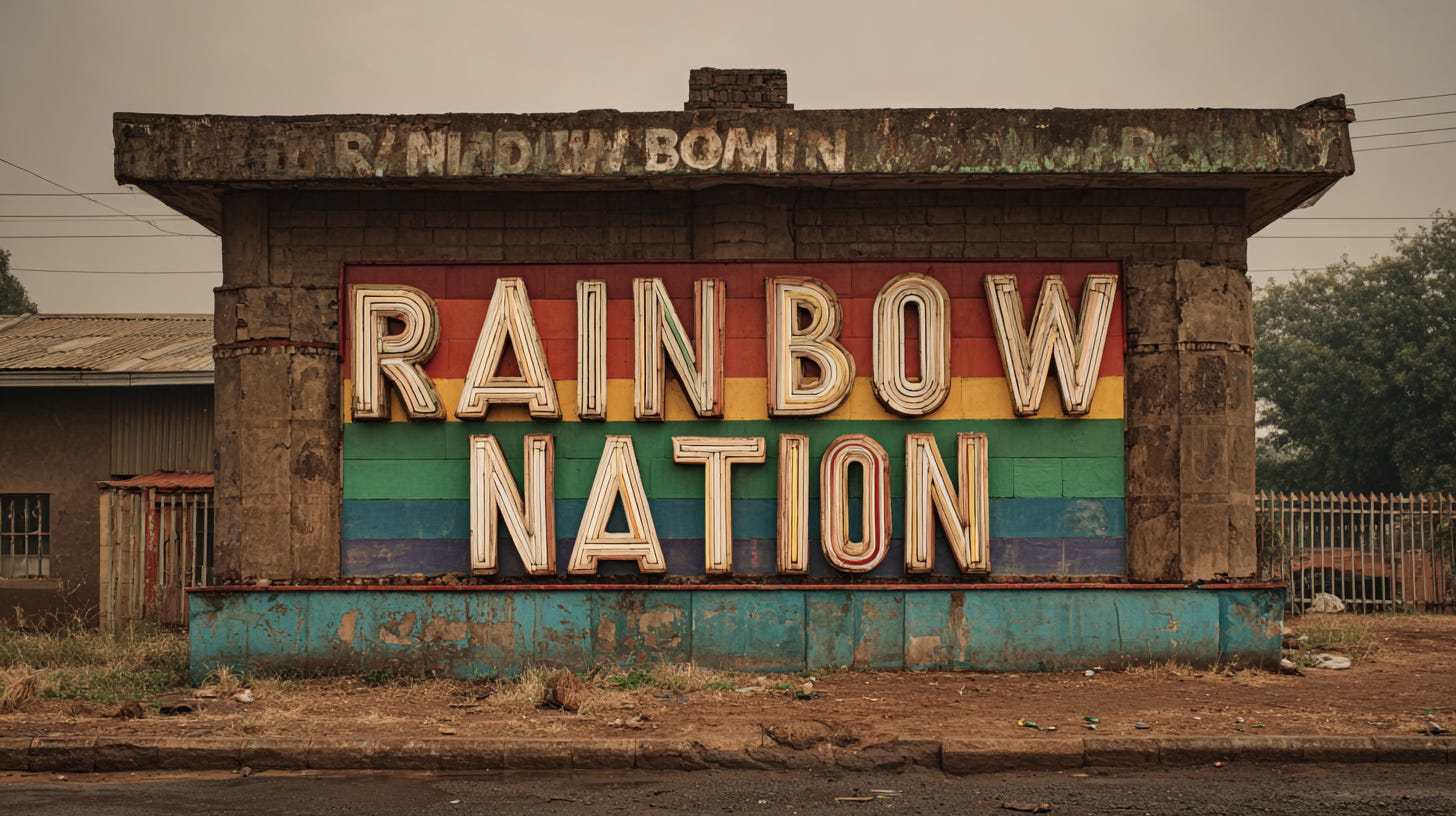
I am a child of the 1990s. Not only was that the best era for economic liberty (prove me wrong), it was also the era of the Rainbow Nation, when there was a new imagination of what South Africa could become. For a brief moment, it seemed we were on our way. Simunye: we are one. Economic growth helped. South Africa recorded growth above 5% in the mid-2000s and cut multidimensional poverty from roughly 38% to under 10%. There were many problems, including unemployment and a president who denied that HIV caused AIDS. Yet we had a vision. When I began at Stellenbosch as a junior lecturer twenty years ago, the future felt open. A decade later, it felt fragile. The 2010 World Cup was a last flourish, but by then Eskom was already failing, and other state institutions were weakening. From 2009 to 2024, the rainbow thinned into a dark cloud. We are today about as rich as we were in 2009.
Why did the rainbow fade? Nations hold together when people who differ from one another still behave as if they share a future. They cooperate, accept rules, pay taxes, and invest in institutions whose benefits largely accrue to others. When that cooperative equilibrium holds, growth becomes easier because trust lowers transaction costs and raises the returns to long-term investment. When it weakens, people retreat into narrower identities or private alternatives, and the economy becomes more conflictual and less dynamic.
Economists have only recently begun to treat nation-building as something measurable. In an NBER working paper on Indonesia, Samuel Bazzi studies one of the most ethnically diverse countries in the world and asks how a shared national identity emerges. His approach is deliberately empirical. Rather than relying on speeches or symbols, he examines policy interventions that plausibly shift identity through policy: mass schooling, administrative integration, land reform, and population mixing. Using quasi-experimental variation, the studies he draws on measure outcomes such as language use at home, inter-ethnic marriage, naming patterns, public goods provision, and conflict. He finds that identity responds to policies, but only under specific conditions. Diversity can be integrated, but the structure of that diversity and the quality of institutions targeted by those policies matter greatly.
Two findings are especially relevant for South Africa. First, contact across groups can integrate or polarise. Where exposure to difference is frequent and no single cleavage dominates local life, a broader civic identity becomes attractive because it reduces the costs of cooperation. Where society is divided into a small number of large blocs, contact can intensify competition and push people towards group loyalty. Second, exit matters. When citizens can credibly opt out of public systems, the integrative power of shared institutions weakens. Private substitutes shrink the everyday spaces in which a national “we” is formed.
This helps explain South Africa’s recent trajectory. Exit has become routine. Private security substitutes for policing. Solar panels hedge against grid failure. Boreholes insure against municipal water collapse. Private schooling and healthcare expand further. Each choice makes sense on its own. Together, they hollow out the shared experiences through which national identity is sustained. They also weaken the political base needed to repair public systems, since those with the greatest voice no longer depend on them.
Repeated state failure can become self-reinforcing. Sirus Dehdari and Kai Gehring study Alsace-Lorraine, a historically contested border region in Europe, using a geographic regression discontinuity design. Municipalities on one side of the border were exposed to repeated repression and shifting national control; those on the other were not. The outcomes include voting in decentralisation referenda and later revealed preferences such as regional newspaper subscriptions and support for regionalist parties. They find that negative experiences with the nation-state strengthen regional identity, and that identity persists for decades. Repression does not teach loyalty; it teaches self-protection.
Similar dynamics are playing out in South Africa. The July 2021 unrest in KwaZulu-Natal was not simply ethnic mobilisation, but it revealed how easily authority collapses when national institutions fail. Regional networks filled the vacuum. The renewed talk of Cape independence, however unrealistic both politically and economically, reflects the same frustration. When the national project stalls and the economy stagnates, regionalism becomes a language for dignity and control.
A final comparison comes from German reunification. Vincent Geloso, Kevin Grier, and Florence Muhoza use synthetic control methods to study the institutional consequences of absorbing East Germany into West Germany. They construct a counterfactual “synthetic Germany” that tracks West Germany’s pre-1990 path, then compare it to the reunified country. Their outcome is a historical index of economic liberty. They find a modest but clear institutional dip after reunification, lasting a decade. The lesson is that even in a rich democracy without ethnic conflict, large integrations carry institutional costs because expectations and preferences adjust faster than administrative capacity.
At this point, it is tempting to frame South Africa’s challenge as a choice between personalities and institutions, as if we need to pick one. That is the wrong contrast. Institutions matter because they outlast leaders. They turn promises into routines. They make fair treatment ordinary rather than heroic. Leaders matter too, because institutions rarely rebuild themselves in a vacuum. Someone has to define the direction, convince citizens that the project is shared, and hold a coalition together long enough for repairs to become visible.
This is why leadership matters in the way Xolela Mangcu describes it. Mangcu is a sociologist, the author of Steve Biko’s biography, and working on a biography of Nelson Mandela. In a recent Our Long Walk podcast, he asked whether South Africa can move towards “a joint culture” or a form of “race-transcendent leadership”. His answer was blunt: “I don’t know if we have the leadership in the first place to articulate that kind of vision… We don’t have it in the ANC. We don’t have it.” His emphasis on “articulate” is crucial. What is missing is a shared picture of where the country is going. A better imagination of the future gives people a sense of the destination. In economic terms, it acts as a coordination device. It clarifies which trade-offs matter, why sacrifice is expected, why rules deserve respect even when enforcement is uneven, and how future prosperity is meant to be shared. It also disciplines elites. When the public story feels genuinely national rather than factional, rent seeking loses its moral cover. It starts to read as betrayal of a common project.
That is also how one should understand the great political entrepreneurs of South Africa’s past. Biko understood that a people must first be able to imagine themselves as agents of their own future. Mandela understood that a shared future needed a language capacious enough to hold difference without fear. Thirty years after the Constitution, South Africa is unlikely to revive the Rainbow Nation as articulated by Mandela in 1994. That moment relied on euphoria and exceptional charisma. A more durable version would be less euphoric and more institutional, less dependent on personalities and more on capability, less about denying difference and more about building a civic identity strong enough to hold it.
There is a simple economic test for whether such a project is real. Are we rebuilding shared institutions that people choose to use together? Schools, clinics, trains, policing, electricity and, as residents of Knysna and Johannesburg would understand very well, water. Occasional moments of national unity, even something as powerful as a Rugby World Cup final every four years, cannot carry that burden on their own. Nation-building takes root when the middle class returns to public systems by choice, and when taxpayers feel they are contributing to a common platform that works for everyone rather than feeding a private extraction machine.
Real economic transformation requires a political and cultural vision, and that vision only holds when the state does the basics well. The cautious optimism of 2026, voiced by business leaders late last year and echoed by The Economist in January, turns on whether South Africa can reconnect the two: a credible account of where we are going, and visible improvements in the institutions that get us there. At present, no leader commands that shared imagination at national scale. John Steenhuisen was never that figure, and his stepping aside ends that option; it also remains unclear whether Cyril Ramaphosa’s likely successor can supply it. Bazzi’s lesson from Indonesia is that nation-building is neither automatic nor mere rhetoric. It is built when leaders align policy, institutions, and everyday experience so that citizens can see themselves in a common destination. Biko and Mandela understood the power of that shared future. The question is whether the next generation of South African leaders can articulate one that feels believable across groups, and then build the institutions that make it real.
An edited version of this article was published on News24. The image was created with Midjourney.
A very good and solid analysis.
This is a beautiful but rather melancholic text. As a Brazilian, I think I can share this frustration with the story of having a bright future but then arriving at that future and seeing that none of what was dreamed of in the past has come to pass. At the same time, we are a slightly older nation state project, and I think the specter of disintegration is something that affects us less than it does South Africa