

Widening the pipeline
Today we launch the South African Economics Pipeline project. Please share – and apply!


In a post on this blog in October last year, I shared a simple count: of the 42 students from Africa enrolled in the top 50 economics PhD programmes in the United States, two were South African. Brazil alone had 47 – more than the whole of Africa combined. In total, 137 came from Latin America, more than three times the African number. Not one South African was studying at an Ivy League department.
This lack of representation matters because the leading economics departments offer training that is hard to find elsewhere: advanced methods, exacting standards, and daily contact with the researchers who set the international research agenda. As I wrote then, ‘being trained by the best is much more likely to also make you the best’. And South Africans bring something their classmates cannot – a close knowledge of this country’s history, institutions and communities. We want more of them asking the questions that matter here, with the tools to answer them well. Many will return; those who stay abroad tend to keep working on South African questions, and to open doors for the students who follow.

That post did something I did not expect. A South African donor read it and asked a simple question: how can we help? I gave them an ambitious answer. Find students with the potential to earn a PhD at a top-50 department, bring them into honours and, for some, a master’s at Stellenbosch, and then train, mentor and fund them until they can apply abroad with confidence. They liked what they heard and backed our ambition.
We did not invent this approach. Latin America has shown, over many years, that it can work – in Brazil, Chile and Colombia. The striking thing is that the change came from individual universities, not from governments: a department decides to compete internationally, and slowly builds the record to do so. In 2024 alone, one institution – the São Paulo School of Economics – sent eleven students abroad to begin PhDs. We are forming partnerships with several of these universities to learn from what they have done, and from the mistakes they made along the way.
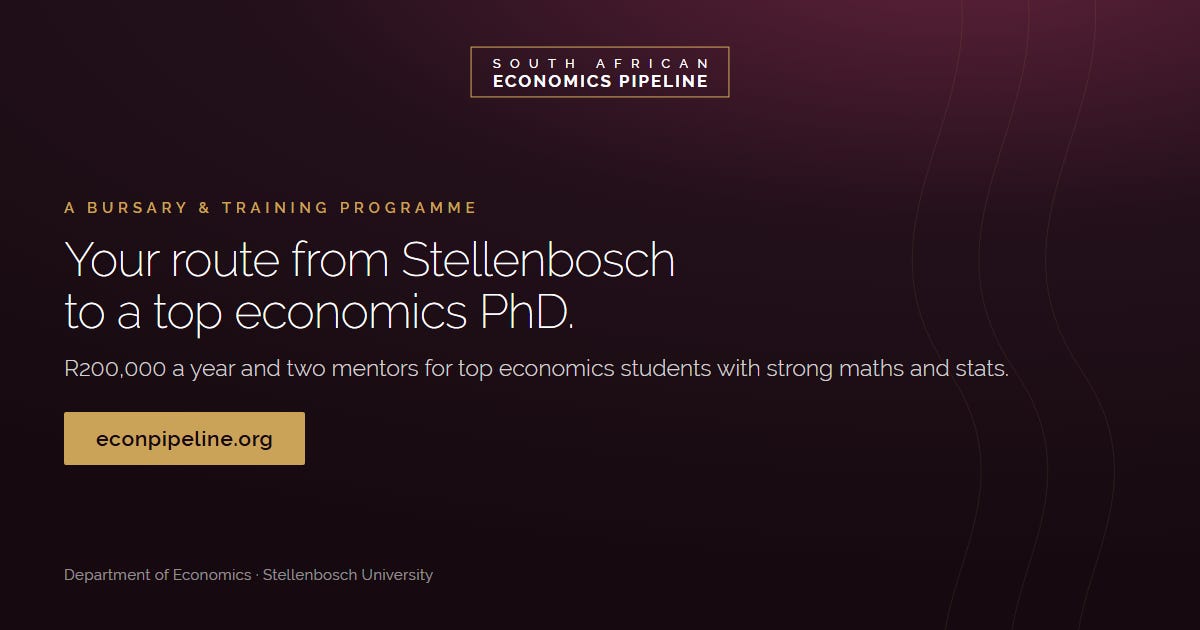
Today we launch the South African Economics Pipeline project. What the programme offers is concrete. From next year, each bursar receives R200,000 a year, enough to study full-time. They complete honours and, where the potential is clear, an 18-month master’s. Each is paired with two mentors – a Stellenbosch academic and an established international scholar in their field. Every November they attend a Summer School of PhD-level short courses taught by visiting scholars, and they take part in the new PSG–SU Economics PhD Workshop, which brings strong young researchers together at Stellenbosch. (More on this PhD Workshop in another announcement over the next few weeks.)
Our long-term aim is to build technical capacity within African universities and the South African government, and it already has support within Treasury. ‘The depth of South Africa’s technical policy capacity is a matter of national interest, and I welcome a programme designed to add to it’, says Dr Duncan Pieterse, Director-General of the National Treasury. ‘I am glad to be named as endorsing this aim.’
Applications are open from today, and closes 31 August. The first cohort begins in January 2027. We are looking for students that studied at South African universities with a strong record in economics, mathematics and statistics, the curiosity to work on hard questions, and the patience to spend several years building real expertise. If that sounds like you – or a friend – you can read the details and apply at econpipeline.org.
We are also looking for donors. Our main donor, The Millennium Trust, funds five bursaries, alongside everything that surrounds them: the Summer School, the mentor pairings, additional teaching, the support through the application process. That infrastructure is now built, and it can carry far more than five students. What limits us is bursaries. Adding one costs $15,000 per student per year. If you would like to put another South African on the path to a top PhD programme, you can find more info here or simply reach out to me.
The pipeline has been thin for a long time. It does not have to stay that way.
Well done! Congratulations on raising the funding.
You probably already have, but take a look at what African School of Economics is doing - I wouldn't be surprised if they now account for 10-20% of the Africans going to PhDs in the US. More impressive as most are native Francophones. The top end of the first few cohorts are now teaching as APs at top 20 departments. Even the middle of the pack largely end up in local policymaking bodies, the World Bank, or orgs like IPA or IDInsight.