

Uninvited
Five million jobs and not a labour economist in sight


This week, News24 will host its ‘On the Record’ summit in Cape Town. The goal: to create five million new jobs in ten years. The speaker list reads like a who’s who of South African public life. President Ramaphosa will deliver the keynote. Trevor Manuel, Fikile Mbalula, Busisiwe Mavuso, Geordin Hill-Lewis, Neal Froneman, Hendrik du Toit, Imtiaz Sooliman, Helen Zille, Siviwe Gwarube and Tsakani Maluleke will all take the stage. International voices include the Chinese economist Keyu Jin, the Irish writer David McWilliams and the Indian planner Montek Ahluwalia. News24 journalists will moderate panels on the economy, growth, youth unemployment, BEE, crime and cities.
Count the professions in that room. A president, a party secretary-general, an auditor-general, a mining CEO, a mayor, a fund manager, a disaster-relief founder and a stable of journalists. Now count the labour economists. Zero. Not one person who has run a randomised experiment on job search in Soweto. Not one who has evaluated a wage subsidy or measured the cost of spatial mismatch. The people who have spent their careers studying this exact question are not in the room. As one friend said to me: would you organise a cancer conference without inviting an oncologist?
Over the past decade, South Africa has produced some of the best experimental evidence on unemployment anywhere in the developing world. Published in the discipline’s top journals – the American Economic Review, the American Economic Journal: Applied Economics, the Journal of Development Economics, World Development – and cited globally. This work will be entirely absent from the country’s biggest jobs summit. It matters because ignoring what we already know guarantees we will waste time and money repeating what does not work.
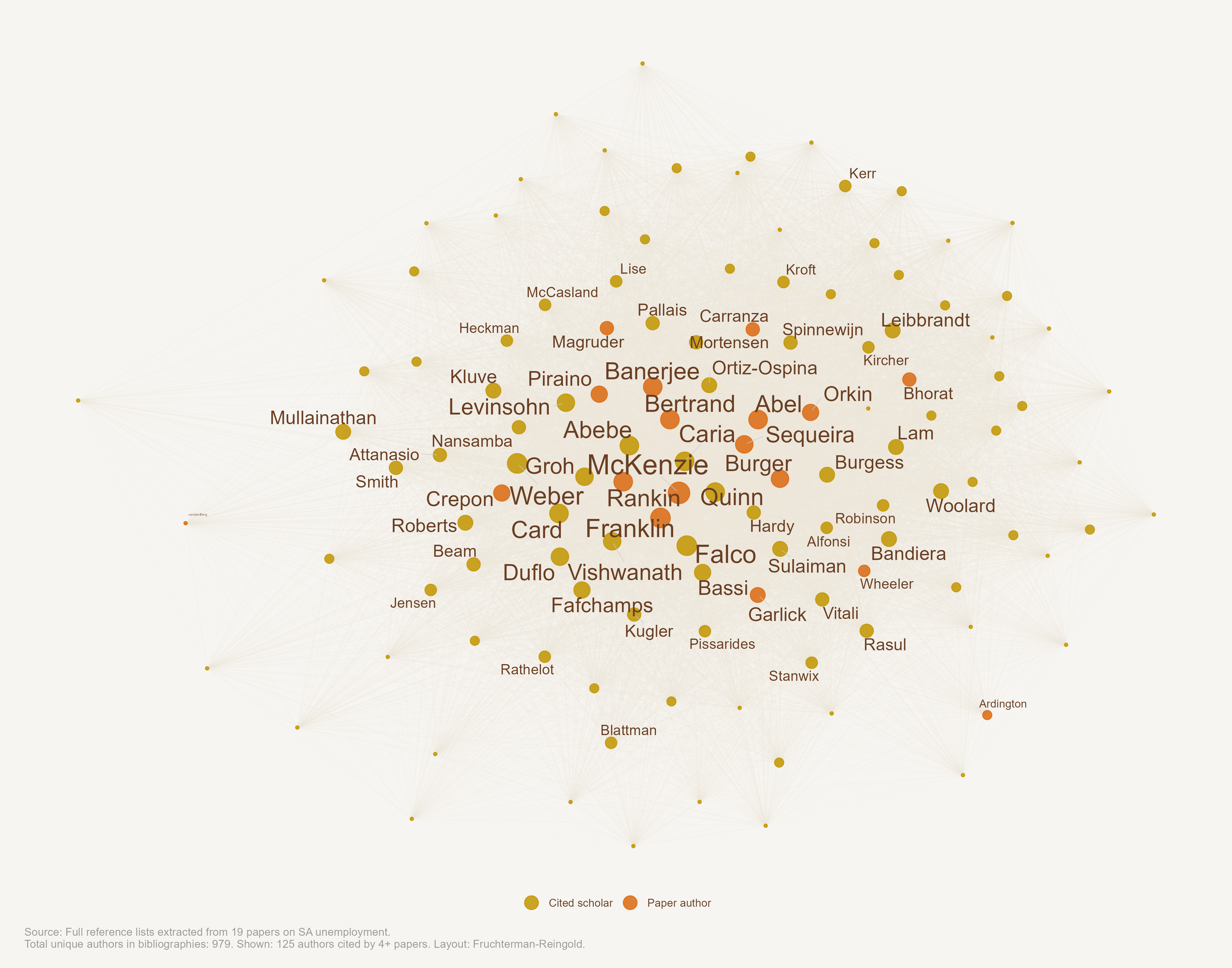
The figure above maps the network of economists behind this research – a co-citation network drawn from all the references in 19 of what I judge to be the best recent economics papers on South African unemployment. Two scholars are linked when they are cited together; larger nodes are cited more frequently; orange dots are the authors of the papers themselves. Not one of them is speaking at the conference. In the conference booklet produced for participants, more than seventy people are thanked for the time and expertise they contributed. Only two are professors. Only one – Haroon Bhorat – appears on the list above. If the organisers wanted the world’s leading experts on the topic, based on this network graph, they might have invited David McKenzie, Marianne Bertrand or Simon Quinn. If they wanted South African scholars, why not Rulof Burger, Neil Rankin or, indeed, Haroon Bhorat?
How could this research make a difference to the conference? The largest cluster of findings concerns information frictions – the idea that employers and job-seekers simply do not know enough about each other. Eliana Carranza, Robert Garlick, Kate Orkin and Neil Rankin, writing in the American Economic Review in 2022, showed that giving young South Africans a credible skills assessment they could share with employers raised both employment and earnings. Martin Abel, Rulof Burger and Patrizio Piraino found that reference letters from former employers – a practice virtually absent in South Africa’s low-skill labour market – increased callbacks by 60 per cent. Andrea Kiss and colleagues demonstrated that job-seekers who receive better information about their own comparative advantage redirect their search and earn more. Laurel Wheeler and co-authors showed that training job-seekers to use LinkedIn raised employment by 10 per cent, with effects lasting at least a year. And in a striking experiment, Marianne Bertrand and Bruno Crepon found that simply teaching small firms about labour law – correcting their misperceptions of how burdensome it actually is – increased their hiring by 12 per cent.
A second body of work addresses spatial mismatch, the apartheid-era legacy that placed black workers far from where jobs concentrate. Abhijit Banerjee and Sandra Sequeira gave transport subsidies to young job-seekers in Soweto and found something unsettling: when subsidised workers searched more in Johannesburg’s CBD and still could not find work, they updated their beliefs downwards and gave up. Cally Ardington and colleagues showed that when grandparents in rural KwaZulu-Natal begin receiving the state pension, their grandsons are significantly more likely to migrate for work – the pension finances the search.
Cash transfers tell a similar story. Haroon Bhorat and Timothy Kohler, evaluating the Social Relief of Distress grant in World Development, found that it boosted job search and even short-term employment – but the employment effect vanished after a single quarter. Alessandro Tondini found the same pattern for the Child Support Grant. Money helps people look for work. It does not create the work.
And the big-picture reviews are sobering. David McKenzie’s critical assessment, Carranza and McKenzie’s 2024 survey in the Journal of Economic Perspectives, and Crepon and Van den Berg’s Annual Review piece all converge: traditional active labour market policies – large-scale vocational training, wage subsidies, public works – produce, at best, employment gains of around two percentage points. South Africa’s own flagship programme, the Employment Tax Incentive, had what Amina Ebrahim and Jukka Pirttila diplomatically called ‘fairly limited’ effects.
The most promising interventions are cheap and scalable: skills assessments, reference letters, plan-making prompts, digital job platforms. But they move the needle by single-digit percentage points. None of them, individually or collectively, can absorb eight million unemployed South Africans. There is also an awkward implementation gap: private-sector initiatives like Harambee and Yes4Youth have been far more eager than the Department of Labour to use this research to design their services, yet their reach remains a fraction of the DoL’s employment centres. The evidence exists; the institution best placed to act on it at scale largely ignores it.
Which brings us to the uncomfortable gaps. The research is excellent on the margins – how to make job search more efficient, how to reduce information frictions between workers and firms. But it is largely silent on the structural constraints that create mass unemployment in the first place: rigid labour laws in a low-productivity economy, BEE and other compliance costs that deter small-firm hiring, minimum wages set above market-clearing levels for low-skill work, and barriers to informal-sector entry that are, by developing-country standards, unusually severe. Emily Breza and Supreet Kaur’s recent review notes that South Africa is a genuine outlier: high unemployment combined with an abnormally small informal sector. Juan Pablo Rud and Ija Trapeznikova reach a similar conclusion: labour market frictions matter more than firm entry costs, and South Africa’s formal sector is extraordinarily large relative to its employment rate.
The honest answer most labour economists would give off the record: only sustained economic growth – four to five per cent a year for a decade – will meaningfully reduce unemployment. The Western Cape’s declining unemployment rate offers a domestic proof of concept. But this truth is politically inconvenient, because it implies removing restrictions rather than adding programmes.
So why are economists absent from this conference? I am an economist, and I think the answer begins with us. We are terrible salespeople. Academic incentives reward publications in the American Economic Review, not op-eds in the Sunday papers. We publish in journals no policymaker reads, use jargon no journalist translates, and then wonder why no one invites us to the table.
Our answers are also, frankly, small. The interventions we can rigorously evaluate – reference letters, plan-making prompts, skills assessments – move employment by two percentage points. Real, yes. But not the transformative headline a conference like this wants to sell.
And our hardest answers are unwelcome. The structural reforms that would make the largest difference – a working school system, greater labour market flexibility, BEE reform, minimum wage recalibration, informal sector deregulation – are politically toxic. Conference organisers want hope and solutions, not trade-offs and discomfort.
This raises the deeper question. What is the theory of change for a summit like this? If the binding constraint on job creation is political will – and I suspect it is – then adding more knowledge will not help. If the constraint is that decision-makers genuinely do not know what works, then excluding the researchers who do know is self-defeating. Either way, we economists bear part of the blame for staying in our lane.
The risk is that summits like this become substitutes for action; that the act of talking about unemployment creates the comfortable illusion of doing something about it. Or worse: that they entrench the wrong narrative, more programmes and more training, while the evidence points elsewhere – less regulation, more growth, better information.
But the self-criticism must cut both ways. A genuinely useful conference would require economists willing to leave the seminar room. Who can explain a randomised experiment in three sentences? Who can make spatial mismatch vivid to a businessperson or a politician? Until we learn to do that, we have no right to complain about not being invited.1
Five million jobs in ten years is a fine ambition. But ambition without evidence is just a slogan. And evidence without communication is just a PDF behind a paywall no one reads.
In fairness, News24 did invite me – as an audience member. But an economic historian and blogger in the audience, I fear, is not the same as a labour economist on the stage.
“The Talkshop as Performance” should be a keynote address there.
Although maybe dated by now. prof Frederick Fourie also did a great job with the Redi 3x3 initiative, concluding that there are 3 strands of research on the topic and that they don't even reference each other in their publications. Also, his current research on the possible role for the informal sector in job creation. It also irritates me that every second journalist have a view on the exchange rate, unemployment etc. The biggest danger is if you don't know what you don't know. I fully agree with the point you are making about this workshop. Trevor Manual invited all the top academics to provide input to National Treasury, a few years ago. This concluded in a good academic conference with proper discussions.