

The new gold rush
The last mining boom built universities. What will the AI boom leave behind?

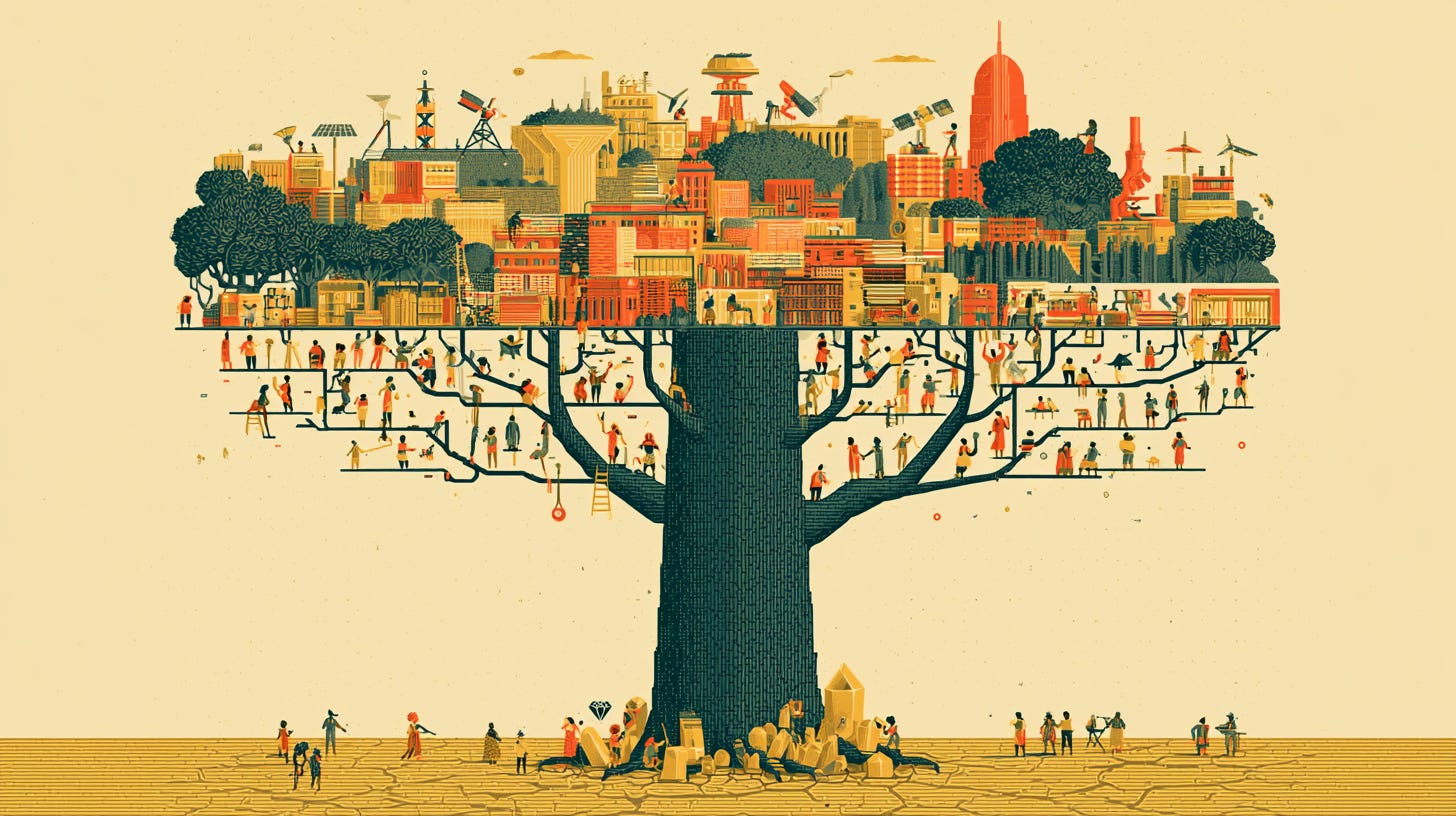
The OpenAI Foundation holds an enormous fortune. It owns just over a quarter of the company, which at today’s valuation is worth around $220 billion. Anthropic’s seven co-founders have promised to give away 80% of what they own, and the firm runs the most generous donor-matching scheme in the history of Silicon Valley. Nan Ransohoff, who runs public goods at Stripe and has done the sums more carefully than anyone, reckons all of this could release somewhere between $37 billion and $100 billion a year in new philanthropic giving. American charitable donations already run to about $600 billion a year. We are about to add a sixth of that, almost overnight, and nearly all of it earned by the same people, on the same technology, at the same moment.
This is a new gold rush.
We have had one before. In a 2023 paper in Past & Present, the historian Caitlin Harvey traces how the gold and mineral booms of 1848 to 1910 paid for a whole generation of universities – what she calls ‘the goldfield foundations’. Berkeley, Melbourne, Adelaide, Otago. And three of our own. The University of the Witwatersrand sits on the gold reef that made Johannesburg. The University of Cape Town grew up on mining money; the Rhodes Memorial still overlooks its rugby fields. Stellenbosch, where I teach, owes its independence to Jannie Marais, who made his fortune on the Kimberley diamond fields and left much of it to a university. The mines may have closed, but the universities remain.
So here is the question worth asking of this new gold rush: will it, too, build universities?
Almost certainly not. Frontier research now depends on computing power, data and salaries that sit inside a handful of firms rather than inside universities – more on that below. And these donors are in a hurry. They believe the coming decade will decide how the AI transition goes, so they are unlikely to spend it founding new institutions. If not universities, then what?
Two answers are already on the table. I think both are, at best, incomplete.
The first is Ransohoff’s own. In a widely-read essay she argues that we need a ‘Silicon Valley for public goods’: thousands of new ‘philanthropic startups’, a class of ‘philanthropic VCs’ to fund them, talent recruited out of tech and paid in equity, and a venture capitalist’s appetite for risk and speed. Her diagnosis is largely correct. The binding constraint on all this money is not the money; it is the capacity to absorb it well. GiveDirectly, one of the few organisations that can move cash at scale, has said it could spend perhaps $500 million a year, a tenth of $5 billion and a small fraction of a $50 billion potential funding stream. So the money will need organisations to receive it.
But building a new apparatus from scratch has a cost that the essay understates. It operates apart from the two institutions that development actually depends on: the state and the market. A parallel philanthropic economy, staffed by people recruited from San Francisco and answerable to the funders who pay them, is not obviously what a middle-income country most needs. So, what is the alternative?
A second option is the nostalgic one. With USAID gutted and official aid falling across the rich world, why not let AI philanthropy simply replace it, and become the foreign aid that governments no longer wish to give?
Because, as I argued on this blog a year ago, that breaks the two principles that should govern any transfer of this kind. Foreign aid must not disrupt the relationship between a government and its citizens: the moment a health system answers to a donor in California rather than to voters in Lusaka, the fiscal contract that makes states accountable weakens. And aid must work through the market, not replace it; money that distorts local prices or crowds out local firms leaves a country poorer the day it stops. Ken Opalo has made the state half of this case with more force than I can: three decades of substituting NGOs for the government has weakened state capacity across Africa, and the way to reverse it is to put elected, accountable, imperfect governments back in charge. Axel Dreher’s careful surveys point the same way. Aid does least for growth and most for whatever the donor privately wanted; and when it stops abruptly, as it just has, the cost can be measured in conflict and in lives. Putting AI money into that system would not repair it. It would only sustain something we already know can leave a recipient economy worse off.
Which brings me to my own profession. Oliver Hanney, who edits VoxDev, has written a forceful case that development economics is failing the AI moment – too reliant on the randomised controlled trial to say much about the larger questions AI raises – and, in this FT interview, he says he would like the AI labs to hire more development economists. On the first point he is right. On the second I disagree. We do not need more development economists, at least not the kind who spend five years measuring whether one app raised one test score in one district. If this money is to fund economists at all, it should fund the ones who study innovation, firms and science: the economics of how growth actually happens. Those are complements to the market and to the state. The randomista is too often a substitute for both.
So what would I do, if I had this money to give away?
I would endow chairs.
Endowed chairs are one of the clearest examples of a wider kind of gift: one that works alongside the state and the market rather than around them. And not at Harvard or Oxford; they are well provided for. And not yet at the universities too weak to use the money well. I would fund permanent chairs at the institutions ranked, say, between 100th and 600th in the world – the strong universities in the middle, with the talent but not the endowment – at the new intersections of fields: AI and economics, AI and biology, AI and ethics. I would pay the holders at the top of the global market, enough that the best Kenyan or Brazilian or Indonesian in a field could do frontier research at home rather than move to a firm. And I would give each of them a substantial budget for computing.
The striking thing is how little this would cost. By the QS rankings there are 504 universities between the 100th and the 600th in the world. Endow a $20 million chair at each and the whole thing comes to about $10 billion – still less than a twentieth of what the OpenAI Foundation alone is worth. And $20 million buys very different things in different places. Given what American industry now pays its AI researchers – of which more below – it might stretch to a single chair, with the computing power to match, at a university in the United States. In a country like South Africa the same sum endows not a chair but an institute: a senior scholar, a bench of postdocs and doctoral students, the research staff around them, and the compute they all depend on – in perpetuity, and at the frontier.
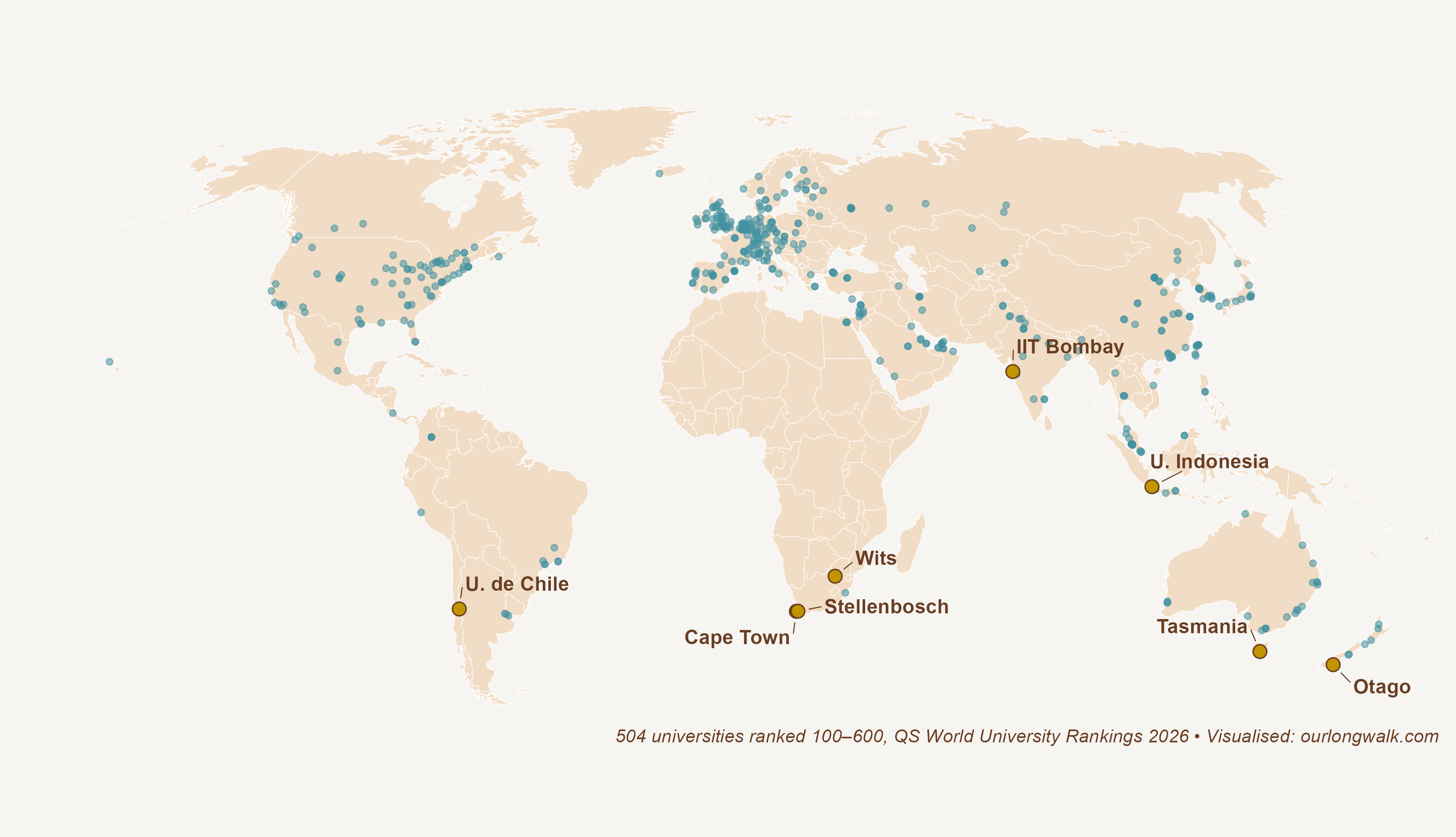
It is worth seeing where they would be (see map). They are on every continent: the middle-ranked universities of North America and Europe, but also the Indian Institutes of Technology, the great public universities of Latin America, the research universities of Southeast Asia and the Gulf. And among them sit the survivors of the last gold rush. Berkeley and Melbourne have long since climbed into the global elite and need nothing; but Otago, built on the Otago diggings, Cape Town, raised on mining money, the Witwatersrand, on the reef itself, and Stellenbosch, on Marais’s diamond fortune, all fall inside this band. The universities the last boom built are precisely the ones the next one should endow.
I am not being sentimental about universities. This is the one intervention that answers a problem we can now measure. In a recent NBER paper, Ufuk Akcigit and colleagues track 42,000 AI researchers through two decades of American tax and publication records. The top 1% of AI scientists in industry now earn about $1.5 million a year more than comparable academics – a gap that has widened fivefold since 2001 – while academic salaries have barely moved. The response is what any economist would predict: researchers are moving to large, established, well-resourced firms, and from open, published science to patents held privately. Universities are losing their best researchers because they can neither match industry salaries nor provide comparable computing power. A well-paid, well-resourced endowed chair is designed precisely to close that gap.
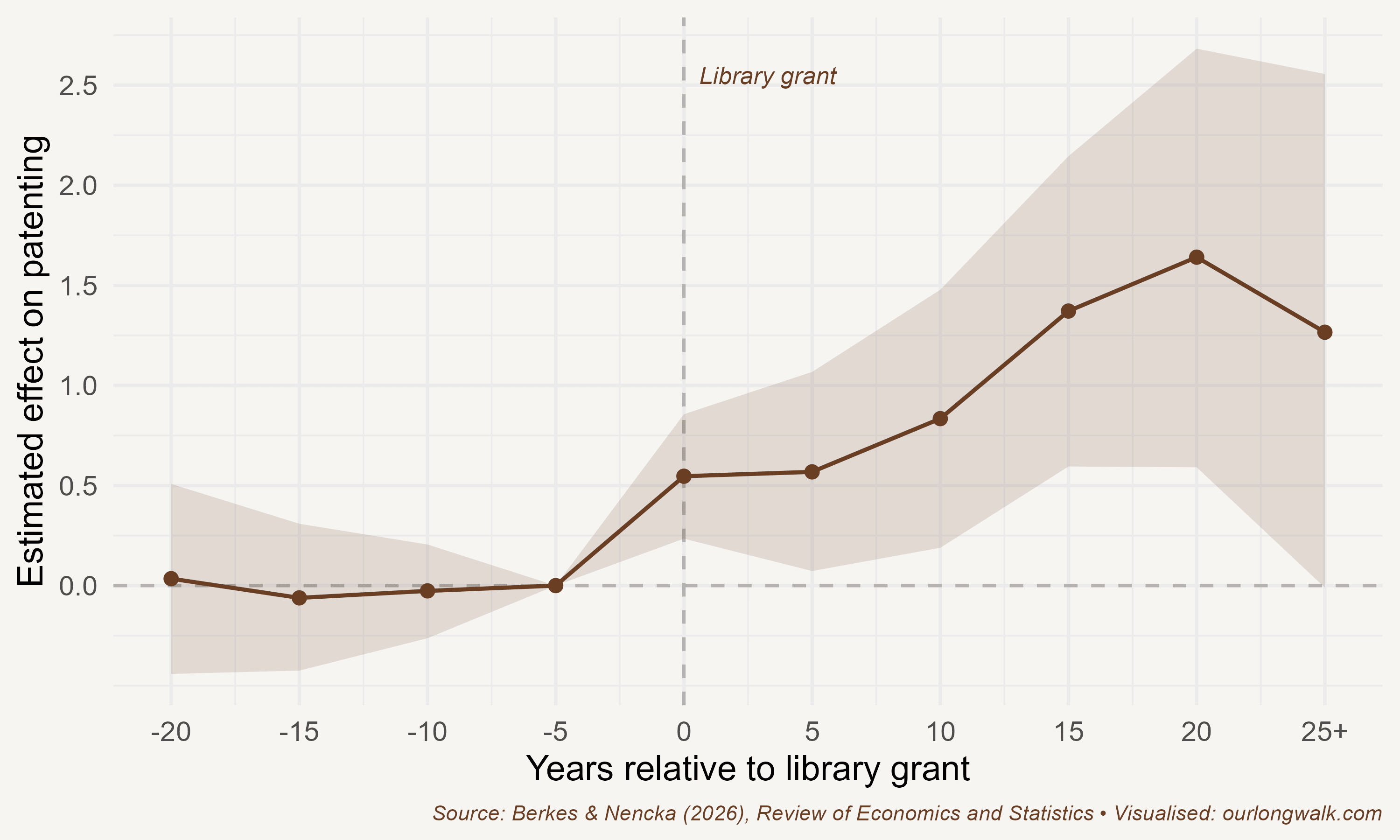
There is a precedent for exactly this kind of gift. Between 1883 and 1919 Andrew Carnegie funded more than 2,500 free public libraries around the world – 1,687 in the United States alone, and one at Stellenbosch University itself. For a long time these were dismissed as a rich industrialist’s monuments. Then economists examined them. In a paper just published in the Review of Economics and Statistics, Enrico Berkes and Peter Nencka compare American towns that built a Carnegie library with near-identical towns that qualified for one but, for local reasons, did not. Patenting in the library towns rose by 10 to 12 per cent over the following two decades, and the additional inventors were disproportionately women and the foreign-born – the ‘lost Einsteins’ that economies routinely fail to develop. The two groups of towns patent at the same rate for twenty years before the grant and diverge only once the library opens (see figure). Gregory Gilpin, Ezra Karger and Nencka find a similar effect today: invest in a library and the reading scores of nearby children rise. Free access to knowledge is, on this evidence, one of the highest-return public investments we have measured.
This is the clearest lesson economic history offers: prosperity comes from ideas, ideas come from access to them, and the societies that broaden that access grow faster. Endowed chairs are the equivalent, in our century, of the Carnegie library: the same investment in knowledge as a public good, applied where the scarce input is no longer the printed book but the trained researcher and the computing power they require. And, like the libraries, they satisfy both principles. They leave the government to govern and the market to operate, and they add to the stock of knowledge that both depend on.
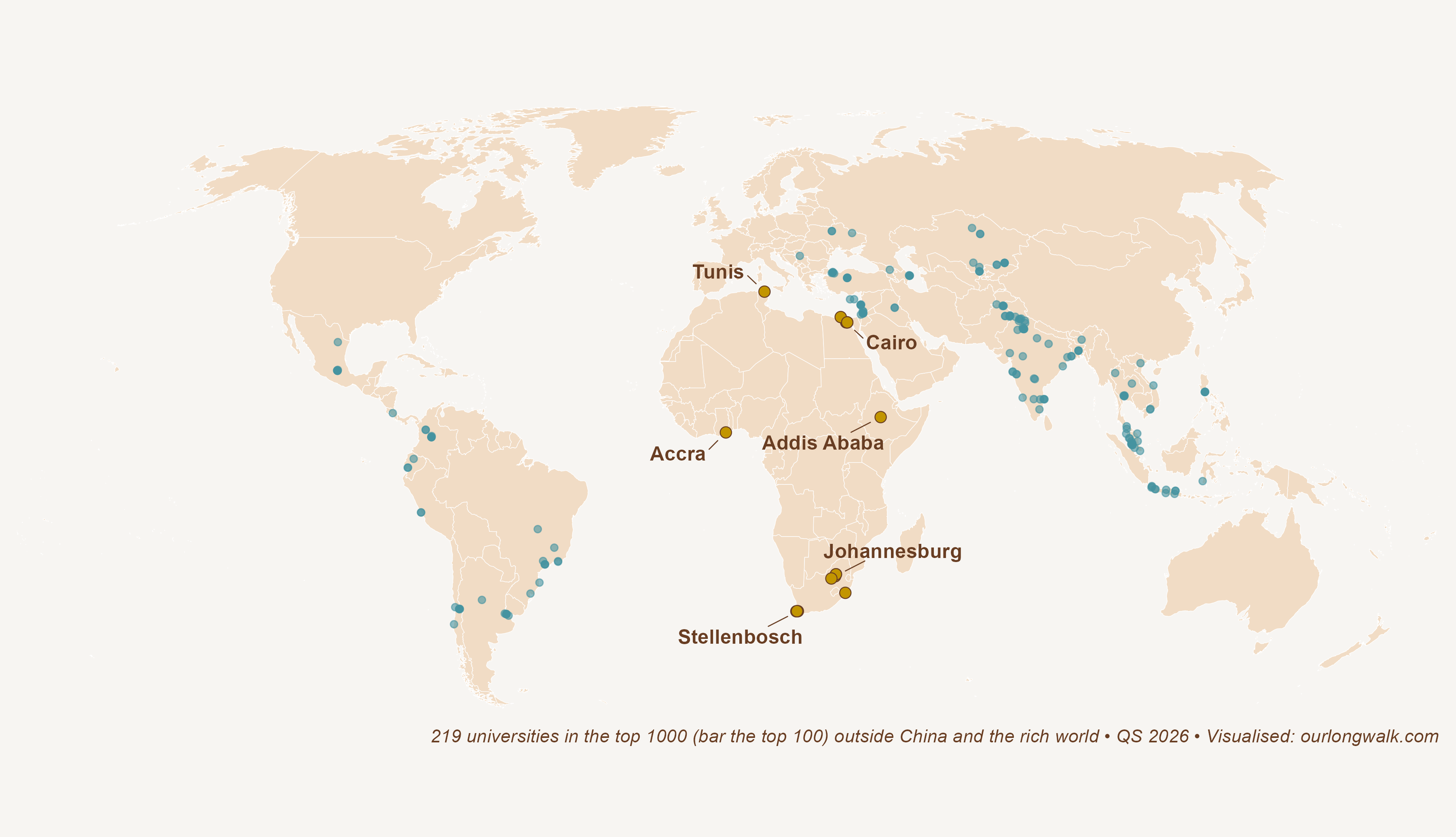
There is a more radical version of this idea. Instead of endowing chairs at strong universities everywhere, aim the whole fund at the places that need it most, and make each gift larger: not a chair but a research institute, fifty million dollars apiece, and only at universities in the developing world that already sit in the global top thousand. Set aside China, the high-income countries, and the states whose sanctions put them beyond an American donor’s reach and the QS rankings leave 219 of them. An institute at each would cost about eleven billion dollars: close to what the chairs would, and still only a twentieth of the OpenAI Foundation’s stake. The map, though, looks quite different. The weight shifts south and east – thirty-seven institutes in India, two dozen across Malaysia, a long band through Southeast Asia and Latin America – and, for the first time in this story, Africa appears in numbers – nine universities in South Africa, five in Egypt, and one each in Ghana, Ethiopia and Tunisia – though I would make the case for a few more, perhaps adding Senegal, Nigeria, DRC, Rwanda, Kenya, Angola and Tanzania to the list.
The last gold rush understood something this one has not. Marais and Rhodes and the diggers of the Rand did not set out to abolish poverty within a decade. They built institutions that outlasted them, and, as it happened, outlasted the mines that paid for them. A century later, the reef beneath Johannesburg is nearly worked out; the University of the Witwatersrand is not.
This boom will also end, as booms do, and some of today’s valuations will look absurd in hindsight. The question is what will remain when it does. Fund an apparatus that operates apart from governments and markets, or use the money to restore an aid system we already know distorts both, and little will last. Fund the researchers who produce knowledge, and pay them enough to stay, and this gold rush may leave what the last one did: universities that outlast the boom that paid for them.
Now to convince a billionaire.