

Our Long Walk in 2026
What I learned from the reader survey, and the changes coming this year


At the end of last year, I asked you, subscribers to Our Long Walk, to complete a short survey. 182 of the 5600 or so subscribers responded. I asked ChatGPT whether that’s what is to be expected.
182 out of 5,600 is a 3.25% response rate (roughly 1 in 31 subscribers).
As I wrote on Monday, my favourite numbers are 3 and 1. So this seems like the perfect response rate for me. ChatGPT continued:
Is that “a lot”? It’s modest in absolute terms, but for a newsletter audience it’s not embarrassingly low. General online survey benchmarks often sit in a wide band like ~5–30% depending on channel, audience, and friction. But Substack-style reader surveys people discuss anecdotally often land more like ~2–6% of total subscribers, which would put you squarely in the normal range.
Two sober caveats (because the universe likes caveats):
Your real denominator probably isn’t 5,600. Many subscribers won’t even open that particular email. If your open rate is, say, around the low-40s (a common newsletter benchmark), then 182 responses could be closer to ~8% of openers, which is healthy engagement.
Representativeness is the bigger issue than “n”. With 182 responses you can absolutely learn a lot, but it’s a self-selected sample of your more engaged readers. Treat it as a “reader panel”, not a referendum.
Statistically: if this were a random sample (it isn’t), n = 182 gives a rough worst-case margin of error of about ±7 percentage points. In practice, selection bias will dominate that.
First, I immediately changed my ChatGPT personality from Nerdy to Efficient. I don’t need a machine to mock me. Second, ChatGPT is not wrong; there is indeed strong selection bias. Consider that, on 31 December, 43% of Our Long Walk subscribers were based in South Africa, 16% in the US (16%), 6% in the UK (6%), 4% in Kenya (4%) and 3% in Nigeria. (Our Long Walk has subscribers in 130 countries!) By contrast, 73% of survey respondents are based in South Africa, and only 5% in the US. Two conclusions are likely: Americans clearly don’t like surveys. Or: They subscribe but rarely read. I’ll go with the former.
Despite the selection, I’ve enjoyed the reader responses – and it has influenced my publication schedule for 2026. Almost half of all respondents want only one email per week. Interestingly – and pleasingly – those readers that read more also want more to read: most of those who ‘dip in occassionally when a topic catches my eye’ want only one email a week. Several of those who ‘read almost every post’ want a daily email.
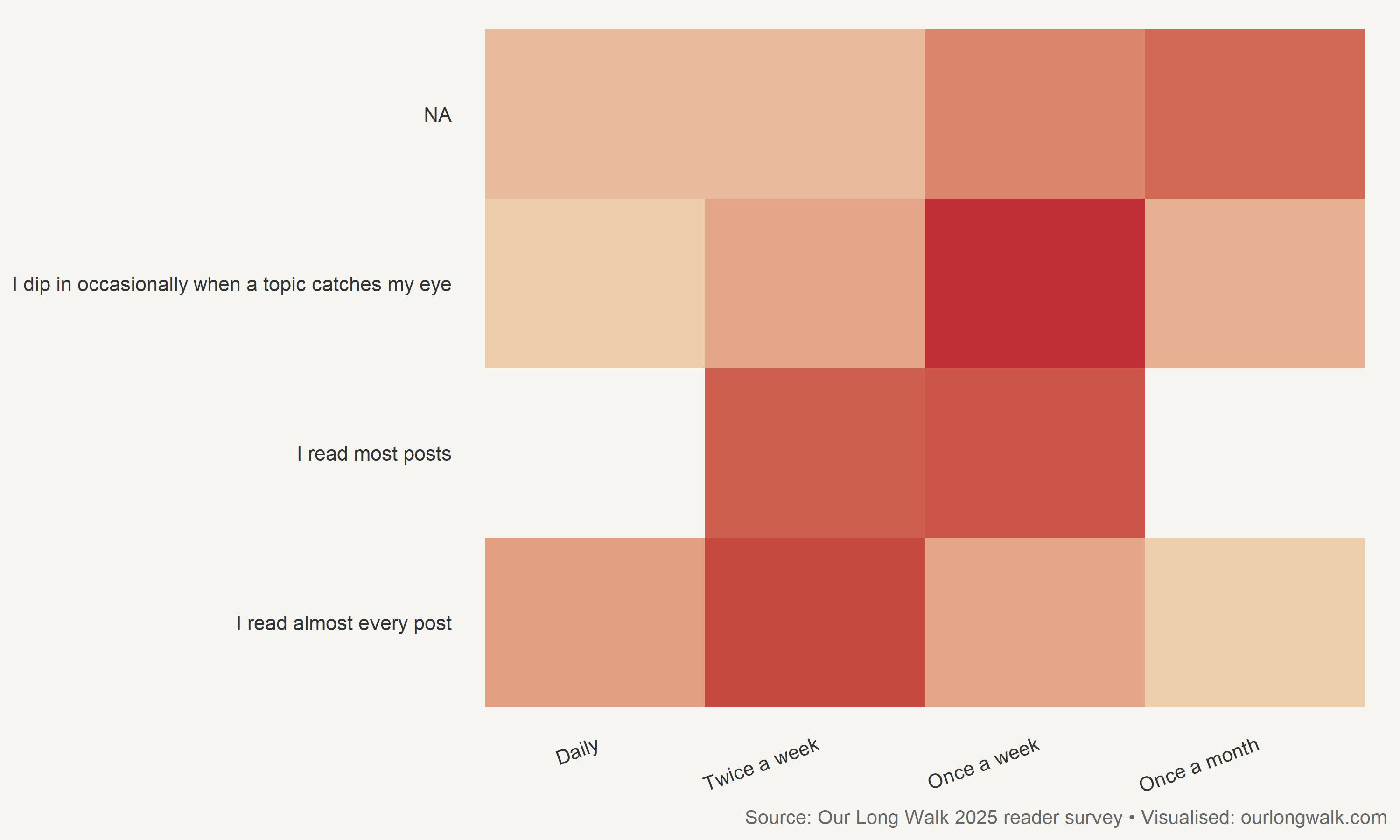
I won’t go daily – I do have a real job too – but I do want to keep producing around 100 posts per year. So here’s what I’ll do: free subscribers will receive only one email per week. That email, on a Monday, will include links to all the posts published the previous week (with and without a paywall). The now-more-than 100 paid subscribers will receive two emails a week, on a Monday and Friday. As always, please subscribe if you can.
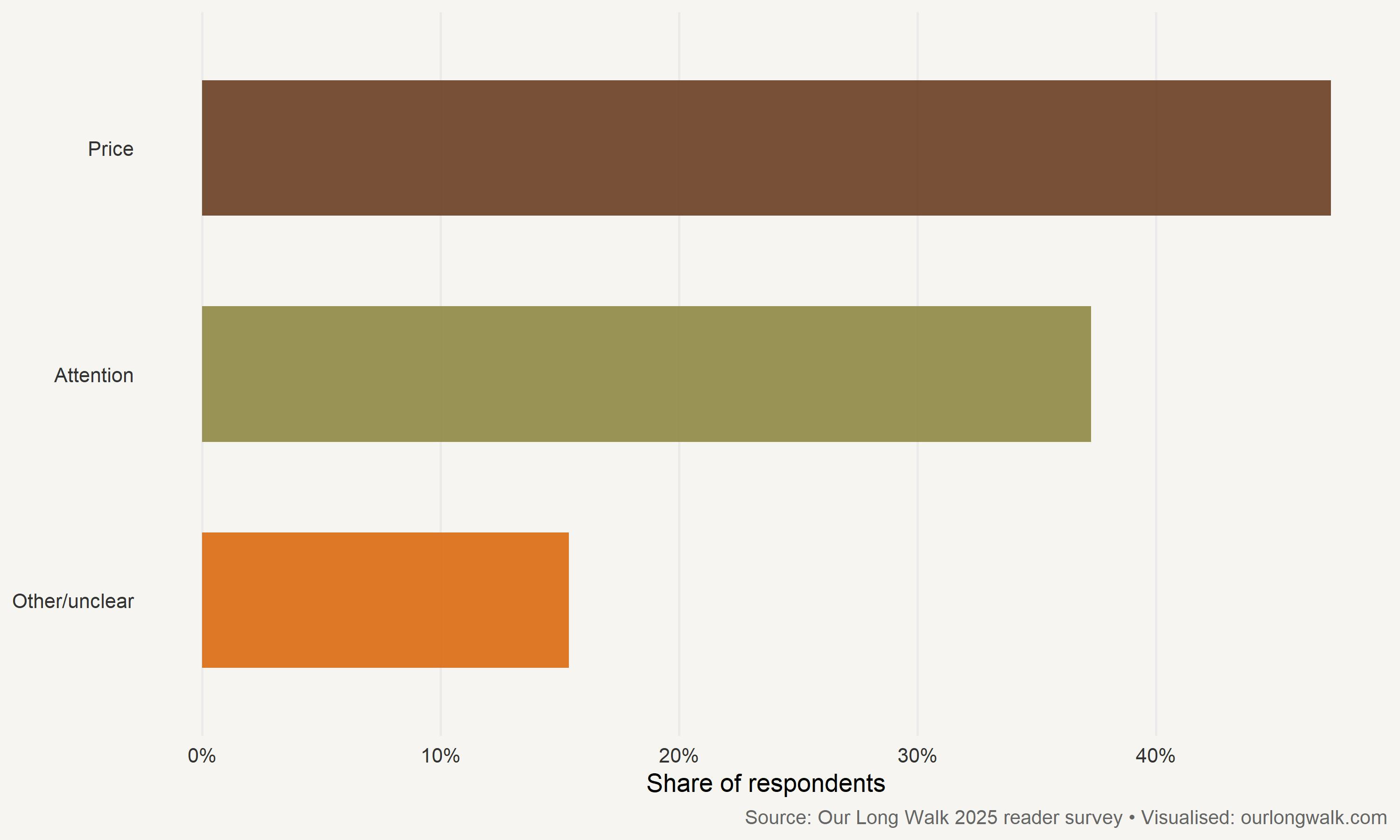
On that point, most respondents answered that a paid subscription is too expensive. Here, I have good news too. The dollar-price will remain the same, but because South Africa’s Rand has been appreciating rapidly over the last few months, the $75 is now much less expensive than before! (More good news: For those that cannot afford to pay the subscription, there is another way to access paid posts: Substack has the option where you can sign up three or more friends for the free version, and you’ll be automatically upgraded to paid status for a few months!)
In all seriousness, paid subscriptions allow me to be as productive as I am: I use the income for subscriptions to other authors, subscriptions to editing and other tools, prizes (more on that in the next few months), administrative costs and, the largest outlay by far, marketing certain posts to specific audiences on Instagram (predominantly) and other platforms.
What will I write about in 2026? I’m happy to report that most respondents really liked what I produced last year. There were many comments like ‘I think it is all super cool as it is now!’, which is super cool to hear. Others gave thoughtful comments that I will carefully study over the next week or so. There was only one comment that was really disappointing to read: ‘Try Pickleball instead of Padel.’ Boo.
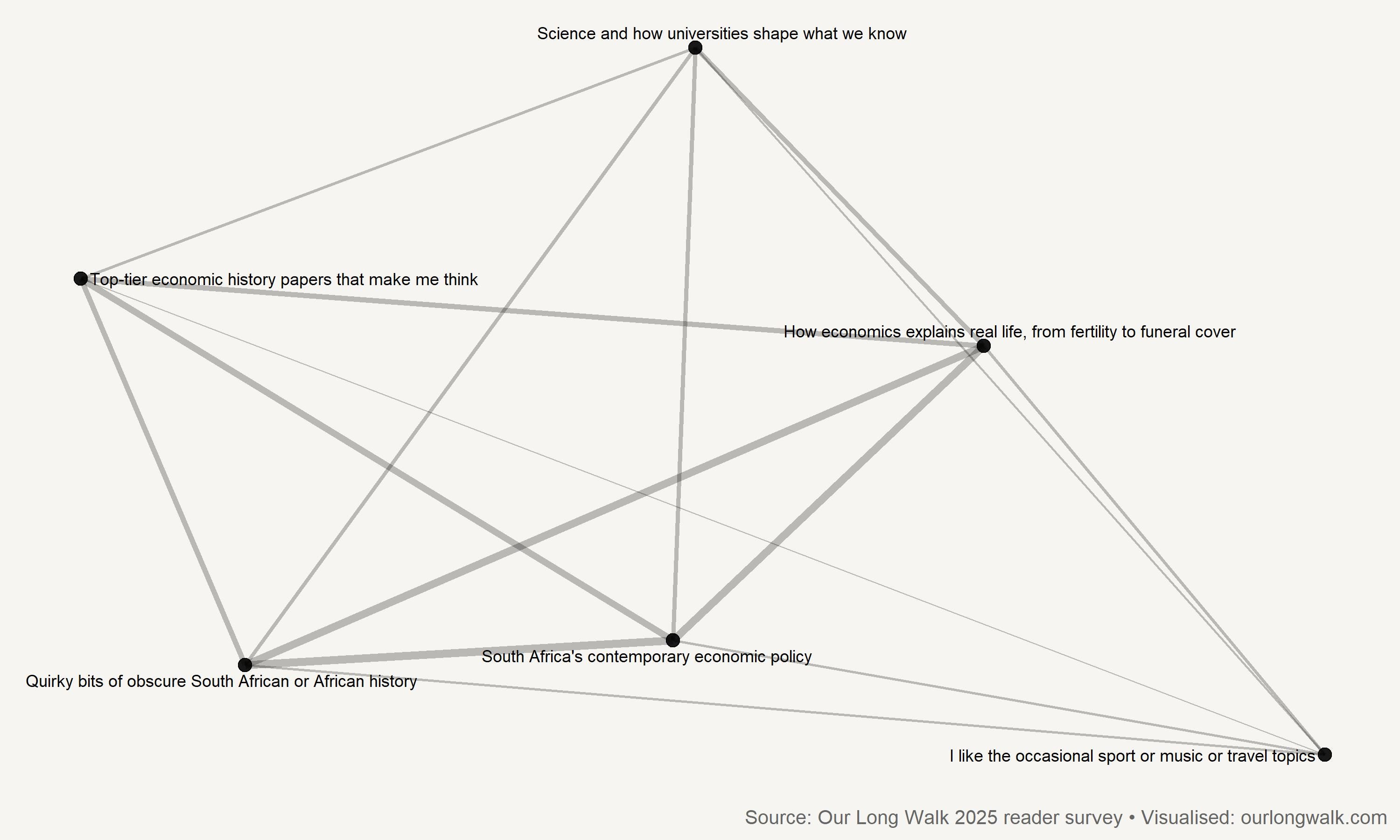
I asked one question about which topics you’d like to know more about, and three jumped out: ‘How economics explains real life, from fertility to funeral cover’, ‘South Africa’s contemporary economic policy’ and ‘Quirky bits of obscure South African or African history’. These were also all in close proximity (meaning the same people liked them), so that will be the core of my offering going forward.
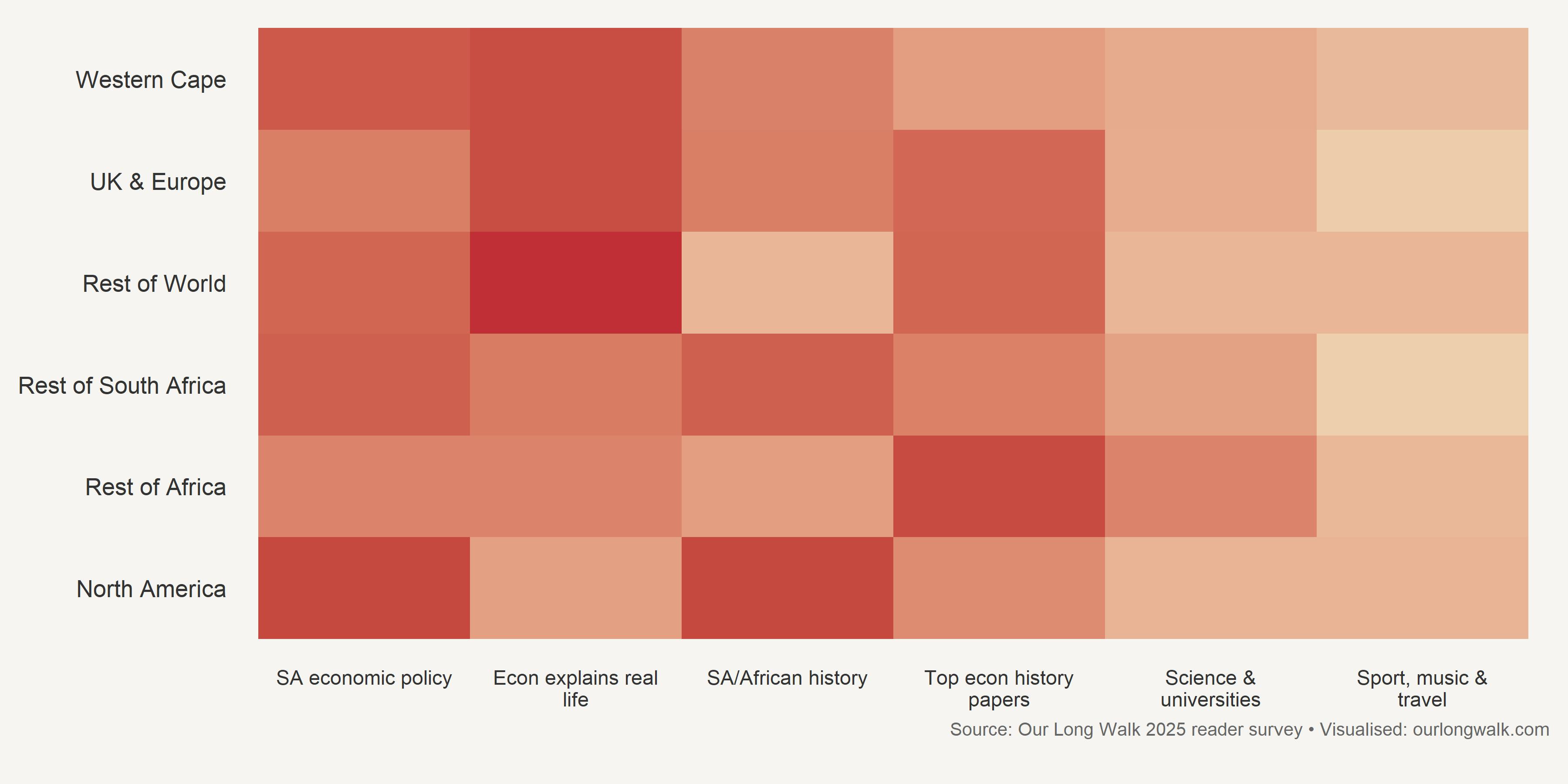
It’s also interesting to see how those topics overlap with geography. Almost all territories want more ‘SA economic policy’ and ‘How economics explain real life’ (though less in America and more in the rest of the world). North America, interestingly, want a lot more African history – good – while Africans want more ‘Top econ history papers’ – great.
It is also this topic – ‘Top-tier economic history papers that make me think’ – that was the most requested in the question about what to bring back (41%). Expect to see econ history paper summaries soon again. Fewer wanted to see guest essays (23%), to see me work on another book (14%), or have me play more padel (16%, presumably excluding the respondent who made the silly comment about Pickleball!). 30% just said: ‘In the immortal words of the LegoMovie: everything is awesome’. Again, that’s great, thanks!
I asked questions about the podcast as well, and these provided perhaps the most surprising results. More on that in a future post.
And finally, some of you who completed the survey will remember that I offered an incentive: five one-year subscriptions to the paid version. I appreciate all the responses, so I’ve decided to double this to ten subscribers. Here are the lucky winners: I’ve just realised that 1) I probably should not publish names without explicit permission and 2) I don’t actually have the names of the winners, only their email addresses. So, if you’re a winner, you would have received an email from Substack last night upgrading you to a year of paid subscriptions! Congratulations!
I’ve returned from holiday with lots of new ideas. You’ll find them in your inbox on a Monday and, if you’re a paid subscriber, on a Friday too. To those of you who completed the survey, thank you. For those of you who missed the survey, or who have more to say, I’m always open to feedback and suggestions for improvement. Just send me a mail.
Now, let the writing begin…
All the best with your writing goals for 2026, I for one enjoy your writing, it has inspired me to start my writing journey on Substack.
There was only one comment that was really disappointing to read: ‘Try Pickleball instead of Padel.’ Boo.
😂😂 sorry Johan. I stand by that comment. Pickleball is the future.