



When Poland began its post-communist reforms in 1992, its GDP per capita was roughly where South Africa’s is today. Twenty years later, Polish living standards had doubled. South Africa, over the past fifteen years, has averaged near-zero per capita growth. If nothing changes, living standards a generation from now will be essentially the same as they are today. That gap between Poland’s trajectory and ours is the difference between a country where young people find work and one where they do not.
I recently published a research note for the Bureau for Economic Research comparing five countries that faced critical junctures – Chile, Poland, India, Germany and Argentina – and asking what political conditions enabled sustained growth. The note attracted some attention. Hendrik du Toit quoted it at the News24 On the Record conference. The Financial Mail ran a story. The core argument is simple: crises open windows for reform, but only credible political settlements turn those windows into lasting prosperity. Here is why that matters for South Africa right now – and why the clock is ticking faster than most people realise.
Economists have three powerful theories about why countries get stuck. Each one describes a trap that South Africa is either already in or drifting towards.
The first is the war of attrition. The idea, developed by Alberto Alesina and Allan Drazen, is straightforward: when reform is painful, every faction tries to wait the others out, hoping someone else will bear the cost. Reform happens only when the crisis becomes so severe that delay is costlier than concession. Think of it as a game of chicken. In Poland, hyperinflation and shortages made the cost of waiting unbearable – the Solidarity movement’s broad coalition meant no single group could offload the pain. In Chile, the 1982-83 banking crisis was deep enough to discredit both the military’s initial economic model and the opposition’s maximalist demands, forcing a centrist convergence.
In South Africa, the war of attrition is playing out in slow motion. The ANC’s dominant faction knows that serious reform – on energy, on logistics, on the structure of the state – will antagonise powerful internal constituencies: public-sector unions, politically connected contractors, cadre-deployed officials whose positions depend on the status quo. The DA, for its part, risks alienating its base if it is seen to make too many concessions. The EFF and MK Party, sitting outside the GNU, have every incentive to wait: if reforms stall, they can campaign on the coalition’s failure. If reforms succeed, they lose their grievance platform. The logic of attrition tells us that each faction is calculating whether it can outlast the others. The danger is that while everyone waits, the window closes.
The second theory is status-quo bias, from Raquel Fernandez and Dani Rodrik. Even when reform would benefit most people, rational uncertainty about who specifically will gain and who will lose produces collective resistance. People who might benefit from trade liberalisation or deregulation cannot be sure they will be among the winners, so they oppose the change. The result is paralysis even when the status quo is terrible.
This is the BEE problem in a nutshell. Black economic empowerment policies were designed to redress historical injustice – a legitimate and necessary goal. But over three decades, the compliance machinery has calcified into a system that creates enormous uncertainty for investors and entrepreneurs. Reforming BEE is not about abandoning transformation but about recognising that the current structure – with its complex scorecards, ownership requirements and sector charters – generates exactly the kind of rational uncertainty that Fernandez and Rodrik describe. The businessman in Sandton who spent years building a compliant ownership structure cannot be sure it will count under the next revision. The young graduate from Soweto cannot be sure she will ever see a share of the promise. And so everyone defaults to defending the status quo, even when most people would be better off under a simpler, more predictable system. The lesson from the comparative evidence is clear: do not start here. This is the hardest reform, not the first one.
The third theory is the veto-player framework, from George Tsebelis. More veto players make policy change harder – but conditional on change, they also make reversal harder. This is what makes institutional constraints valuable. Poland’s EU accession locked in reforms so thoroughly that no subsequent government could undo them. Chile built its institutional framework during the acceleration – central bank independence in 1989, democratic transition in 1990, OECD peer review later. In Germany, the federal structure made the Hartz labour reforms difficult to pass but equally difficult to reverse. When Merkel’s CDU-led grand coalition succeeded Schroeder – initially governing alongside the SPD, which held eight of fourteen ministerial portfolios – she preserved and extended the reforms because reversal would have required an equally broad consensus.
South Africa’s institutional stock is depleted but not destroyed. The Constitutional Court retains credibility. The Treasury’s technical capacity is intact. The Reserve Bank’s independence is constitutionally protected. The NPA is rebuilding. The GNU itself, with its multiple parties, creates veto players. That is a feature, not a bug – if the coalition can agree on a reform programme, reversal becomes very difficult. But the flip side is real: if the coalition cannot agree, nothing moves.
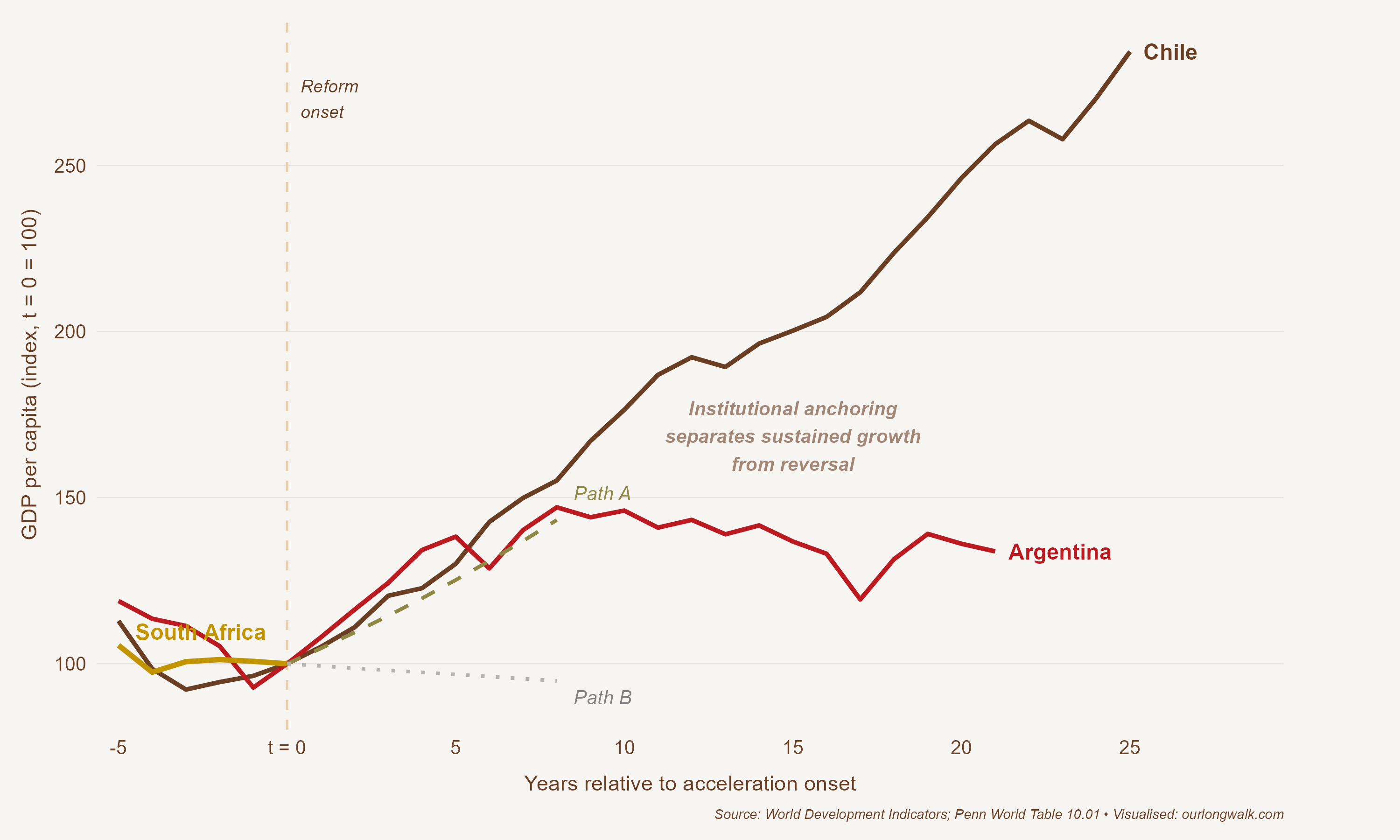
The figure below shows the fork. Chile sustained its growth for two decades; Argentina reversed. South Africa is right there, at the point where the paths diverge.
The most consistent pattern across successful reform episodes is sequencing. Countries that sustained growth started with high-visibility, broadly beneficial reforms and deferred the most politically costly changes until a growth dividend materialised.
Chile opened trade first, then reformed finance pragmatically after the banking crisis. Labour flexibility increased only gradually. India moved incrementally: tariffs were cut and industry deregulated through executive discretion, but labour reform was left untouched. Growth accelerated without it. Poland liberalised broadly and simultaneously – but only because the collapse of the planned economy left no status quo to defend. Germany is the exception that proves the rule: as a mature economy, the binding constraint was labour-market rigidity, so Schroeder went directly to it. He paid with his career.
For South Africa, the binding constraints are infrastructure and regulatory bottlenecks. Energy reform, logistics reform, digital spectrum allocation, water infrastructure – these are our equivalent of macroeconomic stabilisation. They are high-visibility, broadly beneficial and achievable through executive action. And it is encouraging that some ministers have understood this. Sputla Ramokgopa has driven the electricity turnaround with visible urgency. Leon Schreiber at Home Affairs has cut through decades of bureaucratic paralysis. Dean Macpherson at Public Works and Infrastructure has begun, though progress there remains uneven.
These are the green shoots. They matter enormously – not just for their direct economic effects, but because they demonstrate that the GNU can translate agreement into action. Poland’s experience shows how quickly the investment climate can shift when delivery becomes visible. Each completed project, each unblocked port berth, each megawatt of new capacity signals to investors that the political settlement is real.
Labour-market reform – the Labour Relations Act, collective bargaining structures, minimum wages, and yes, the BEE framework – should be deferred until infrastructure delivery has built political capital and a growth dividend has materialised. Chile and India both demonstrate that growth can accelerate before labour markets are reformed. The political space for those reforms expands once the benefits of growth are tangible. But deferral must be strategic, not permanent. Two decades after Mbeki’s macroeconomic stabilisation, the employment crisis remains unresolved. That is the cautionary tale.
The fact is that reform windows do not stay open forever. Balcerowicz called it the ‘period of extraordinary politics’ – a brief moment when normal interest-group resistance is suspended because the crisis is so severe. South Africa’s crisis is slow-burning rather than acute: a decade of stagnation, collapsing municipal infrastructure, youth unemployment above 60 per cent. A slow crisis allows factions to hope the situation will improve without concessions. It allows them to wait.
The GNU has perhaps two to three years before the next election cycle begins to dominate political calculations. If by then the coalition has not delivered visible improvements, the incentive structure flips. Coalition partners start positioning for the election rather than cooperating on reform. The ANC’s internal factions begin calculating whether they are better off with or without the DA. The opposition parties outside the GNU – the EFF, MK Party – gain ammunition. The window closes.
And then there are external shocks. The current global turbulence – with war in the Middle East spiking diesel prices and disrupting supply chains – could not have come at a worse time. South Africa is at a delicate moment: the reforms are just beginning to generate momentum, investor sentiment is cautiously improving, and the rand was rising strongly against the dollar. A prolonged war that keeps diesel prices elevated and dampens global demand could derail this fragile progress before it produces results. It would be a cruel irony if external factors beyond our control undid the tentative gains of the past eighteen months.
The good news is that our future prosperity is still in our hands. So let me be direct about what a political economy path to growth looks like for South Africa.
First, the GNU must maintain operational coherence around infrastructure delivery. This means a shared reform scorecard – publicly endorsed by the ANC, DA, IFP and other coalition partners – with specific, measurable targets. Not vague commitments to ‘transformation’ or ‘growth’. Concrete deliverables: megawatts connected, port turnaround times, water treatment plants operational, visa backlogs cleared. Ramaphosa’s role is to hold the coalition together around this scorecard and to protect the ministers who are delivering.
Second, protect and repair institutions. The Reserve Bank, the Treasury, the NPA, the Chapter 9 bodies – these are the commitment devices that make the coalition’s bargain credible beyond the current electoral cycle. Every time a politician attacks the Reserve Bank’s independence or undermines the NPA’s prosecutorial discretion, they are telling investors that the settlement might not survive the next election.
Third, resist the temptation to tackle everything at once. BEE reform, labour-market restructuring, NHI – these are all important, but they are not where the coalition should spend its political capital right now. The sequencing lesson is clear: build credibility through delivery, generate a growth dividend, and then use that political capital for the harder reforms. Schroeder could tackle labour because Germany’s other institutions were already strong. Mbeki stabilised the macroeconomy but never got to labour because the political capital ran out. The GNU must learn from both.
Fourth, name the enemies of progress – not people, but practices. Cadre deployment that puts incompetent officials in charge of critical infrastructure. Procurement corruption that doubles the cost of every project. Regulatory capture that protects incumbents at the expense of new entrants. The coalition needs the courage to confront these practices openly, because they are the binding constraints on delivery.
And fifth, keep the eye on the prize. The prize is not ideological victory for any party. It is not BEE compliance scores or privatisation targets. The prize is growth – sustained, broad-based growth that creates jobs and raises living standards. Everything else is instrumental. If a policy contributes to growth, keep it. If it does not, change it. That is the pragmatism that Chile, Poland and India all demonstrated at their best.
The lesson from five countries is that South Africa stands at a fork. One path leads to a Poland-like trajectory – doubled living standards in a generation, unemployment halved, a country that works. The other leads to Argentina’s pattern of fleeting hope followed by reversal and decline. The difference between these paths is not resources or geography or even policy design. It is political will, coalition discipline and the courage to sequence reforms wisely.
We do not have forever. The window is open now. Let us not waste it.
Amazing article, Dr Fourie.
While not being South African, I wish the country only the best. South Africa stands out on the continent with institutions that, at least for now, seem relatively stable. The fact that the nation mostly needs reforms to these systems, instead of full-on overhauls like other African countries, is a gift on its own
.
The South African government needs to leverage the few advantages the nation has and implement meaningful policy, not just political talking points — real change that will ensure every South African is housed, well-fed, and has work. No political pandering or ideological virtue signalling, just pragmatic solutions to the myriad of problems that plague the country.
Hopefully, some higher-ups read this and implement the change needed. A strong South Africa is a win for Africa. I can only wish the best for this national experiment in the coming decades.
Very good article, thank you. It does not address the rampant crime in this country though. Unfortunately, due to political incarcerations back in the day, political prisoners were looked after by gangsters in the prison system, which has led to them owing a whole lot to orgainsed crime in this country.
This is quite clear - the political will to prosecute organised crime does not exist, since they are two sides of the same coin.
This was clearly demonstrated by Jacob Zuma and his Bell Pottinger arranged 'white monopoly capital' meme, which divided the country along racial fissures, which are still maintained by the ANC and the EFF to this day.
A country can simply not move forward if 85 people are murdered every day, and only 1 out of 10 of these murders are solved.
Additionally, there are no prosecutions of known criminals in the government, even if these ridiculously expensive commissions shed light on the most grotesque conduct when it comes to managing energy, water and related infrastructure projects in this country.
I do agree with the political inaction as described in this article, due to the slow motion decline of this country, which also certainly is applicable to the number one problem: crime in all strata of South Africa, but especially in the leaders and their minders.