

Animals do well where people do well
A hundred years of the Kruger National Park

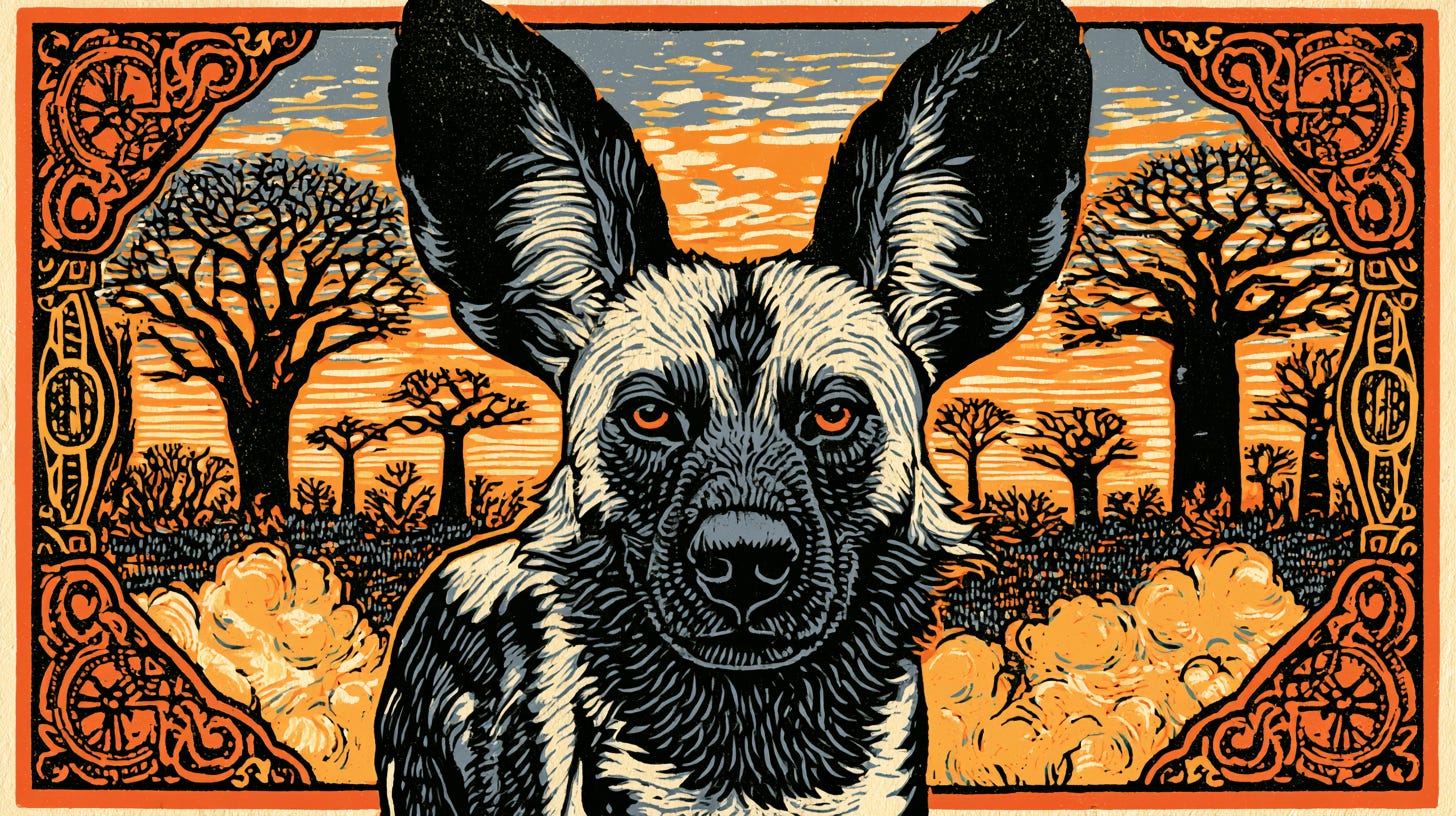
We came round a bend on a dirt road in the centre of the Kruger National Park two weeks ago. A pack of wild dogs had just pulled down an impala, a few meters from the car, and two of them were tearing the body apart while the animal, by all appearances, was not yet dead. It was an extraordinary sighting. It was also genuinely gruesome.
Wild dogs hunt this way out of necessity. They lack the heavy jaws and long, dagger-like canines of a lion or a leopard, which can kill large prey with a single suffocating bite to the throat. A wild dog cannot. So the pack pulls its prey down and simply begins to eat, shearing into the soft parts – the belly, the rump, the head – often before the animal has died. Efficient. Awful to watch.
It was not, on paper, an easy eight days. Many roads were closed after the floods a few months earlier. The grass was long, which makes spotting animals harder, and two small children make for few leisurely drives. On the first day, a boomslang, one of the most venomous snakes in the country, dropped out of a tree onto the hide we were about to enter. And yet we saw lion, leopard, elephant, buffalo, and those wild dogs. Most people alive today will never see any of it.
Kruger turned 100 yesterday. The instinct on a centenary is to do one of two things: to celebrate, or to mourn the poaching and the crumbling infrastructure. I want to do something else, because I think the most interesting thing about Kruger is an economic point that most people get backwards. We usually assume that wildlife and economic growth are enemies – that more people and more money must mean fewer animals. For a park like Kruger, the relationship runs the other way. Kruger is not only a contributor to South Africa’s economy. It is a beneficiary of it. Animals, it turns out, do well where people do well.
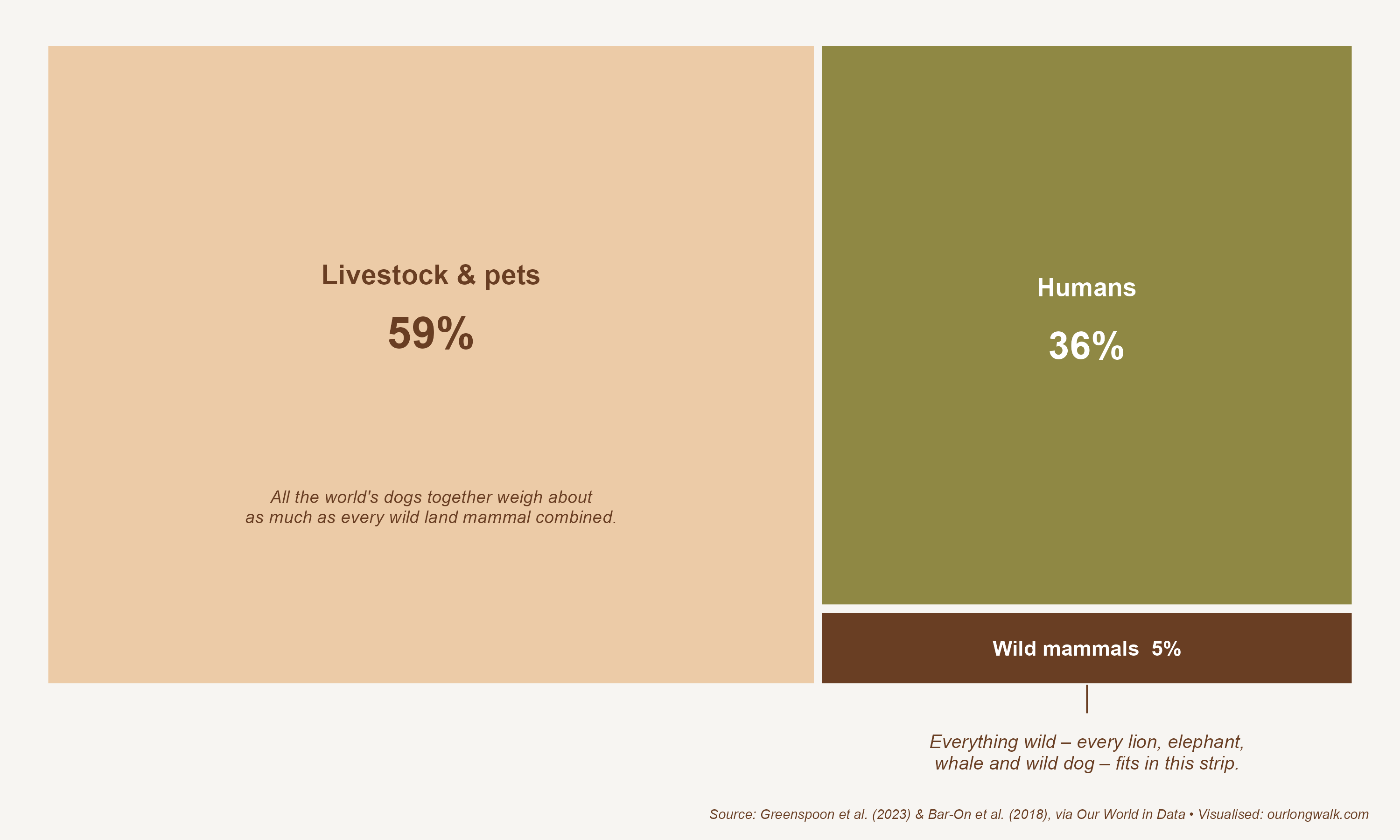
To put it into perspective, consider a strange but revealing exercise from the team at Our World in Data: weigh every mammal on the planet and ask how the total divides up. Wild mammals account for just 5 per cent of it. Humans are 36 per cent, and our livestock and pets – mostly cattle – make up the remaining 59 per cent. Our own bodies outweigh every wild mammal on Earth by more than seven to one. All the world’s dogs, taken together, weigh roughly as much as all the wild land mammals combined. Birds tell the same story: poultry outweigh wild birds by more than two to one. The biomass of wild mammals has fallen by something like 85 per cent over the past 100,000 years, most steeply since we learned to farm.
This collapse has a name. The late economic historian Eric Jones, in a book published shortly before his death, called it the ‘drawdown’ – the long extermination of wild animals that ran alongside, and helped to power, the rise of the modern economy. His claim is deliberately uncomfortable: that ‘without animal bloodshed and captivity, modern economies, societies, settlement and agriculture might not have emerged as they did’. The wealth that now lets us mourn the wild was built, in part, by destroying it.
In short, wild animals at scale have become a rare commodity. The places where they still exist in large numbers are not accidents of wilderness left over from an older world. They are deliberate, managed, expensive choices. Kruger, at nearly 2 million hectares – a long, thin park running down most of South Africa’s border with Mozambique – is one of the largest such choices on the planet. That is the first thing to keep in mind.
How that exception came to exist is a more tangled story than the gift-shop version suggests.
When the park was proclaimed in 1926, the New York Times ran the charming headline, ‘Biggest Zoo is a Vast Jungle’. Kruger was assembled from two older game reserves, the Sabi (proclaimed in 1898) and the Singwitsi (1902), and those reserves had been created, somewhat awkwardly, to protect game stocks for commercial trophy hunting. Conservation, in other words, began as an investment strategy. Farmers and the companies that had given up their land expected to recoup their losses through hunting once the herds recovered. The land itself was handed over precisely because it was thought agriculturally useless.
This does not mean the land was empty. As the historian Jacob Dlamini has shown, the lowveld had long been home to an African economy built on hunting and the ivory trade. Within a year of his appointment as head ranger, James Stevenson-Hamilton had driven roughly 2,000 people off the land around the Sabi, cutting them from the means that sustained them. They gave him the name ‘Skukuza’ – the destroyer.1 In a cruel twist, that name now belongs to the park’s largest rest camp and its administrative heart.
For a while the project looked likely to fail. Neighbouring farmers, whose livestock made easy prey once hunting was banned inside the reserve, dismissed it as a ‘government lion-breeding concern’ and lobbied to have the animals exterminated. And then, in the space of a few decades, the mood flipped. The ‘Great White Hunter’, in William Beinart’s phrase, became the ‘Great White Safari Guide’. The newspapers that had wanted the lions shot now competed to be the scheme’s loudest champion.
What changed was partly sentiment and partly money. The campaigners had a powerful example to point to: Yellowstone, the world’s first national park, which had demonstrated something governments needed to hear. Viewing wildlife, it turned out, was a legitimate and financially viable use of land. You could make more from tourists with cameras than from farmers with rifles. The choice of name sealed the deal. Calling it the Kruger Park – after the old Boer republic’s president, Paul Kruger – was an act of reconciliation between English- and Afrikaans-speaking whites, part of the same nation-building decade that gave South Africa a new flag. It was also, as the historian Jane Carruthers notes, a small fabrication: Kruger was not a particularly keen conservationist, and proclaimed the Sabi reserve only under public pressure. But the myth did its work.
With the park proclaimed, all that remained was to fill it. In 1928 the South African Publicity Association launched an advertising crusade aimed squarely at the United States. ‘A new bid for American tourists and their dollars is being made,’ reported the New York Times, ‘and South Africa is the bidder.’ For every 10,000 American visitors, the planners reckoned, something like a million pounds would follow. The bet paid off, and what drove the growth that followed was, tellingly, a set of luxuries: the private motor car, the camera, the cinema reel. Tourists were even reassured that they need not panic if a lion stared at their vehicle, since the animal had ‘probably never seen a car before’.
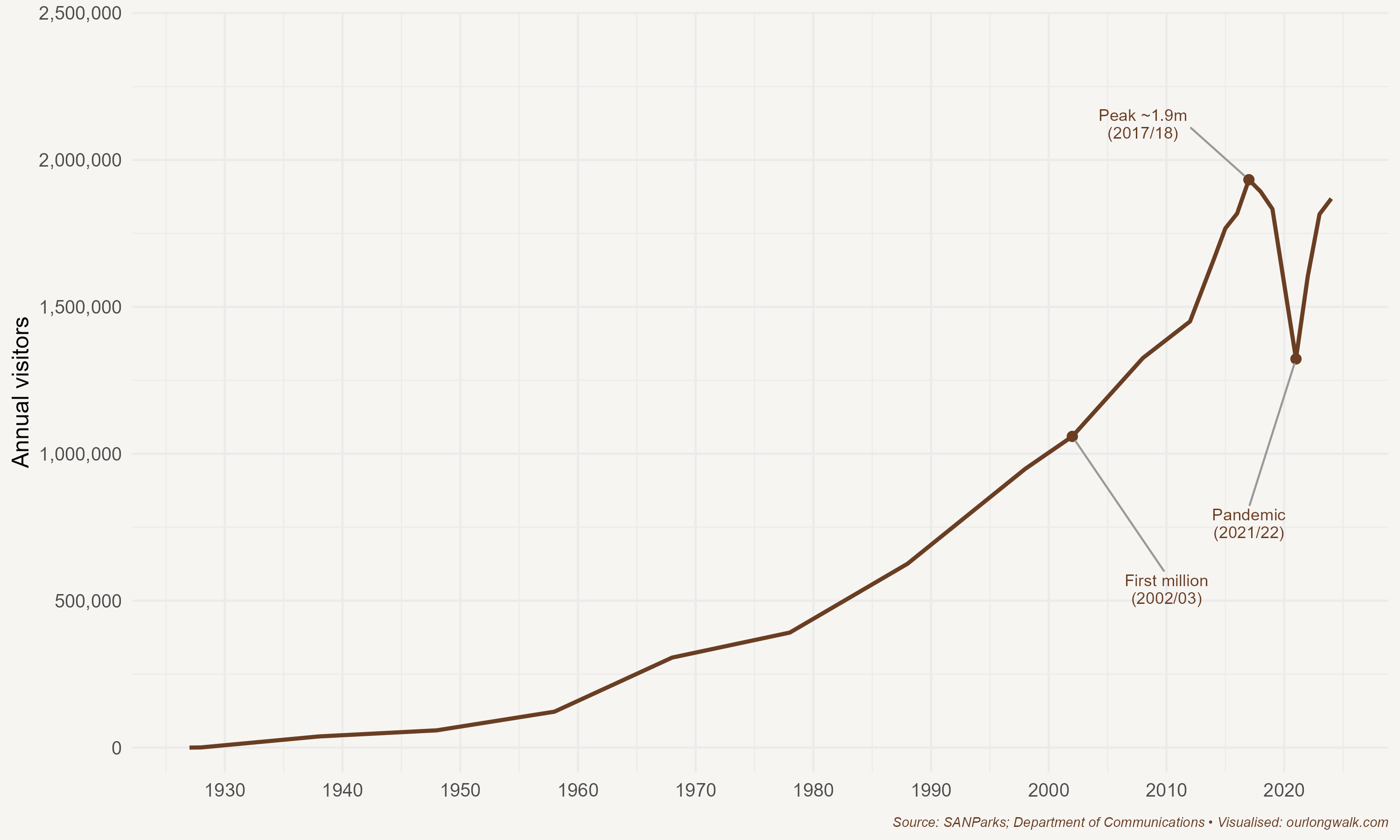
Look at the visitor numbers and you are really looking at South Africa’s economic history in miniature. In 1927 the park received 27 visitors. The next year, 650. By 1938, more than 38,000. The park welcomed its millionth visitor in the 2002/03 season and climbed to a peak of about 1.9 million in 2017/18, roughly doubling every decade for most of a century. The pandemic knocked it down to 1.3 million in 2021/22, and it has since recovered to about 1.87 million. A 2018 projection had visitor numbers doubling again to 3.65 million by 2029. That now looks fanciful, and the reason is simple: visitor growth stalled when the economy stalled.
This is the heart of it. A safari is a luxury good, the kind of thing people buy more of as they grow richer and forgo when times are hard. That holds for foreign tourists choosing between South Africa and Kenya, and it holds for South African families deciding whether they can afford the week away at all. The prices have always tracked a market – a rest-camp hut once went for a few rand a night – and the gates open widest when wallets are full.
But the dependence runs deeper than ticket sales. Protecting wild animals is enormously expensive. It takes rangers, fences, veterinarians, anti-poaching patrols, and roads and bridges – including the ones the recent floods washed away. That money comes from tourism revenue and from a state with the fiscal capacity to fund what tourism does not. Kruger, the profitable giant, helps cross-subsidise the smaller parks in the national network. When the economy is strong, visitors come, budgets hold, and the pressure to poach a rhino for quick cash eases. When the economy is weak, every one of those supports buckles at once. Put differently: the wild dogs we watched on that road depend, in the final analysis, on whether the South African economy works.
Which is why the cracks matter, and why I do not want to paper over them. Some of the units we stayed in had clearly seen better years, while the rondavels at Skukuza are being rebuilt in luxury. It is, in a small way, the whole South African story – the widening gap between what still works and what is falling apart. And in the same week we were there, something happened that had never happened in the park’s hundred years: two South African visitors were stabbed to death at Crooks Corner, in the far north where South Africa, Mozambique and Zimbabwe meet. Their car is still missing, and the likeliest explanation is a crossing from across the border. Kruger was supposed to be the safest place in the country, somewhere you could sleep without fear. This does not mean the park is failing. It means the park is not sealed off from the country, or the region, around it. Insecurity is what arrives when economies fail on both sides of a border.
Jones had a name for the second act, too. Where economies grow rich enough, he argued, the killing eases and some species stage what he called the ‘Great Rebound’ – a recovery bought rather than stumbled upon. That is what Kruger is: not a fragment of old wilderness that survived us, but a rebound we chose to pay for. Jones left the harder question open. The West’s pillaging has subsided; will the rest of the world repeat it as it develops, or learn to afford the rebound instead? Kruger is South Africa’s attempt at the second answer – and it holds only for as long as the economy does.
The lesson? If we want lions and leopards and wild dogs to still be here at the bicentenary, in 2126, it is not enough to guard the fence. We have to grow the economy that pays for the fence, staffs the gate, fixes the bridge, and fills the camps with people who can afford to come. Conservation and prosperity are not rivals fighting over the same hectares. They rise and fall together. A hundred years ago a newspaper called this place a vast jungle and marvelled that anyone would protect it. The task of the next hundred years is to keep it that way – which, in the end, means keeping South Africa a place where people, and therefore animals, can do well.
Google and the guidebooks on sale in the camp are more generous towards Stevenson-Hamilton than Dlamini: Skukuza, they say, is derived from the Tsonga word sikhukhuza, which translates to “he who sweeps clean” or “the person who turned everything upside down”.
Interesting! It would be cool to see if the correlation between economy and visitor numbers holds across other countries (e.g Serengeti, Masai Mara, Okovango)
Hi, great piece but I'm surprised you left out the multiple land claims all around Kruger, the contentious first claim resolved (Makuleke 15 Dec 1998) the award and rights of which must be financially and socially managed amidst tricky community dynamics, the cross subsudisation of other parks, and Sanparks new euphemism to manage the multiple other unresolved claims in terms of their Mega Living Landscapes strategy. These restitution claims are costly and almost impossible to find a truly happy resolution for parks and claimants