

A football is not enough
What the FIFA World Cup have taught me about economic growth

On the afternoon of 11 June 2010, in a packed Soccer City, Siphiwe Tshabalala collected the ball on the left, took one touch, and smashed it into the top corner. It was a brilliant goal, nominated for a Puskas, but it was a magic moment because of what it signaled. Sure, Bafana Bafana would go on to draw that match against Mexico, then crash out in the group stage. But nobody in that stadium was thinking about the standings. They were thinking that South Africa, and Africa, was on the world’s stage.
Like most South Africans, I remember that moment – and what turned out to be one of the best World Cups – very well. And in the epilogue to my book I used that month to make an argument about economic growth. Want to win the economic World Cup, I wrote, then stop hiring expensive coaches and top-down strategies. Give every child a soccer ball. Empower the next generation, and let them design their own future.
I still believe the spirit of that line. But sixteen years of football – and sixteen years of economics – have taught me it was incomplete. A football, it turns out, is not enough.
Let me show you why, using the World Cup itself as a teacher.
Start with a simple question. Each World Cup is awarded to a host nation. Where does that host sit on the global income ladder when the tournament arrives?
I ranked every country by GDP per capita – the Maddison Project’s long-run income data – in each World Cup year, and measured the host against the world’s frontier economy, the United States.
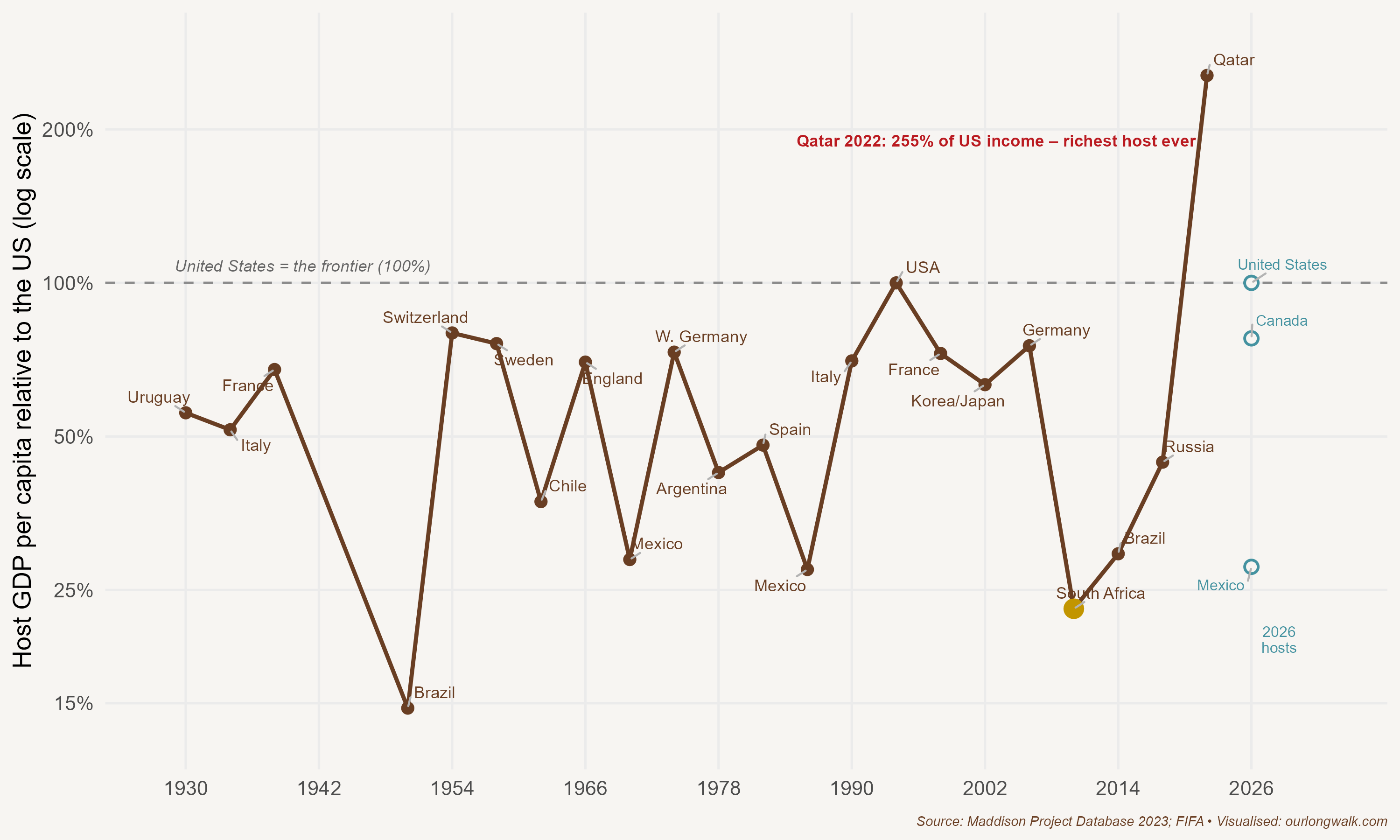
My hunch was that hosts have crept closer to the frontier over time. The data says something else. For sixty years, hosts hovered between a third and four-fifths of US income: Switzerland and Sweden near the top, Brazil and Mexico far below. The 1990s and 2000s had World Cups in countries close to the frontier, followed by South Africa, Brazil and Russia less than half of US GDP. Then, a reversal, with Qatar in 2022 at 255 per cent of US income, the richest host ever, by a distance.
In one decade FIFA swung from the poorest host to the richest. South Africa’s World Cup was sold as development – a coming-out party for a young democracy and a whole continent. Qatar’s was a petro-spectacle, air-conditioned stadiums paid for with gas. So much for the idea that hosts edge ever closer to the frontier. If anything, the choice of who hosts has come seems unmoored from how rich a country actually is.
Perhaps, instead, there is a correlation between income and victory? Let’s look at the final itself. In every World Cup final since 1930, I compared the two finalists’ GDP per capita.
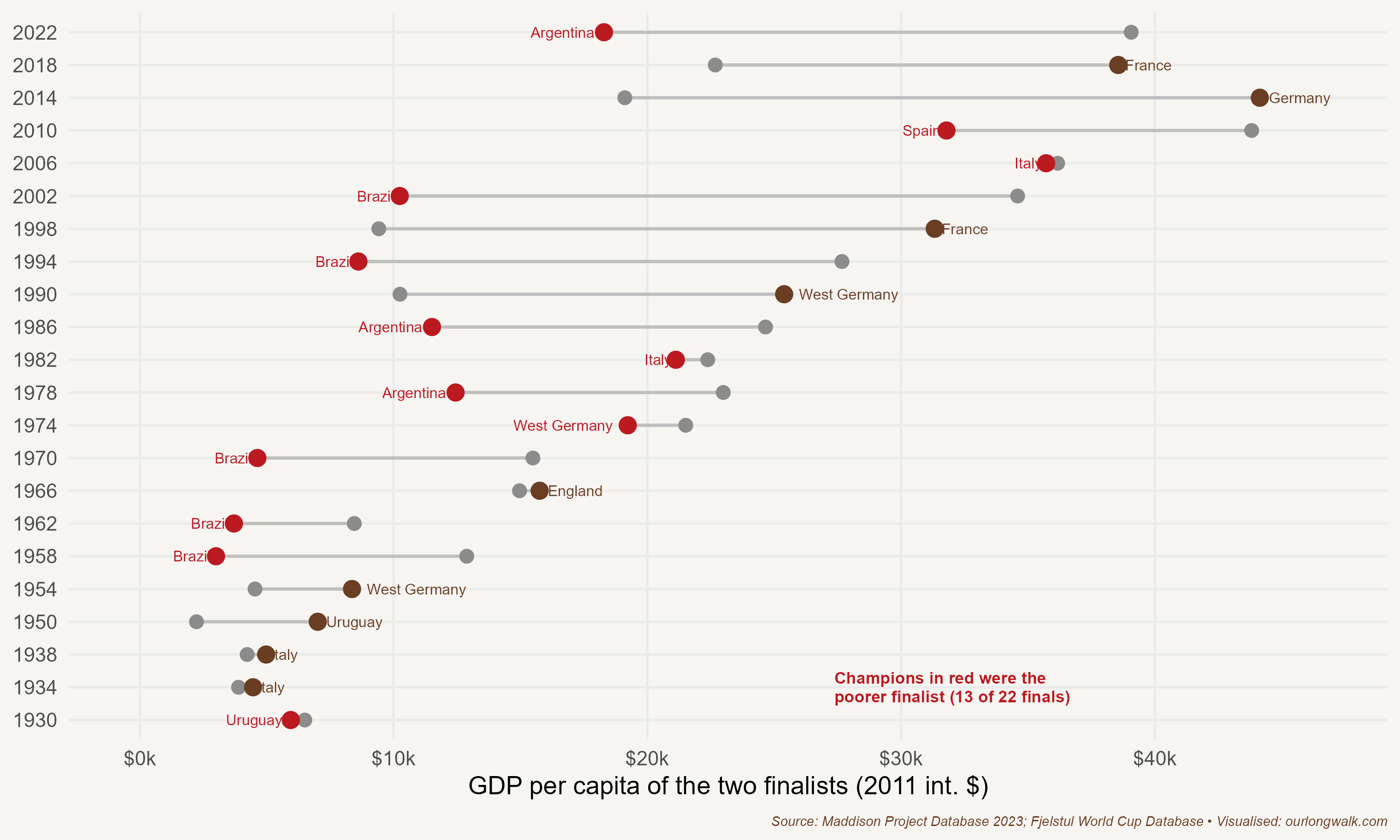
In 13 of 22 finals, the poorer nation lifted the trophy. Brazil, never close to the income frontier, won five times, usually against richer European opponents. On any given afternoon, ninety minutes is a great leveller.
And yet zoom out and the picture inverts completely. Only eight nations have ever won the World Cup. Plot the concentration of titles across the world’s countries, the way economists plot the concentration of income, and the contrast is brutal.
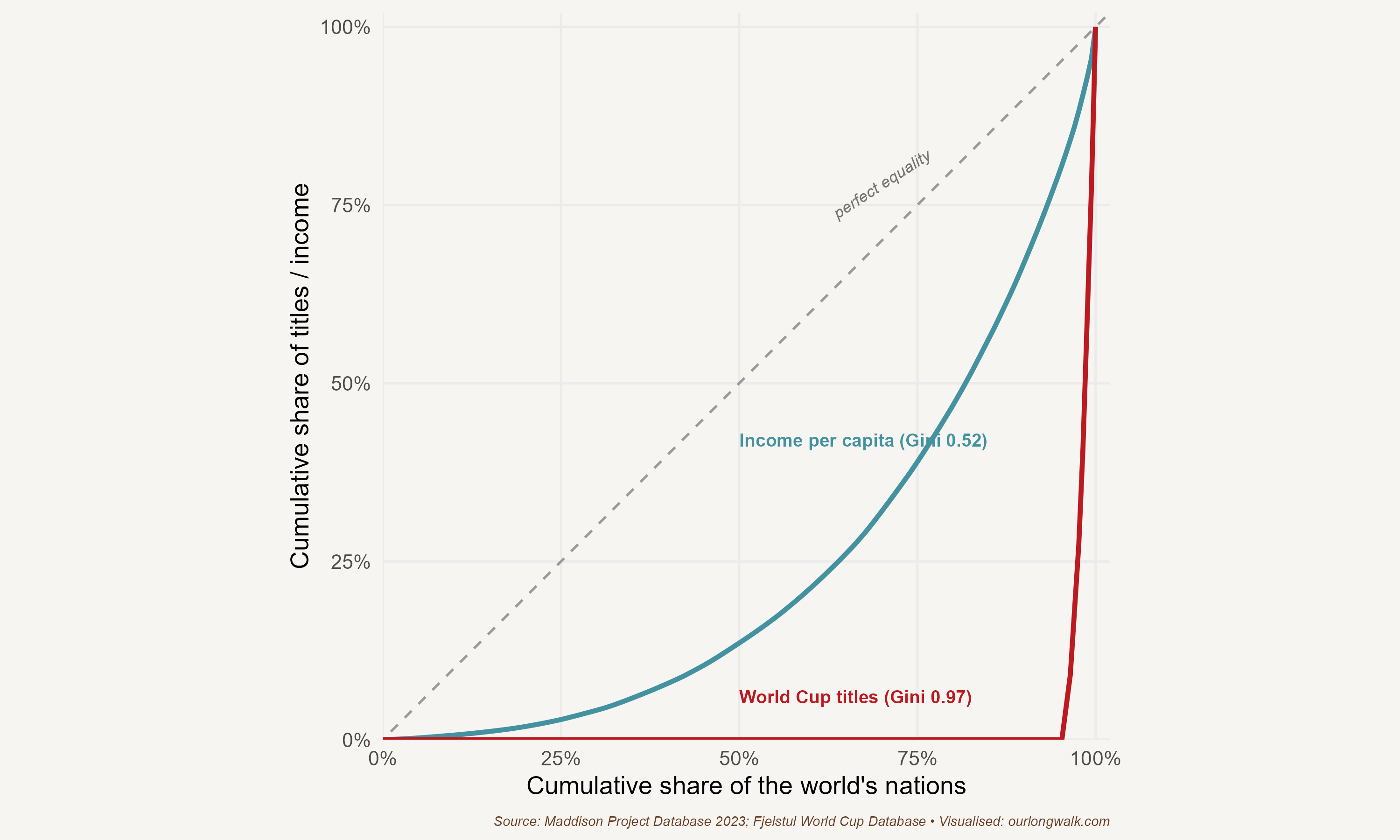
Income across nations has a Gini coefficient – the standard measure of inequality, where zero is perfect equality and one is one country owning everything – of about 0.52. The distribution of World Cup glory has a Gini of 0.97. The people’s game, supposedly the most democratic sport on earth, hoards its ultimate prize more tightly than the world economy hoards money. Football is radically equal for ninety minutes and radically unequal across a century.

If money does not buy trophies, what does? As I wrote before, football is unusually generous with evidence, because it records everything.
For the 2022 World Cup I counted, for each squad, how many players earned their living at clubs in Europe’s ‘Big Five’ leagues – England, Spain, Germany, Italy and France – and compared that to how the team performed.
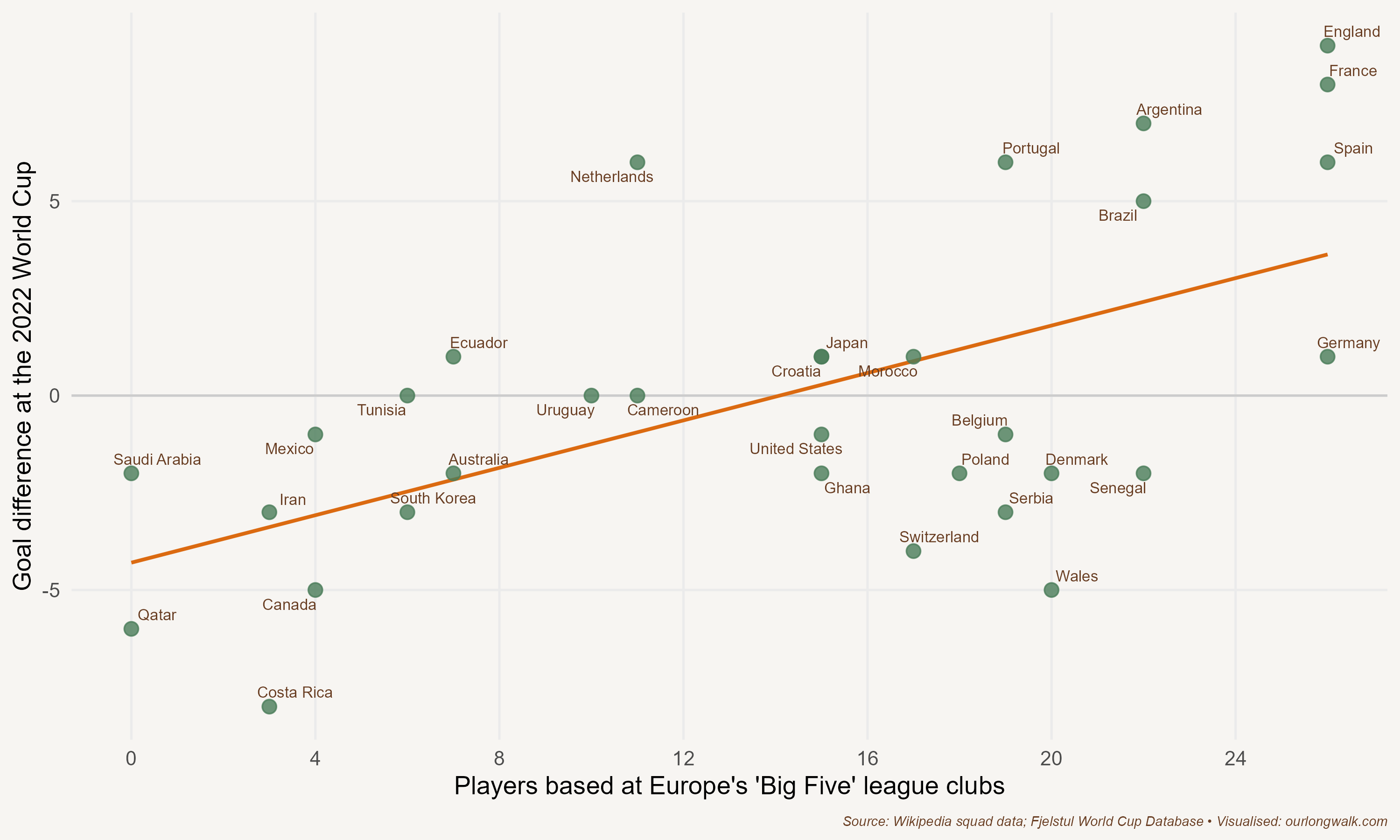
The relationship is clear: roughly every three or four players plugged into those elite leagues is worth an extra goal of margin over the tournament. Teams do well when their best talent reaches the steepest learning environments and tests itself against the best, week in and week out.
It is the same lesson I drew from the Africa Cup of Nations, and it is an old lesson in economics too: openness beats protection, and skills are built where competition is fiercest. Note the cautionary dot, though. Germany arrived in 2022 with more Big-Five players than anyone – and went home in the group stage. Access to the best matters; on its own, it is not enough. You still need the system around it to function.
Now combine the lessons. Football has been getting more equal where it matters for spectacle – the gap between the strong and the weak on the pitch has narrowed. The economy has been doing the opposite.
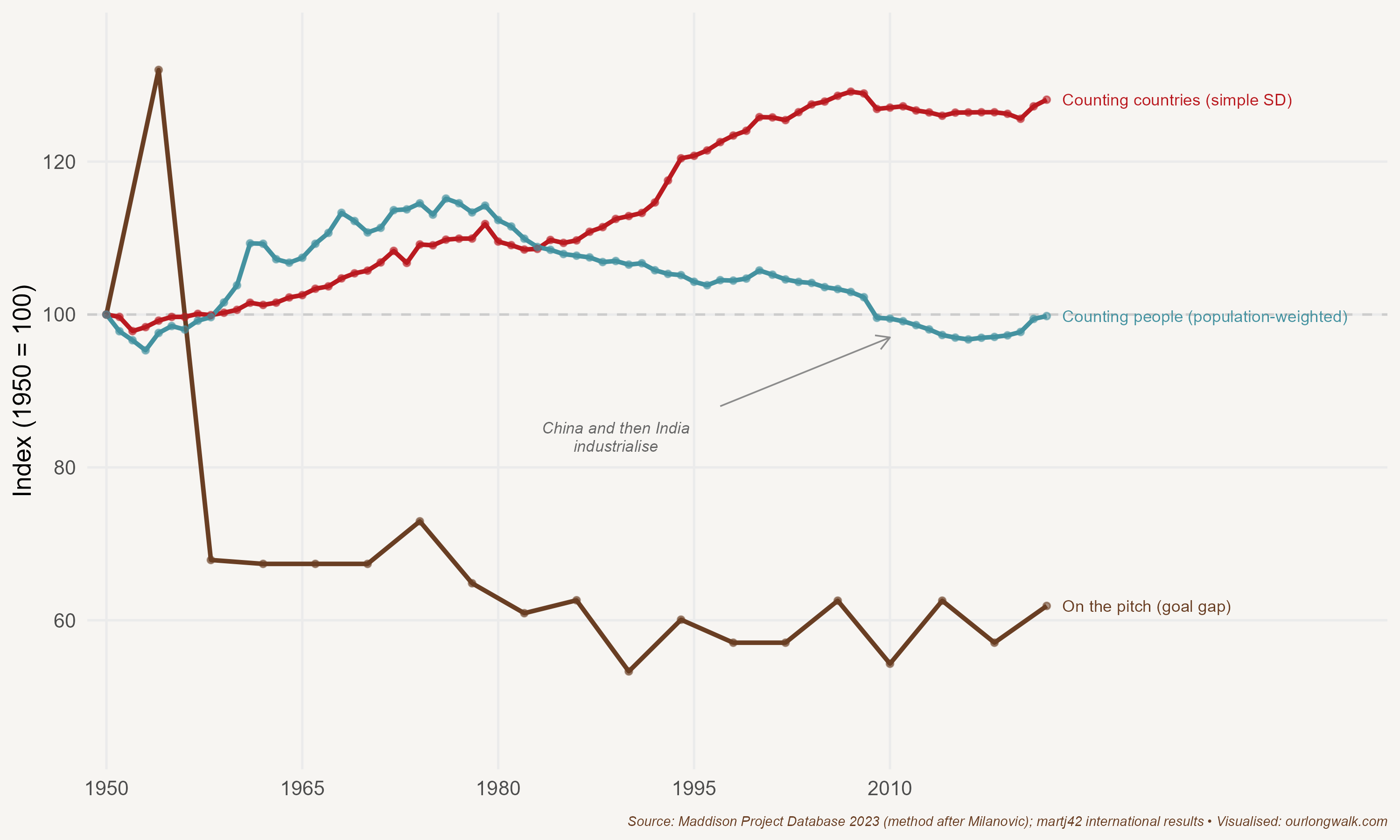
Start with China and India. As the two of them industrialised, well over a third of humanity saw their incomes race towards rich-world levels – the largest catch-up in history. Count every person equally, weighting each country by its population, and the gap between the world’s economies has been shrinking since around 1990. By that measure, the world is converging.
Measure the very same thing with a simple standard deviation, though – treating tiny Togo and giant India as equal points – and you get the opposite: divergence, dominated by the many small, poor economies that really have fallen further behind. And here football picks the second measure. A World Cup does not count people; on the pitch nobody weights by population, and tiny Togo has exactly as many shots at the trophy as giant India. By the tournament’s own arithmetic – one country, one team – the economic gap between the contenders really has widened. That divergence line is the world as football itself counts it.
And yet, on the pitch, the gap has done the opposite. Since 1950 the average winning margin in World Cup matches has fallen by more than a third, from about 2.3 goals to 1.4; minnows now routinely hold giants.
Why can football close gaps that economies cannot? Because footballers can move easily and the rules are the same everywhere. A century ago, barely one World Cup player in twenty turned out for a club abroad; by 2026 it is seven in ten.
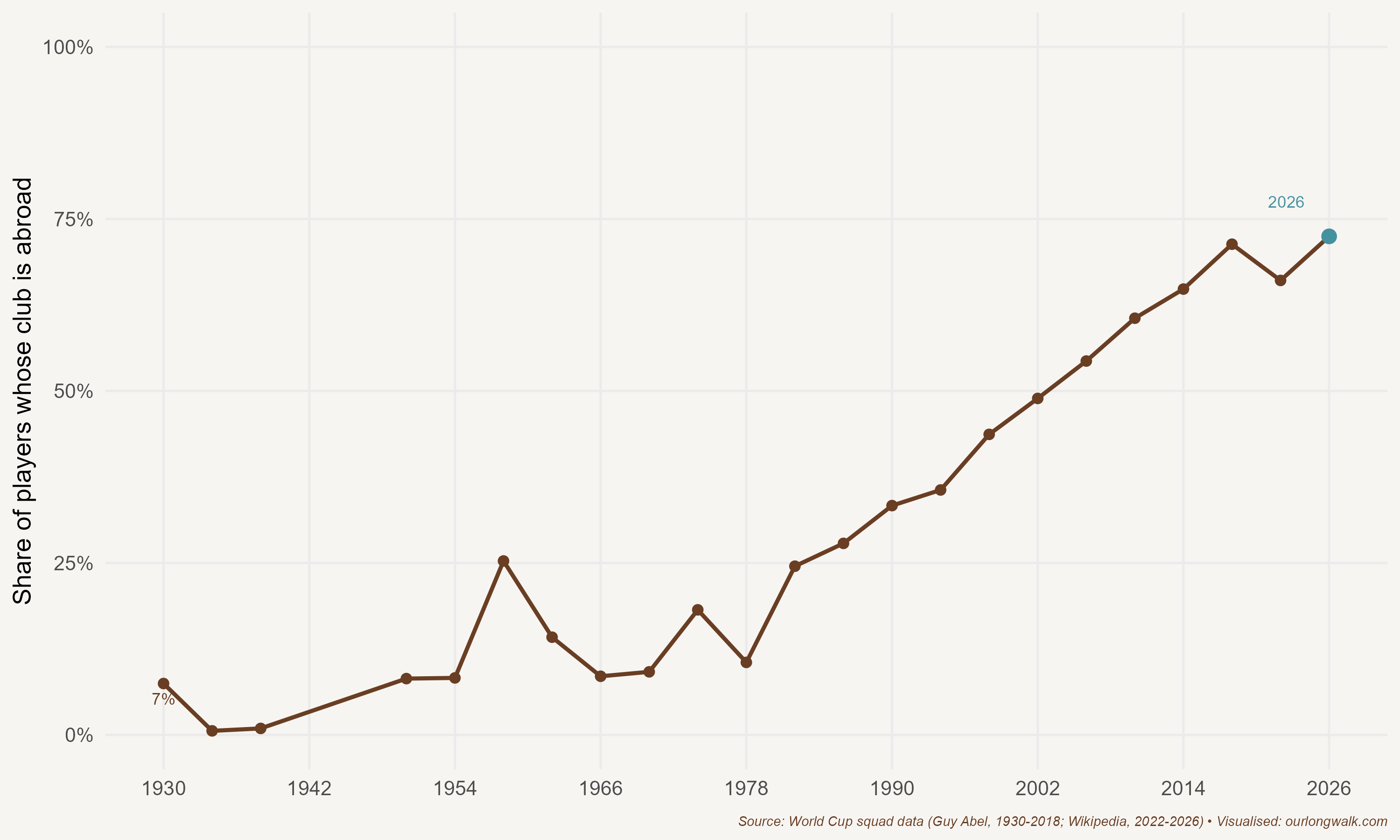
A talented teenager from Addis to Zagreb can be scouted, signed and schooled in Madrid, and bring that learning home. Knowledge, coaching and competition flow across borders far more freely in football than the institutions, capital and know-how that actually make countries rich. The pitch is flat. The world is not.
Which brings us back to 2010, and to my own analogy.
When I wrote ‘give every child a soccer ball’, I meant education. Empower people with skills and they will build the economy themselves. It was the optimism of the moment, and it was half right. But the defining finding of development economics over the past fifteen years is uncomfortable: schooling is not the same as learning.
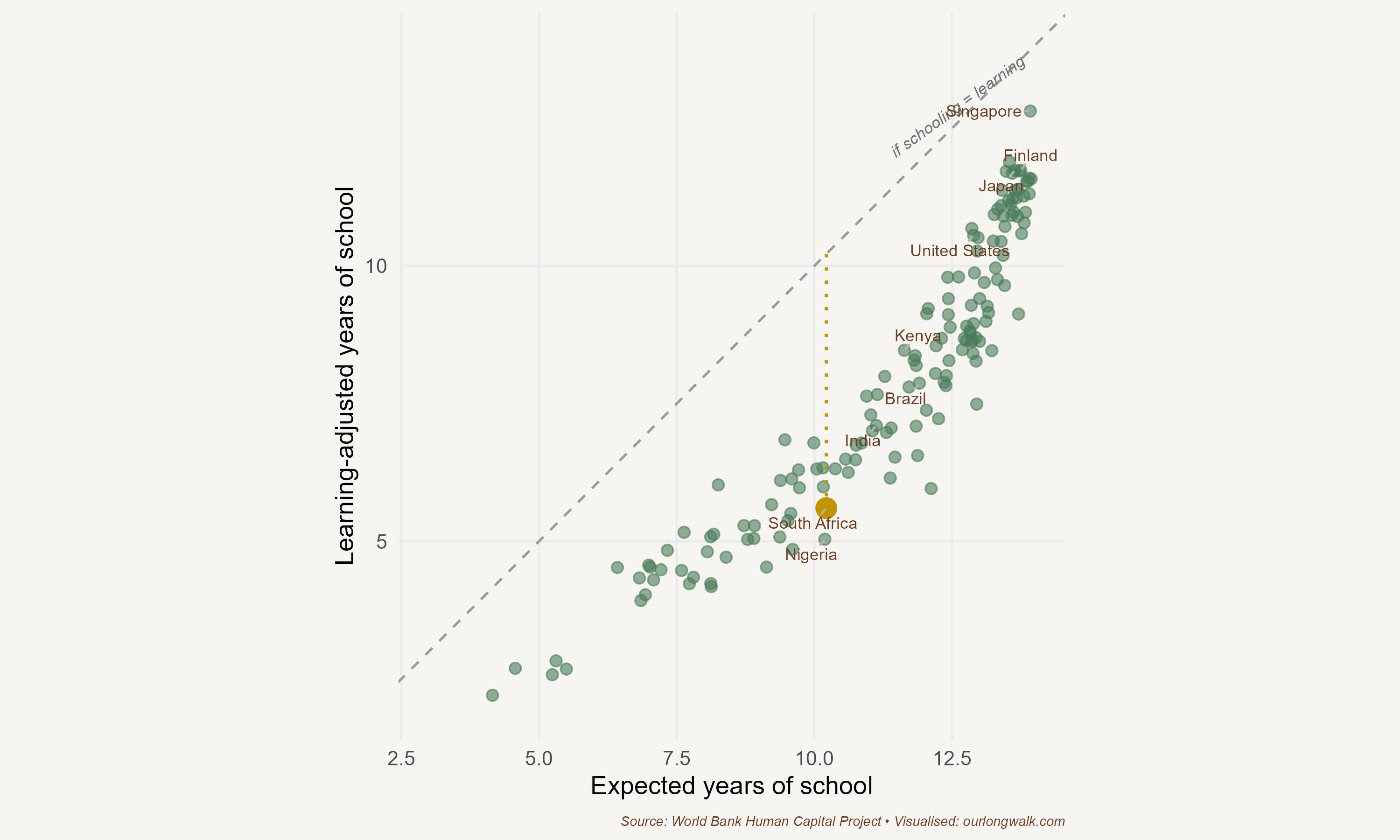
Plot every country’s expected years of schooling against its learning-adjusted years – the World Bank’s attempt to count how many of those years actually produce reading and reasoning – and almost everyone sits below the line where school equals learning. South Africa sits a long way below it. Our children spend about 10.2 years in school but acquire the equivalent of 5.6 years of genuine learning. Four and a half years simply evaporate. We handed out the soccer balls, but they never had fields to play on, or coaches showing up for training sessions.
And the consequences show up exactly where you would expect.
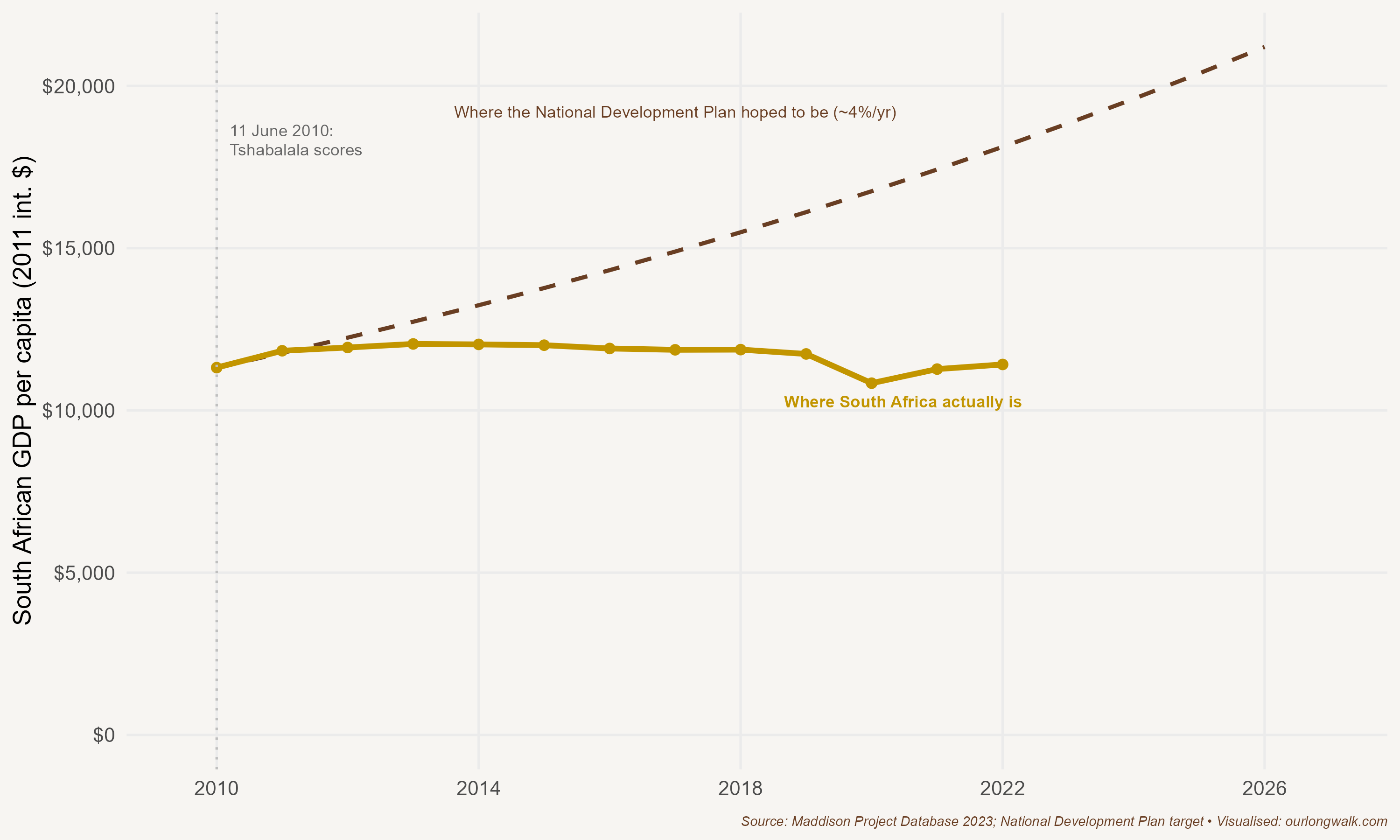
Here is South Africa’s income per person since Tshabalala scored. The gold line is what happened: essentially nothing. In 2022 the average South African was no richer than in 2010. The dashed line is where the National Development Plan – our own grand strategy, drafted in that hopeful era – hoped we would be. The gap between them is a lost generation, roughly 60 per cent of income that never materialised. Tshabalala’s goal was a flash of individual genius with no system behind it. So, it turned out, was the promise of 2010.
The lesson is that a child with a ball and nothing else does not become a World Cup player. He needs a pitch that is not a rubbish-strewn field, a coach who has himself been coached, a league that lets him play competitive matches, a referee who applies the rules fairly, and the freedom to move to wherever the game is hardest. The ball is the cheap part. The ecosystem is the hard part – and it is the part that wins tournaments and grows economies.
That is what I would change about my old analogy. I would aim even higher for ordinary people, and be honest about what that takes. Growth is not handed down by a clever coach with a five-year plan, and it does not bubble up automatically from a warehouse of soccer balls either. It comes from building the whole apparatus around the talent: real learning rather than mere schooling, institutions that enforce the rules, markets competitive enough to sharpen skill, and openness that lets people test themselves against the best.
When the tournament kicks off again in 2026 – across the United States, Canada and Mexico, three hosts spanning almost the full income ladder – watch which underdogs hold the giants. The beautiful game will, once more, flatten the field for ninety minutes at a time. The harder, slower, less glamorous work is building an economy that can do the same for a lifetime.
South Africa is back, too, playing the opener against Mexico, in a repeat of 2010. But look at where Bafana start.
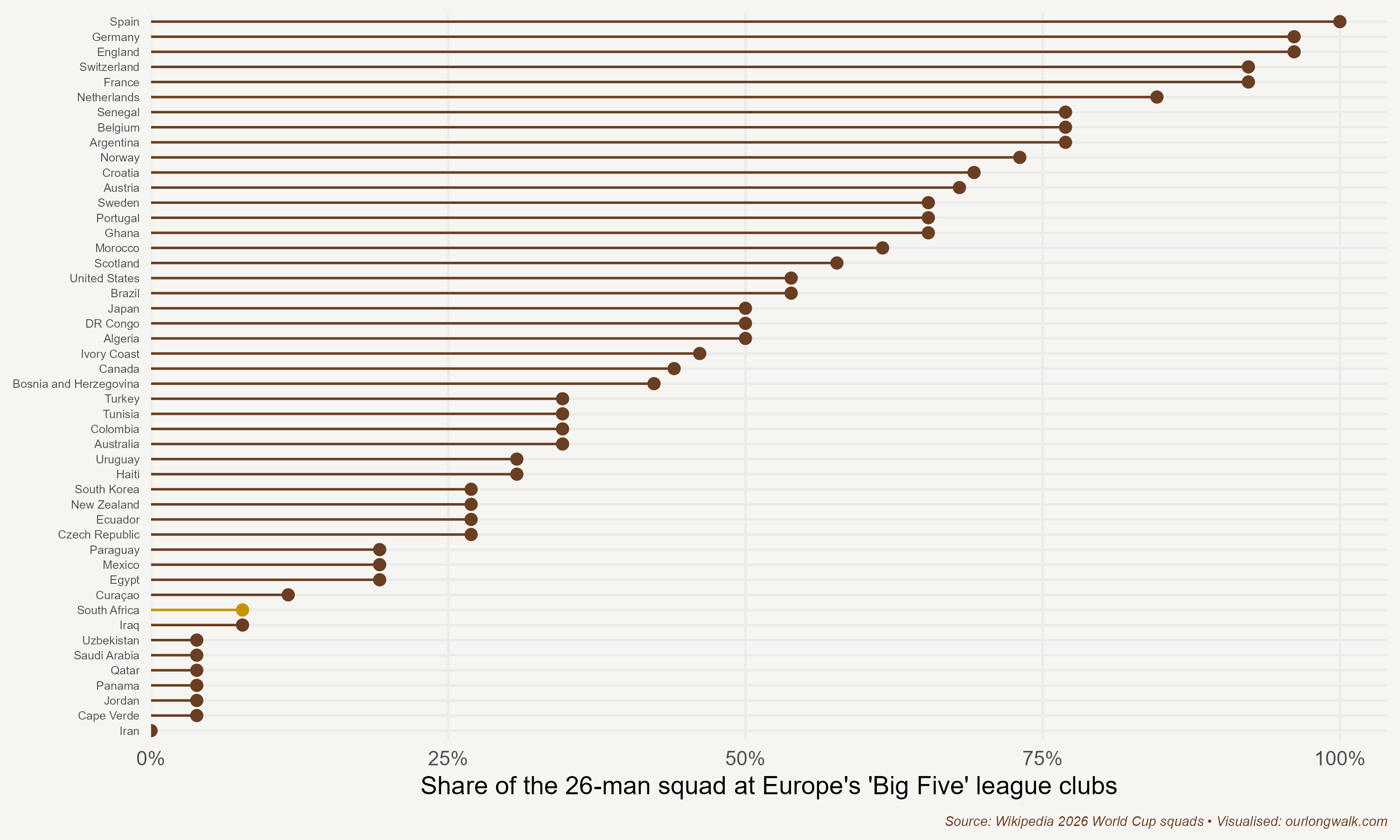
Of all 48 squads heading to North America, theirs is among the least exported – barely one player in eight at a Big-Five club, while Spain and England field almost nobody who is not. If the lesson of this piece holds, that is exactly the gap to watch: on the pitch in 2026, and in the economy long after.
Wow... An exceptional read less than 12 hours before kickoff to make one think.
I will be thrilled if Bafana Bafana surprise the world at this World Cup. I will be even more thrilled if we as a nation select (vote in) a team that can deliver the footballs, pitches & coaches we need to get to where we have the potential (and deserve) to be on the economic performance curve.
And as a wicked side wish: a match between Iran and the USA will be entertaining. Gemini predicts the probability of this happening to be no more than 7%.
Really very good writing and extremely insightful. This one excerpt from your article (amongst many others) is the appropriate thinking to ignite progress: "aim even higher for ordinary people, and be honest about what that takes" . In South Africa, tragically so, the goal posts were set lower on many levels. Rather let 50% of pupils/students fail, than feeding the economy with streams of input from false ''belief-systems'' that schooling=education. The "failures" will be forced by mechanisms to ''re-calibrate'' their own thinking. The vehicle of a growing and robust economy does not lie: it rejects components which fit not its machinery. One disempowers any entrant to the economy when one presents incumbents with false beliefs about the nature and quality of skillsets in a highly competitive modern world.