

Why 1976?
The economics of the Soweto uprising

In 1955, 970,000 black children were enrolled in South African schools. By 1967 the figure had reached 2.24 million. By 1973 it was 3.31 million – a 131 per cent jump in twelve years. And it happened even though school was not compulsory for a single one of those children, and even though almost everyone, parents included, knew the schools were failing them.
The schools were chronically underfunded and overcrowded. Most teachers had no tertiary training. Most pupils never made it from primary school to high school, let alone to matric (the final school-leaving examination). And still the numbers enrolling grew every year. The historian Oliver Aiken calls this the paradox of Bantu Education: a system designed to give black children less, swamped by black families demanding more.
Why would a parent enrol a child in a school they knew was failing? Part of the answer is simple: any education was worth more than none. A literate child could find work a non-literate one could not. Families were making an investment – in the ordinary economic sense of the word – and they understood what they were doing.
We remember the uprising of 16 June 1976 as a revolt against Afrikaans, and as the moment Black Consciousness arrived in the streets. Both are true. But they explain why the students marched, not why they marched that year. For that, it helps to look at the economy.
The timing of Soweto appears to have been shaped, to a surprising degree, by the South African business cycle: by a boom that allowed white voters to ignore black schooling, a downturn that prompted business to help pay for it, and a recession that withdrew the funding at a particularly bad moment.
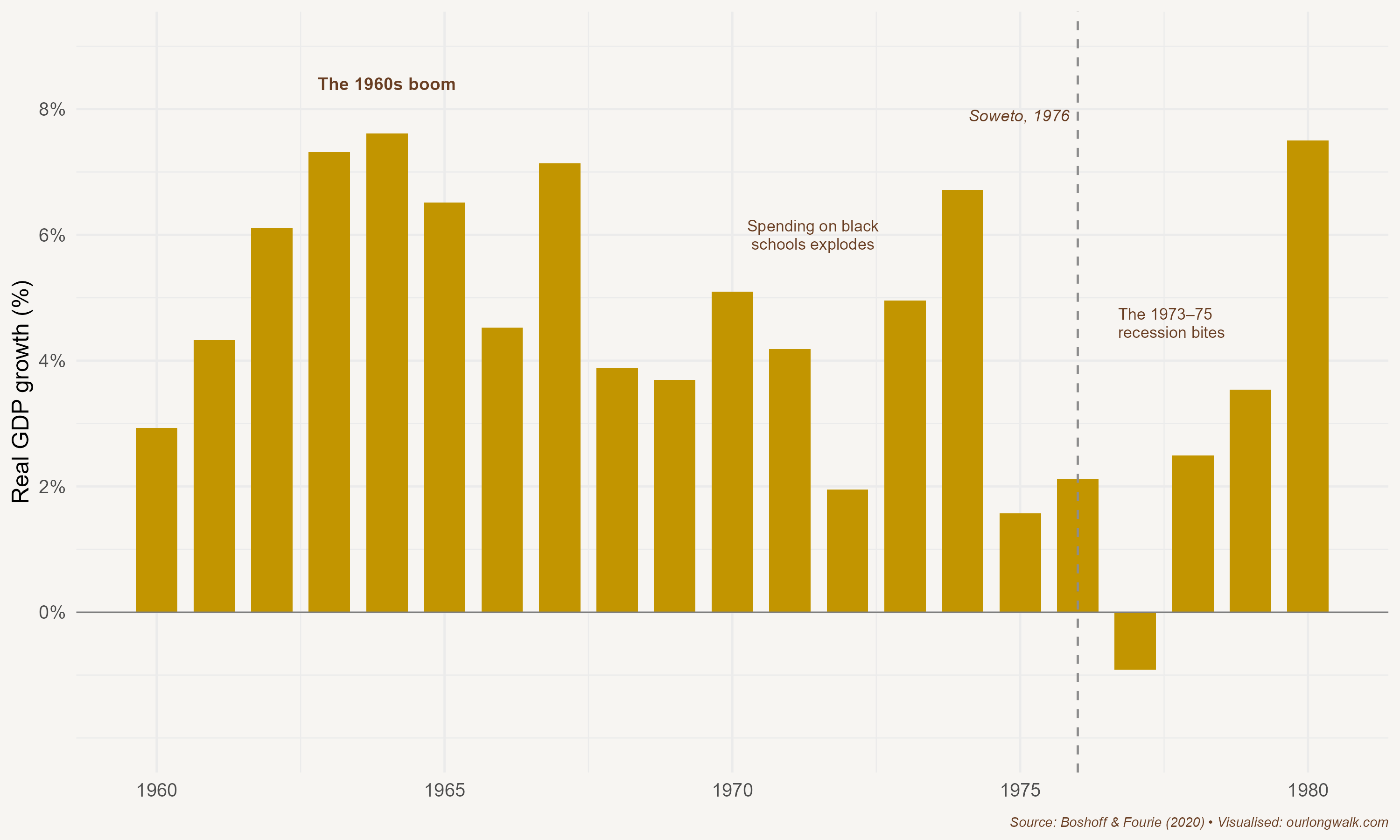
Start with the boom. Through the 1960s the economy grew quickly – six to seven per cent a year for much of the decade. Employers’ demand for skilled work was met comfortably by white workers, whose higher salaries they could afford to pay. What they wanted from black workers was narrower: literate, low-skilled, low-wage labour. Bantu Education was built to supply close to that, and little more. As Hermann Giliomee notes, white South Africans of the time largely did not support large-scale spending on black schooling. There was little economic reason, from their point of view, to train skills that employers did not yet intend to buy.
So the system was kept small by design. Spending on Bantu Education was capped at R13 million; anything beyond that had to come from taxes levied directly on Africans themselves. Black parents, unlike white parents, paid for school fees and textbooks out of their own pockets. By 1971–2, the state spent roughly eighteen rand educating a white child for every one rand it spent on a black child. In the nominally independent Homelands – the rural territories to which the apartheid state assigned black South Africans – schooling was funded worse still.
Into that gap stepped the parents. In 1967, Tswelelang Higher Primary in Meadowlands set out to build extra classrooms by levying a R2 tax on local residents and running a bottle-cap collection drive. The Department refused to match a cent of what they raised. When the Urban Bantu Council asked the liberal-leaning Johannesburg City Council to help lift the monthly schooling levy from 18 to 38 cents, the government dragged its feet, conceded two cents, and left the council R55,000 in debt by 1970.
By 1971 Soweto had twenty secondary schools – roughly one for every 80,000 urban African families. To put that in perspective: a township of more than a million people had the secondary-school capacity of a small country town. When residents pressed again for the higher levy, the deputy minister, Piet Koornhof, told them any extra money would be spent not in Soweto but in the Homelands, where black secondary schooling was supposed to happen anyway.
Then the cycle turned. The downturn of 1969 achieved something a decade of liberal argument had not: it changed the minds of business leaders. For years, liberals – here, those who wanted apartheid’s economic restrictions loosened – had warned that Bantu Education would eventually leave the economy short of skilled black workers. In a slump, with white labour looking expensive and scarce, that warning began to look practical rather than theoretical.
Companies that had ignored black schooling now moved to fund it. In August 1971 Reckitt and Colman pledged R100,000 for bursaries; Barlow Rand set up a foundation with some R700,000; in February 1972 Harry Oppenheimer’s Anglo American gave R160,000 towards a junior secondary school in Soweto; The Star launched its TEACH fund. Because these gifts flowed through the City Council and private hands, they bypassed the R13 million ceiling.
Government shifted too. A pragmatic, verligte (reform-minded) wing of the National Party had decided, as Jonathan Hyslop puts it, to accept ‘the continued existence of the urban black working class’ – and to spend accordingly. Between 1969 and 1972 it dropped job-reservation rules, eased restrictions on black urban employment, and, most importantly, in 1972 shifted the financing of black education off African taxation and onto the state’s general revenue. The 38-cent levy was finally granted. Spending on black education rose from R55 million in 1970–1 to R97 million by 1973–4.
The effect was substantial. In four years the number of secondary schools in Soweto doubled. Secondary enrolment climbed from 12,656 pupils in 1972 to 37,656 in 1976 – an increase of more than 170 per cent.
This sets up the puzzle. Why did Soweto erupt precisely when demand for schooling was at its peak, and when, for the first time, both business and the state were moving to meet it?
Several factors coincided – and most of them were economic.
First, the timing was unfortunate. The global recession of 1973–5 reached South Africa, and the government reversed course and cut spending. As one historian puts it, the building of Bantu Education’s infrastructure ‘slowed down just at the moment that the greatest demands were being made on the system.’ The chart above shows the squeeze: growth fell from 6.7 per cent in 1974 to barely positive in 1975 and 1976, and into contraction by 1977.
Second, the same demand for skilled black labour that had opened company chequebooks now drew the best teachers away from the classroom. A factory or clerical job paid better than teaching, and teaching – long one of the few respectable careers open to educated Africans – became less attractive just as the schools needed staff most.
Third, the Department chose this moment to shorten black schooling from thirteen years to twelve, combining two cohorts of pupils into one in 1976. The result was a ‘bulge’ of younger children pressed into schools that had specialised in senior grades and were not equipped to receive them. Philip Bonner’s assessment is blunt: ‘Learning was virtually impossible and the pass rate plunged to lower levels than ever before.’
Into that overcrowded, underfunded and overstretched system, the government introduced a deeply unpopular measure. The 50–50 rule – that half of all lessons be taught in Afrikaans – had for years been applied loosely; by 1964, 95 per cent of secondary classes were taught in English. But hardliners wanted it enforced. In 1976 Vorster appointed the conservative Andries Treurnicht as deputy minister, and on 11 June Treurnicht ordered five striking Soweto schools to obey the rule. Soweto had planned, as in earlier years, to resist quietly. This time the Department forced the issue. The sense of ownership that residents had built over their schools, Aiken writes, ‘collapsed in an instant.’
None of this reduces Soweto to economics. The students who marched were refusing a language that stood for their subjection, and they carried a new confidence – Black Consciousness – that told them they need not accept it. Bantu Education was, at its core, a racist project designed to keep black South Africans politically and economically confined. The business cycle does not explain that, and it is not meant to.
What economics helps explain is the timing. It suggests why the system was so close to breaking in June 1976, rather than five years earlier or five years later: a school system swollen by demand, briefly funded, then squeezed again in a recession – all within half a decade. The Afrikaans decree was the immediate trigger. The economic conditions help explain why the system it met was already under such strain.
Thanks Prof Fourie for this brilliant piece, Would have loved to see the bibliography for this article, if you do not mind sharing it. thanks !
So glad I read this article. This factual account helps me understand the emotional backlog that still lingers among fellow citizens.