



Twenty-four centuries ago, a playwright put a professor in a basket.
In Aristophanes’ comedy The Clouds, staged in Athens in 423 BC, Socrates is hoisted up in a hanging basket while his students measure how far a flea can jump – by dipping its feet in wax to make tiny slippers. Into this ‘think-shop’ comes Strepsiades, a farmer deep in debt, who wants one thing from the university: to teach his son how to argue his way out of paying. He’s looking for useful, applied knowledge. A clear return on investment.
He does not get it, and promptly burns the place down.
What Strepsiades wants is plain: training that pays, a skill his son can take to market. Whether that is what a university is for, or whether it exists for something less immediately useful, is a question universities have never settled. What has changed is that it is now answered, every year, by a number.
That number is a ranking. Agencies such as the Center for World University Rankings (CWUR) publish a global league table in which Harvard comes first, and always does, because the scale is built so that Harvard scores 100 and every other university is measured as a fraction of it. CWUR then ranks the rest on four things: research output and citations, the prizes their staff hold, and the share of graduates who reach senior positions in large companies.
These rankings exist for a sensible reason. A student in Soweto cannot see inside a lecture hall in Stanford; a donor cannot audit a department. A ranking is a signal that makes hidden quality comparable, much as a university degree itself once did. The difficulty is narrower: what a ranking can measure is a small part of what a university is, and that part is losing its value.
A recent paper by the economists David Cutler and Edward Glaeser begins with what a university actually is, and finds the most durable institution we have built: of America’s best-funded universities, 98.6 per cent are more than fifty years old, against 57.2 per cent of the Fortune 500 firms. What accounts for that endurance is structural. A university is a self-governing community of scholars, protected by autonomy, which attracts people with an unusual appetite for discovery. That structure allowed universities to reinvent themselves repeatedly – dropping subjects, adding laboratories – as the world changed, while keeping their character.
A structure of that kind is precisely what a ranking cannot observe, so the table measures the observable instead: citation counts, prize-holders, and the later salaries of graduates. Goodhart’s Law warns of what happens next: once a measure becomes a target, it stops being a good measure. Point a university at its citation count and it will produce citations, whether or not they add anything.
The figure below sets the world rank of South Africa’s leading universities next to their underlying score, edition by edition, with Harvard for scale.
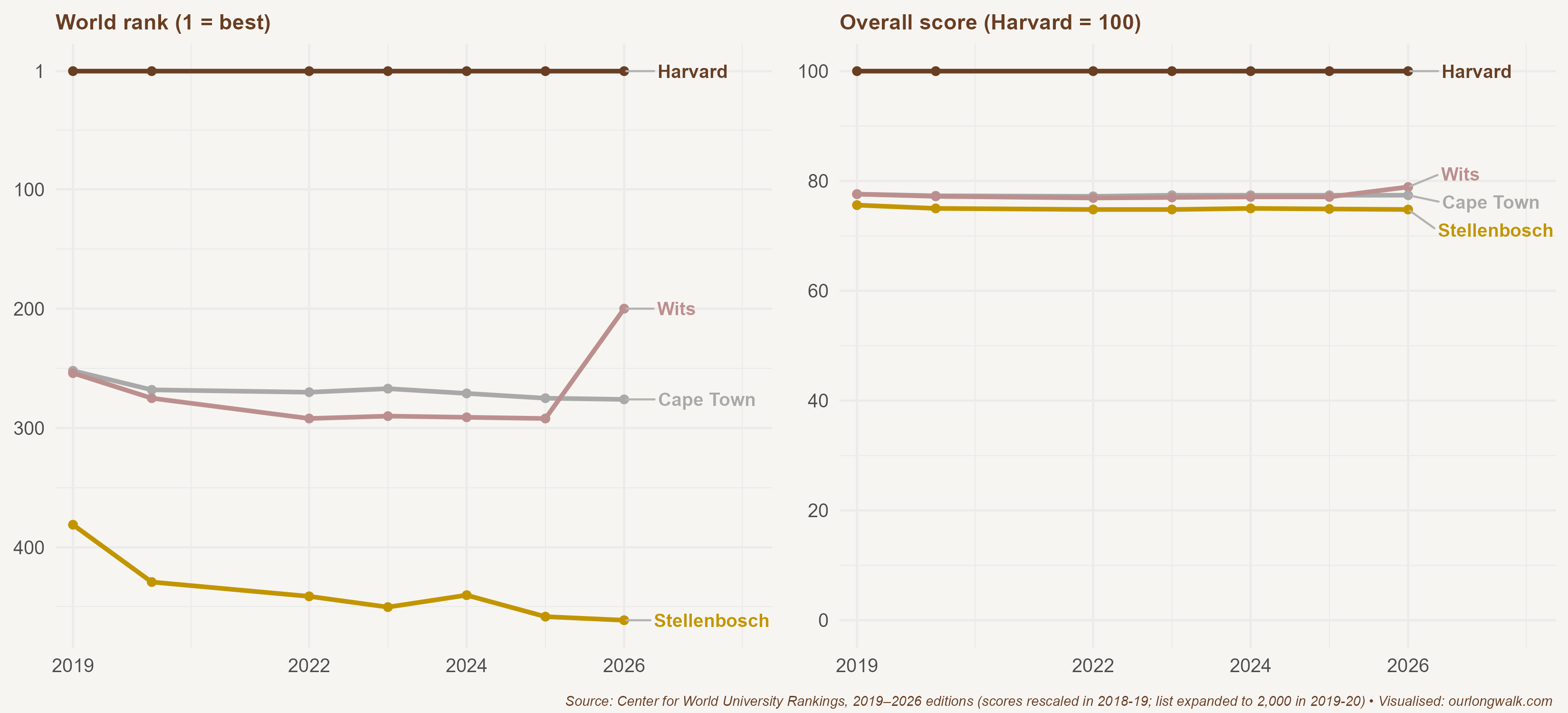
The two panels show the same institutions measured two ways, and the results diverge sharply. On the right, the scores are almost flat: Stellenbosch has stayed within a single point of 74.8 for the better part of a decade, Cape Town and Wits sit just above it, and Harvard, by design, is fixed at 100. On the left, the same universities are ranked, and the lines move a great deal.
The flatness is built into the method. CWUR counts research over a rolling ten-year window, credits alumni careers that stretch back well over a decade, and sums prizes accumulated across whole lifetimes. Scores of this kind cannot lurch from one year to the next; they accumulate slowly. A university’s position, and the direction of any drift in it, says far more about the past twenty years of its life than about the past one or two.
The single large exception on the chart proves the point. In the 2026 edition Wits climbs from 292nd in the world to 200th, yet its score rises by only 1.8 points, and all of that comes from one pillar. Research and employability were flat and the education score fell; the gain is entirely in the faculty pillar, which counts staff holding the major prizes in their fields, and on which Wits moved from unranked to 87th in the world. Cape Town and Stellenbosch register nothing on this pillar at all.
What produced the change is impossible to tell from outside. It may be a genuine appointment, a prize-winner arriving at Wits. It may just as easily be administrative: a distinguished scholar already on the staff whose affiliation was, for the first time, reported to CWUR. In that case nothing about the university changed except the paperwork. Either way, a single entry lifted a university of tens of thousands 92 places up a global table.
Aristophanes chose his title with care. Clouds change shape continuously while carrying little substance, which was his image for a certain kind of intellectual display. The yearly movement of the rankings has the same quality: a great deal of change on the surface, very little beneath it.
The flat scores, meanwhile, conceal a change that is real but too slow to register in an annual table. It concerns what a university is for.
It is tempting to stop here, fault the method, and defend the university. But on the question of purpose, the ranking may be reporting something true. A full quarter of the CWUR score rests on employability – on graduates who reach senior corporate positions – and that is, in practice, what much of modern higher education has reorganised itself to supply. Not the frontisterion, the place for thought, but the prakterion, the place for training. Universities sell degrees as routes to a salary, advertise their employment rates, and report graduate earnings. The ranking rewards career outcomes, universities publish them, and the older question – what is worth knowing – recedes. The historian Chad Wellmon, in After the University (2026), tells this as a centuries-long story: how higher learning came to justify itself in the language of productivity and economic utility, leaving unmentioned the practices of disciplined study that once defined it.
Strepsiades, then, largely won. The university that supplies a credential and asks few questions about wisdom is close to the one we now run, and the ranking reflects that choice back to us with some accuracy.
The promise underwriting that bargain was straightforward: complete the degree, and step onto a stable professional path. Artificial intelligence weakens it from both sides. It performs the measurable academic tasks – the essay, the literature review, the standard analysis – at very low cost, and it is removing many of the entry-level jobs the credential was meant to secure. This may explain an otherwise odd scene: students booing speakers who praised AI at their own graduation ceremonies in 2026. Read as simple technophobia it is hard to follow; read as the suspicion that the path they were trained for is closing, and that their training fitted a smaller idea of the university than they had been promised, it makes sense.
It is not only new graduates who sense this. The public has begun to withdraw its confidence in the degree itself. In Britain, the share of people who think university is not worth the time and money has more than doubled, from 14 per cent in 2005 to 34 per cent in 2025, while the proportion expecting graduates to end up much better off financially has fallen from a half to barely a third. In the United States the slide is steeper: three in four adults called a college education ‘very important’ in 2010; by 2025 only about a third did. No comparable series exists for South Africa, and the mood here is probably less sour – but the direction of travel is unlikely to be different. A bargain struck on financial return cannot hold once the return itself is in doubt.
Cutler and Glaeser are honest about the limits of their own method. They can value medical research because health has a unit: years of life. When they turn to the humanities they pause, asking what it is worth to understand Shakespeare’s sonnets, or the lives of early humans, and concede that they cannot say. The value does not reduce to a number. What long looked like a weakness of the humanities is now closer to a strength: the things a spreadsheet cannot price are, increasingly, the things a machine cannot reproduce.
Two South African scholars saw this coming. The classicist Johan Thom, in his 1997 inaugural lecture at Stellenbosch, took the same comedy as his starting point and then reached back further, to the quarrel between Socrates and the Sophists. The Sophists were the first professionals of higher education: they charged fees and taught the practical art of winning arguments and public office, the original employability. Socrates took no fees and taught the pursuit of the good, which had no obvious use at all. The tension between training for success and educating for wisdom, Thom showed, is as old as the university itself.
Thom’s word for what is now at risk was schole, the Greek root of ‘scholarship’, meaning leisure, or freedom from necessity: the time and space a person needs in order to think. The classics, he argued, train a particular and increasingly rare skill – reconstructing a whole from a fragment, uit die klou die leeu, the lion from its claw, the animal from a few bones. In an age saturated with machine-generated text, the ability to judge a fragment, to tell the genuine article from a plausible imitation, may be the most valuable thing a university can teach.
The Stellenbosch philosopher Anton van Niekerk, in a chapter first published in 2009 and now free on johanfourie.com, makes a complementary point. A university, he writes, is its students and their ‘will to knowledge’; the buildings and the library are only the setting. His image is the voorloper, the person who walks ahead of an ox-wagon to test whether the road ahead will hold. A university’s task is to go ahead of society and report what it finds. This, to me, is the strongest reason for a university to take up AI and use it openly: mapping what these machines can and cannot do, and reporting back to a society that will soon depend on them.
None of this appears in a ranking, and none of it can. A league table does three things at once: it magnifies differences that are largely noise, it records with fair accuracy what universities have become, and it leaves out the part that may matter most – the capacity, protected for nine centuries, to think freely.
So the rankings are worth reading, provided one remembers what they exclude. You cannot judge an oak by counting its acorns, and you cannot take the measure of a place built for thought by recording how far its fleas can jump.
Superb contextualisation