

The procurement trap
What two recent AER papers say about Treasury's draft procurement regulations


South Africa spends just under a trillion rand a year on public procurement – about 15% of GDP, on the best recent system-wide estimate of R931.5 billion in 2021/22. On 16 April 2026, Finance Minister Enoch Godongwana published 100 pages of draft General Regulations under the Public Procurement Act 28 of 2024. The rules scale by contract value: set-asides on contracts up to R20 million, ownership-linked pre-qualification from R20 million to R100 million, and subcontracting conditions above R100 million. On top of this sit minimum allocation targets across 21 designated-group permutations in Annexure 2, and a centralised supplier database, with compliance ultimately the Auditor-General’s to verify. With the Act and the companion Tribunal Regulations, this is the most far-reaching procurement-law reform in a generation.
What does the recent international evidence suggest the consequences will be?
What the regulations actually do
The new rules tighten as the contract gets larger. For contracts below R20 million, the contract is set aside for firms 100% owned by members of one of the designated categories – black people, black women, women, people with disabilities, military veterans, small enterprises, co-operatives, and so on. For contracts between R20 million and R100 million, bidders must pre-qualify by demonstrating either that at least 40% of their past procurement went to 51%-black-owned and -managed enterprises, or that they will subcontract 30% of the contract to 100%-owned enterprises in one of the identified categories. For contracts above R100 million, an institution may, after a feasibility assessment, make subcontracting a condition of the bid; where it does, every bidder must subcontract at least 25% of the contract value to 100%-owned enterprises in the identified category.
Annexure 2 sets a further layer of obligations: minimum set-aside targets across 21 designated-group permutations, expressed as a share of the institution’s annual procurement budget. The headline targets are 30% to black-owned firms, 15% to black-women-owned, 18% to women-owned, 4% to firms owned by people with disabilities, 2% to firms owned by military veterans, 30% to small enterprises, and on through twenty-one rows. An institution does not apply all twenty-one: it selects up to five categories and must meet the Annexure 2 targets for those it picks. The targets overlap – a black woman can count towards several rows – and summed they far exceed any budget, so the real burden is not arithmetical impossibility but administrative complexity, audit risk, and the pull towards chasing measurable categories over delivery.
This is a structural change, not just an adjustment. Under the previous regime, the Preferential Procurement Policy Framework Act, price counted for 80 of every 100 points (or 90 on larger contracts), with the balance awarded for B-BBEE status, so every compliant firm could still bid and could still win on price. The new rules replace points-based preference with hard exclusion: on a set-aside contract, only bidders meeting the ownership criteria are eligible to bid at all.
None of this is to dismiss the draft wholesale. Parts of it are genuine improvements that should survive any redraft: it requires institutions to publish their procurement plans and awarded contracts, it consolidates a famously fragmented system into a single, clearer framework, and its transformation objective is constitutionally legitimate. The question is not whether to pursue transformation through procurement, but whether outright ownership-based exclusion is the instrument that will achieve it. The international evidence is the test.
A debate already in motion
South African procurement-law scholarship has argued for several years that the system is over-regulating its way into worse outcomes. Geo Quinot – my colleague at Stellenbosch and director of the African Procurement Law Unit – has made this case across a sequence of papers. In a 2020 piece for the African Public Procurement Law Journal, he described ‘an extreme level of fragmentation’, with dozens of subordinate instruments layered on top of the primary statutes. By 2023, in Ruch Prawniczy, he was arguing that the granular, ‘band-aid’ approach ‘threatens to undermine the very constitutional foundations of the procurement system’. The Auditor-General’s own data are consistent: only 36% of national and provincial entities were fully compliant with procurement legislation in 2019/20.
In 2025, with Jonathan Klaaren, Ryan Brunette and Ron Watermeyer, Quinot extended the argument in APPLJ. The current paradigm, they wrote, ‘is more appropriate for off-the-shelf products and well-defined services than for public infrastructure and other complex purchases’. They proposed graduating rule-strictness to institutional capacity – relaxed rules for entities able to be trusted with discretion, tighter rules for those that cannot.
In his 2024 UNCITRAL chapter, Quinot put the diagnosis plainly: ‘Where capacity across the procurement system is low and where there are serious integrity concerns, it is common to limit discretion in procurement decisions … by way of strict rules.’ Strict rules and bureaucratic capacity, on this reading, are substitutes: a country leans on the one when the other is weak.
The conceptual argument is already well developed in the South African legal literature. What this post adds is the empirical scaffolding from the recent international economics literature, which the local debate has not yet engaged with. Two papers, both in the American Economic Review, are particularly relevant.
Lesson one
The first paper, by Bosio, Djankov, Glaeser & Shleifer (AER 2022), assembles a dataset of procurement laws, practice, and outcomes across 187 countries. The authors distinguish ‘laws’ (what is on the books) from ‘practice’ (what bureaucrats actually do), and ask which predicts outcomes – integrity of the process and quality of public works.
Three findings stand out. Practice predicts outcomes. Laws predict practice. But laws, on their own, do not predict outcomes. Put differently: once you know what bureaucrats actually do, the rule book adds no further information about whether the system delivers. Stricter regulation on paper has no measurable association with better procurement performance.
The puzzle resolves once one looks at state capacity. Stricter laws improve outcomes in low-capacity countries, where unconstrained discretion would more often be misused. They worsen outcomes in high-capacity countries, because the rules end up blocking welfare-improving discretion – including the discretion to exclude a low-quality bidder who happens to meet every formal criterion. In Bosio et al.’s framing, regulation and public sector capacity are substitutes – the same conceptual point Quinot makes in his 2024 chapter, but supported by cross-country regression evidence rather than legal reasoning alone.
Two further patterns are worth noting. In low-capacity countries, the law is stricter than practice: rules aspire, bureaucrats fall short. In high-capacity countries, practice is stricter than law: capable officials voluntarily exceed the rule book. The well-functioning systems are not the most heavily regulated ones. They are the ones with capable people who do not need the regulation to do the right thing.
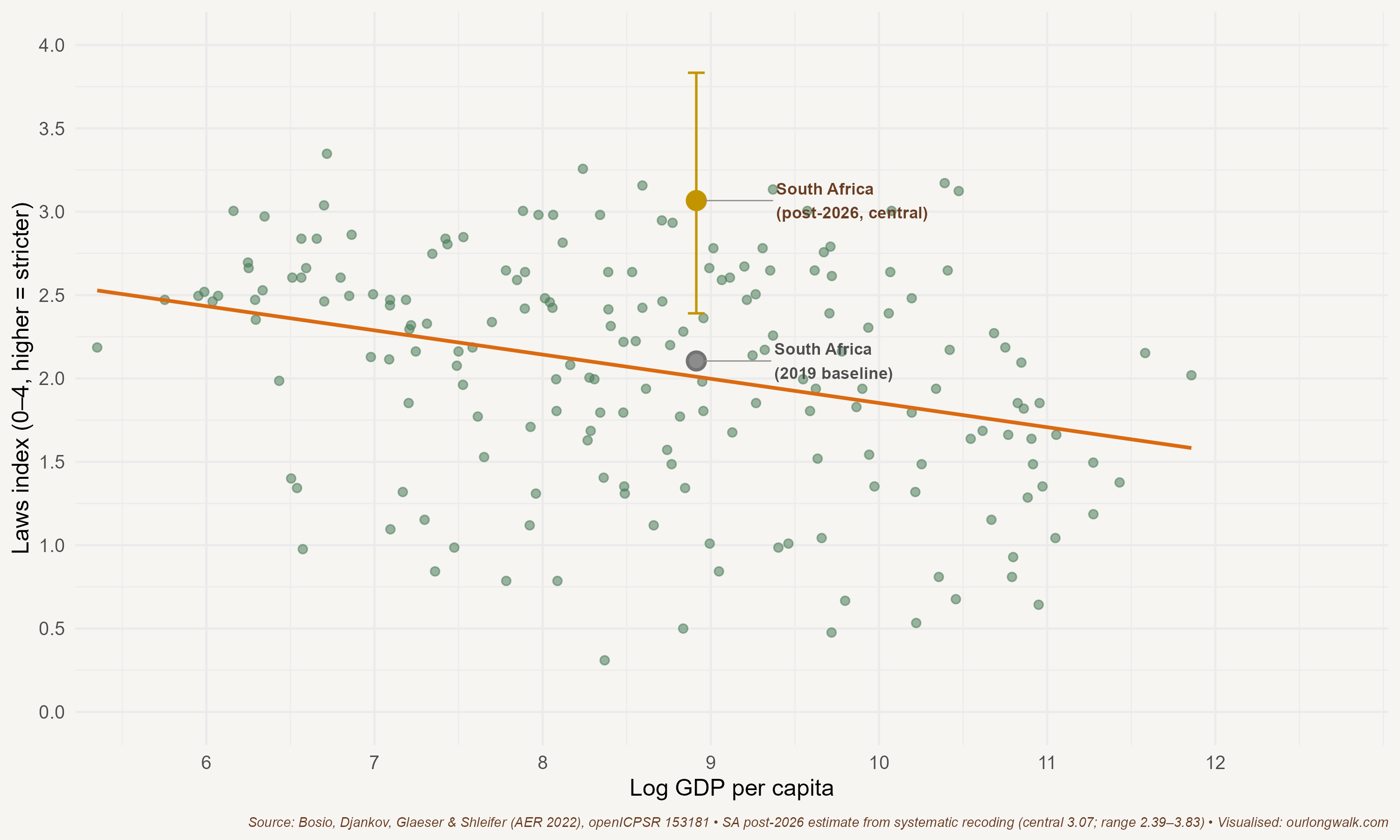
So where does South Africa sit on this picture? Recomputing the Laws index from Bosio’s openICPSR replication file gives a baseline of 2.1 out of 4 – already slightly above the global linear fit at the country’s level of income, meaning the country is already a bit more heavily regulated than the typical country at its income level. Estimating where the new regulations would put it is necessarily approximate: Bosio’s original survey instrument was designed around a hypothetical US$2.5 million road-resurfacing case rather than South Africa’s set-aside architecture. We walked through all 24 Law-side questions, mapped each to a specific gazetted regulation, and applied three pre-registered scenarios: conservative (flip only on explicit textual mandate), central (flip on a reasonable legal reading), and aggressive (flip on intent). The full decision matrix is in the replication folder. The central estimate is 3.07 out of 4, with a conservative-to-aggressive range of 2.39 to 3.83. Under any of these scenarios, South Africa moves from “slightly above” the global trend line to the upper third of the distribution, alongside countries with considerably weaker public sector capacity. Nothing in the new regulations builds the underlying capacity that, on Bosio’s evidence, is the only factor shown to matter for outcomes.
Lesson two
The second paper, by Carril, Gonzalez-Lira & Walker (AER 2026), asks a different question: should the same procurement rules apply to a stationery order as to a wastewater treatment plant?
US Defense procurement runs on a regulatory threshold that helps answer it. Below US$25,000, contracts can be negotiated without public notice. Above US$25,000, contracts must be publicly advertised. Carril and co-authors compare otherwise-similar contracts that fall just above and just below this threshold, isolating the causal effect of forced public advertising. They find that above the threshold, the extra publicity brings in about 60% more bids and prices fall by about 6%. But cost overruns rise by 7%, and delays rise by 8%.
Almost all of the deterioration is concentrated in complex contracts – services, customised work, anything the buyer cannot fully specify in advance. The within-firm decomposition isolates the mechanism: when a given contractor wins under more publicity, it does not deliver any worse than the same contractor under less. The damage comes from which firms end up winning. Forced advertising pulls in marginal entrants who underbid the established suppliers, win, and then fail to deliver. Economists call this adverse selection at the entry stage: forcing competition changes the type of firm that competes, and on complex contracts it is the lower-quality entrants who win.
A complexity-tailored rule – heavy publicity for commodity contracts, lighter publicity for complex ones – would save the DOD about US$104 million a year, about 2% of relevant spend.
This is the same argument Klaaren, Brunette, Quinot and Watermeyer make in their 2025 APPLJ paper: rules should differentiate by procurement type. What Carril adds is the causal magnitude. Uniform rules across heterogeneous contracts have a measurable cost, concentrated where contracts are most complex – exactly where governments most need procurement to work.
South Africa’s new regulations apply uniformly. The R20 million threshold is the same for a stationery contract as for a wastewater treatment plant. The R100 million subcontracting condition, where an institution imposes it, can apply to a building lease and to a rail-signalling system alike. Most of the country’s high-profile procurement failures of the past decade – Eskom’s builds, the Transnet rail expansion, failing municipal water plants – sit in the complex category Carril’s paper identifies as most vulnerable to blanket rules.
Three predictions
What do these two papers suggest about how the new regulations are likely to perform?
First, costs will rise on average, though the evidence cuts both ways and design is decisive. Set-asides are not simply anti-competitive: the most directly relevant study, Cappelletti & Giuffrida’s (2024) decade of US federal procurement, finds that the entry of targeted firms more than offsets the exclusion of others, so the number of bids actually rises. But the same study finds that execution suffers. Small-business set-asides raise cost overruns by 16.2%; the more restrictive disadvantaged-business set-asides – those reserved for narrowly defined ownership groups – raise overruns by 30.9%, with delays lengthening by roughly 5% and 9% respectively. The mechanisms are adverse selection and weaker performance incentives. On preferences specifically, the picture is genuinely mixed: they can lower costs (Krasnokutskaya & Seim 2011; and, as reported in Cappelletti & Giuffrida 2024, Nakabayashi’s study of Japanese set-asides) when they draw genuinely new competitive entrants into a thin market, but they raise costs (Marion 2007 finds a 5% bid preference raised California highway costs by 3.8%) when the favoured pool is shallower than the market it displaces. South Africa’s new design narrows eligibility towards firms 100%-owned by members of whichever designated category the institution selects – a thinner pool than the 51%-black-owned market most firms have grown into under B-BBEE – and the rule sits on top of a budget split many ways. On the design choices made, and with many reserved categories of the restrictive 100%-ownership type, the new regulations fall on the cost-raising side of the evidence.
Second, execution on complex contracts is likely to worsen. This is Carril’s adverse-selection result applied to South African infrastructure procurement. When eligibility for a high-stakes tender is determined by ownership rather than ability to deliver, the firms that win have been selected on the wrong basis, and the cost of that selection error shows up at the execution stage rather than at award.
Third, the pre-qualification tier invites collusion, and the compliance burden will slow decisions. The R20 million to R100 million pre-qualification stage turns procurement into a two-stage process, and any pre-selection stage is a gift to cartels: a partial cartel can coordinate its first-stage bids to crowd competitive rivals out of the second stage and push prices up (Seibel & Skoda 2026). When Slovakia abolished pre-selection, procurement savings rose. South Africa’s construction sector, where collusion is documented in Competition Commission investigations and where the ‘construction mafia’ is a live enough concern that the draft addresses it directly, is fertile ground for exactly this. At the same time, the compliance burden climbs. This is Quinot’s point, made sharper by the new annexure: the categories an institution selects must each be tracked, met and audited, each carrying personal liability for accounting officers. South African courts have accepted that holding officials personally liable for procurement decisions has a ‘chilling effect’ on their willingness to take decisions. The new regulations multiply the compliance tests a single decision must pass to stand up to audit, so decisions are likely to slow, particularly where the compliance position is unclear.
Conclusion
Bosio et al.’s reading of their own results is that the regulation of procurement helps, but mostly in lower-capacity countries where unconstrained discretion is more often misused. South Africa has its problems, but it is not at the bottom of the global capacity distribution. It is in the middle, having lost ground over the past decade. The policy direction the evidence supports is not more law, but more capacity. A procurement system designed to substitute for a weak state tends, over time, to keep the state weak.
There is a parallel risk for the firms the policy means to help. Set-asides can keep firms alive without making them competitive: winners survive on reserved demand rather than rising productivity, showing no measurable productivity premium (Cappelletti, Giuffrida & Rovigatti 2024). A regime meant to build black-owned firms can instead entrench their dependence on the next set-aside. The right test of preferential procurement is whether it builds competitive firms, not whether it reserves contracts.
The conceptual case has been made in the South African legal literature for several years. What the international economics evidence adds is the magnitude: cross-country regressions on 187 countries showing the substitutes relationship, and a causal estimate from US Defense procurement that quantifies what uniform rules cost on heterogeneous contracts. The public-comment period on the draft regulations is open.
On the available evidence, the draft regulations as written are likely to worsen South African procurement outcomes, and they should be substantially redrafted before being gazetted in final form.
Thank you for this insightful piece. The set-aside is by-product of a lack of state capacity. Or a state incapable of supporting black firms to meaningfully participate in the economy. I always likened this to how transformation targets were introduced into cricket around 2013. The system didn’t want to organically transform. Hence, the introduction of targets.
Now the same thing is happening within state procurement because there are no active agents of transformation. Politicians resort to more regulation rather than less…
I suspect the laws, regulations and rules that work 'best' or to hedge 'more effectively' in the world incentivise rather than disincentivise certain types of behaviour and outcomes.
South Africa's policy manadarins should be asking themselves a few key questions pertaining to the new procurement regulations like:
1. What outcomes and impact are we trying to achieve with these procurement changes? Could the outcomes and impact we seek be achieved using alternative tools in the policy-makers tool kit rather than resorting to force fitting every problem to be a nail and new regulations and their associated costs as the solution hammer.
2. How will these changes result in black producers that are more efficient and effective in ways that can be tangibly measured? Set asides with no market-based feedback or disciplining mechanism is not going to produce businesses that are are globally relevant or competitive.
3. Given the potential for various types of capture inherent in procurement functions and more so especially in state procurement given the value of procurement value pools, the legislation says very little on how to track impact for each procurement rand spent. Basic and commodity products and services can easily be indexed and range bound in a database. Complex products and services should have an extra level of care placed on them by developing bespoke measures that can show the outcomes and impact of acquiring a given product, service or solution proposition that is trackable in terms of outcomes and impact created.