

The preacher's assistant
What South Africa should learn from the people already using AI


Over the past two weeks, I’ve had three conversations about artificial intelligence. The first was a podcast with Chinasa T. Okolo, a computer scientist with a PhD from Cornell, a former Brookings Fellow, and one of the leading African voices on AI governance (available soon). The second was lunch with Ufuk Akcigit, a world-leading innovation economist at the University of Chicago, in South Africa to help prepare the upcoming World Bank report on AI and development. The third was an informal chat with a part-time preacher.
You might assume the two academics were the more advanced users. You would be wrong.
The sixty-something preacher uses AI tools daily. He uses it for deep dives on scripture interpretation, yes, but also for translations, newsletters, budgets, event logistics, and much more. Tasks that once consumed entire evenings or required paid help now take minutes. And I can imagine a younger version of himself would have been even more hooked: Wispr Flow to record conversations with congregants, Granola to summarise and provide next steps, Claude Cowork to send out reminder emails and updates. Or, to make his services more accessible, Canva to add subtitles to his sermons, Suno to write personalised gospel music, ElevenLabs to produce personalised voice messages en masse. Just like AI, God can work in mysterious ways.
These three conversations illustrate something the development literature is only beginning to formalise. The most powerful effects of AI may not show up first in the places we expect – research labs, tech firms, universities – but in the hands of people who have always lacked access to cheap professional support.
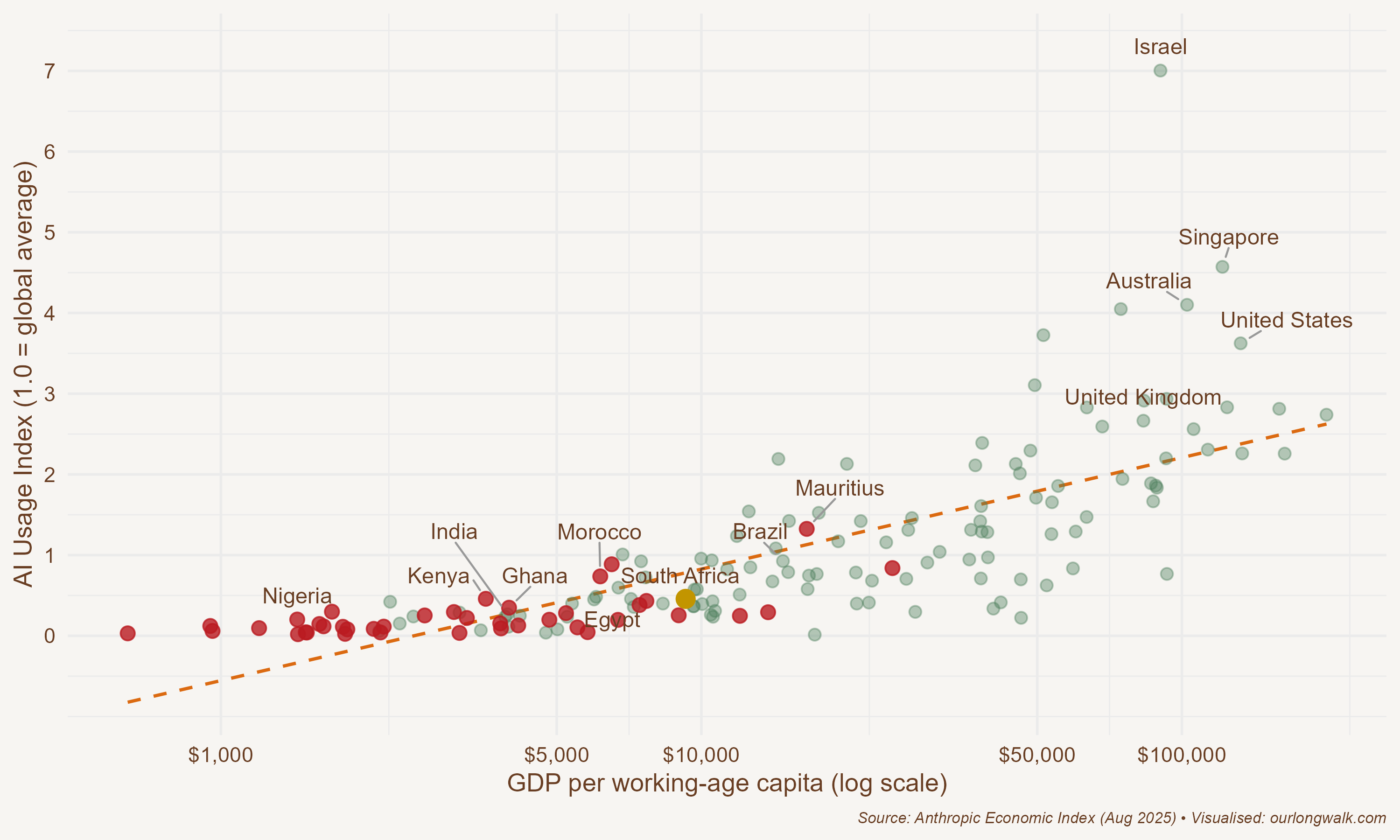
Start with the big picture. Figure 1 plots every country’s GDP per working-age capita against its AI Usage Index – a per-capita measure of how intensively a country’s population uses Claude, Anthropic’s AI assistant. This is an imperfect proxy for overall AI use – it captures one platform rather than the full ecosystem, and likely reflects access constraints as much as underlying demand – but it offers a first, comparable signal. The relationship is stark: richer countries use AI far more. African countries cluster in the bottom left. South Africa, marked in gold, sits at an AI Usage Index of 0.38 – meaning South Africans use Claude at roughly a third of the rate their population size would predict. Israel, at the top, is at 7.0.
This is a familiar story. Technology adoption follows money. It did so with electricity and with the internet – at least initially. The question is whether AI will repeat the same slow diffusion or whether its near-zero marginal cost creates an opening that earlier technologies did not.
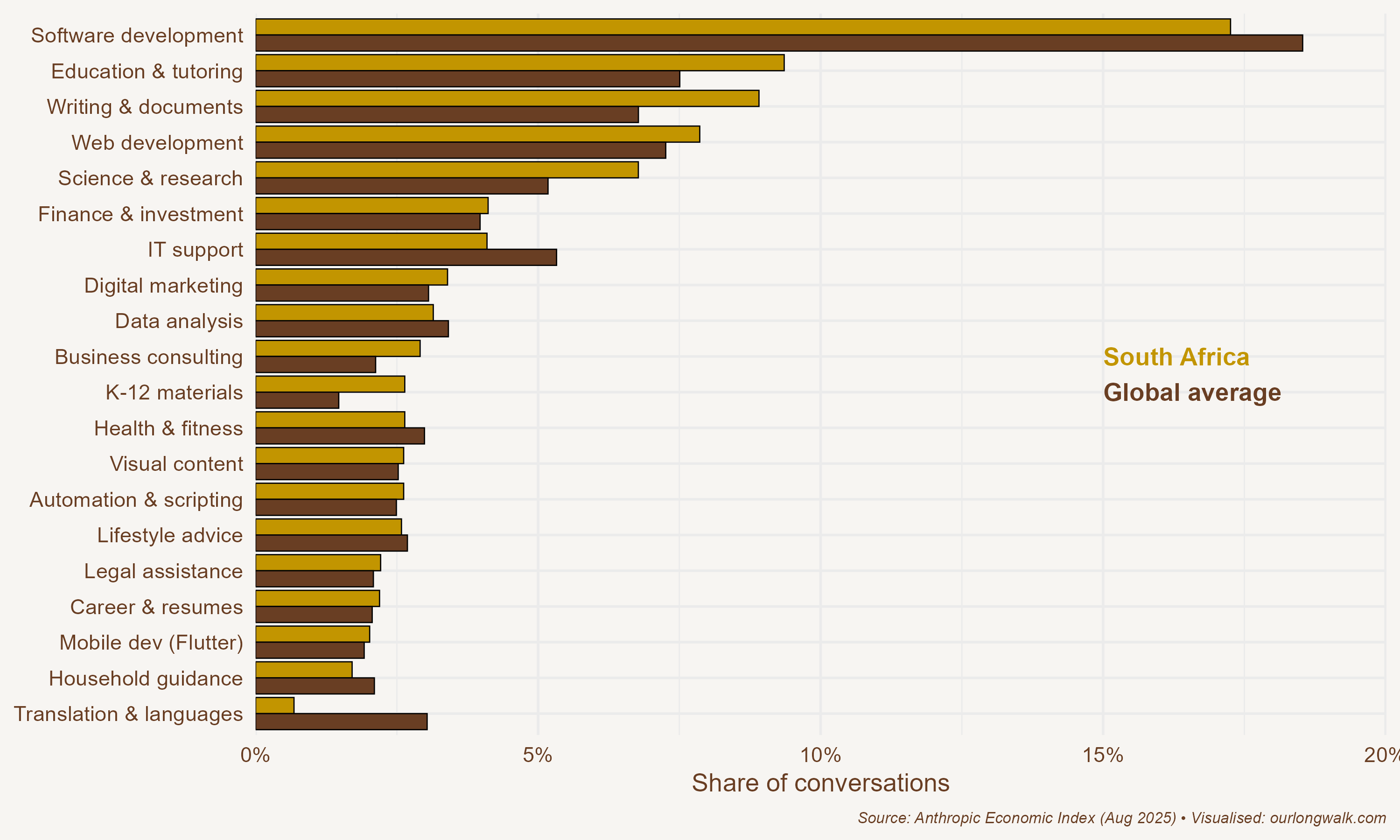
Figure 2 offers a reason for cautious optimism. It compares what South Africans actually use AI for against the global average. Two things stand out. First, South Africa over-indexes on education and tutoring relative to the global average. In a country where the quality of schooling remains desperately uneven, AI is being drawn toward the gap. People are using it as a tutor, not a toy. Second, South Africa has the lowest automation rate in Africa – its usage pattern sits closest to high-income country profiles, with a heavier tilt toward augmentation (iterative, collaborative use) rather than simple delegation. Users are not just asking AI to produce outputs. They are thinking with it.
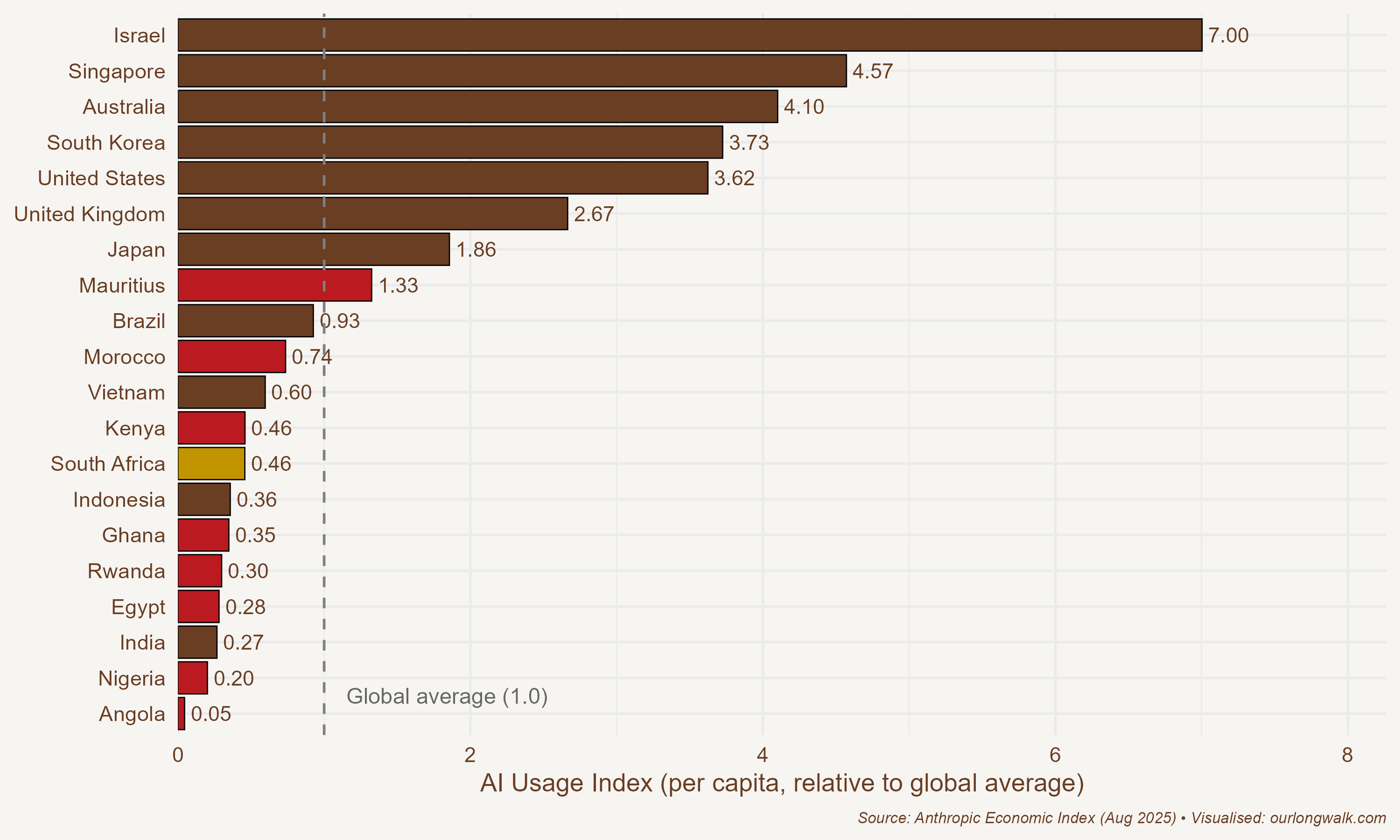
Figure 3 places South Africa’s AI Usage Index alongside a selection of other countries. We sit well below the frontier economies but above most of the developing world. Whether that gap widens or narrows will depend less on awareness than on cost and complementary skills.
Over lunch, Chicago economist Akcigit described a pattern emerging from the early research on AI and firms. The relationship between AI deployment and firm size, he said, appears to be U-shaped. At one end sit solopreneurs and micro-operations – the one-person consultancy, the freelance designer, the part-time preacher. For them, AI is transformative. A single person can now produce outputs that previously required a small team: formatted documents, financial models, marketing copy, basic legal drafts, even rudimentary websites. Adoption is fast because the decision-maker and the user are the same person, and the gains are immediate.
At the other end sit large corporations with deep pockets and IT departments. They buy AI wholesale and manage the transition with dedicated project teams.
The gap is in between. Mid-sized firms – too large to pivot on a whim, too small to afford enterprise AI solutions – face the steepest adoption barriers. They lack internal IT support. The returns are uncertain. The organisational change is daunting.
South Africa’s economy is not characterised by a vast informal sector – that is a common misperception. What we do have is a large number of small, often non-employing firms that struggle to grow. Statistics South Africa’s 2023 Survey of Employers and Self-Employed counted 1.9 million non-VAT registered businesses. Most are sole operators. Almost 70% were started because the owner could not find a job. Turnover is low: more than half earn R1,500 or less per month. But most interestingly, when StatsSA asked these business owners what kind of help they needed, 34.3% said marketing – the single most requested form of assistance, and a figure that has risen by nearly seven percentage points since 2001.
Marketing. That is precisely the kind of task AI can do well and cheaply. A compelling product description, a social media post, a flyer, a customer email – these are outputs that a large language model can generate in seconds, at effectively zero cost, for someone who previously had no access to a copywriter or a marketing consultant. That also applies to business planning, bookkeeping templates, and basic legal documents. The preacher’s experience, scaled across 1.9 million small operators.
Two weeks ago, I interviewed Tyler Cowen – the George Mason University economist, blogger, and podcaster – in a public event at Stellenbosch University. His message to students was blunt.
‘You are the first generation in recent history that really does not know what your future jobs will look like,’ he said.
That uncertainty, Cowen argued, is not a reason for paralysis. It is a reason for investment. When I asked him what he would do if he were, hypothetically, rector of Stellenbosch University, he did not hesitate: ‘I’m pretty sure you all need to make major investments in using AI, teaching AI, and teaching people how to integrate AI into organisations.’
On entrepreneurship, Cowen was optimistic: ‘It will be easier and cheaper to be entrepreneurial.’ AI lowers the fixed costs of starting something – the legal template, the business plan, the marketing material, the website. For a country that desperately needs more entrepreneurs and fewer job seekers, this matters.
None of this means the risks are trivial. Cowen pushed back against a lazy reading of AI as merely a time-saver. ‘Claude or GPT writes the memo for you. That’s great. It frees up your time to write other things where you learn, but don’t think of it as just freeing up your time for leisure. It’s freeing up time to help you truly think on the things that matter.’ At a more macro level, Daron Acemoglu, Akcigit’s co-author and a Nobel laureate, has warned repeatedly about the political economy of AI: who owns the models, who captures the rents, and who sets the rules. The oligopolistic structure of frontier AI – a handful of American and Chinese companies commanding extraordinary resources – concentrates economic power in ways that should concern any developing country.
Computer scientist Chinasa Okolo raises a complementary worry about AI governance in Africa specifically. Who decides how these systems are trained? Whose languages, whose data, whose values are encoded? These are legitimate questions, and they deserve serious institutional attention.
But for a country like South Africa – which is not competing in the AI development race and is unlikely to build frontier models – the strategic calculus points in a different direction. We are consumers of AI, not producers. Ownership still matters, but in the short run the more immediate constraint is whether our people can access and use these tools effectively.
That means cheap and fast internet access, because AI tools are useless if people cannot reach them. It means integration into education, because universities that treat AI as a threat to academic integrity rather than a tool for learning will fall behind. And, perhaps most importantly, it means making AI a government priority – both within government and beyond it.
The United Arab Emirates appointed a Minister of Artificial Intelligence in 2017. That is nearly a decade’s head start. South Africa has rich administrative data, a capable tax authority, and a public that is already comfortable with digital payments. What we do not have is a state that uses these assets intelligently. Consider what AI could do for public services if we let it. A WhatsApp bot that reminds you when your vehicle licence is due – and lets you renew it without visiting a traffic department. A Home Affairs system that reads your supporting documents, flags errors before you join the queue, and tracks your application in real time so you stop phoning a call centre that never answers. A municipal platform that takes a photograph of a burst pipe or a pothole, logs the fault, routes it to the right department, and sends you an update when the repair is scheduled. A business licensing assistant that walks a first-time applicant through the municipal requirements, fills in the forms, tells her which documents to bring, and follows up when the approval stalls – because right now, as StatsSA’s own data confirms, fewer than 11% of informal business owners have a licence, and most of those who don’t will tell you the process defeated them before the market did. None of this requires frontier research. But it does require aligning incentives, building technical capacity inside the state, and sustaining systems once deployed.
The preacher has already figured this out. So have thousands of students, small business owners, and freelancers across the country. The costs of inaction – of falling further behind while the rest of the world integrates AI into daily economic life – are larger than the risks of adoption. The lesson, as usual, is to pay attention to what ordinary people are already doing.
Wow, again what South African students and aspirant entrepreneurs need to take note of, coming from a leading economist at the cutting-edge of AI usage. What an example this professor is setting. Well done, again, Johan...