


Although I said that Friday posts would be delivered only to paid subscribers, I’ve since realised that Substack doesn’t allow this option for free posts. So all free posts – like this one – will go out to everyone, while paid posts – like last Friday’s – will be delivered only to paid subscribers. To make sure you don’t miss anything, please consider a paid subscription.

I teach a graduate course in economic history. Each year, I update the reading list to include the latest, greatest research in the field of economic history, broadly defined. The criteria are simple: as this is a course for Honours (fourth year) and Master’s economics students, I focus on the papers I think best reflect the most interesting (read: best) economic history work by economists. I’ve previously published my reading list for the 2024 and 2025 academic years. Below is my 2026 list.
There are 18 sessions (we usually only have time for 12 to 13 of those). I divide the course into three broad themes: First, a few major historical episodes (like the Industrial Revolution). Then, the roots of growth, in which we focus on things like innovation, trade, human capital. This year, we have split innovation and technology into two: Ideas and innovation, and Technology. There were just too many great papers to fit into a single session. We end with eight session options on Hot Topics: gender, migration, violence, culture, etc. Here, too, there is a new session: Politics! Students usually choose three or four of these.
How do classes work? The first is an introductory lecture by me, with four prescribed papers, and the rest of the sessions are class presentations: a student presents one paper, others critique it, and then I (and teaching assistants) add further comments. We do this four times each session, so 30 minutes per paper for a total of two hours per session.
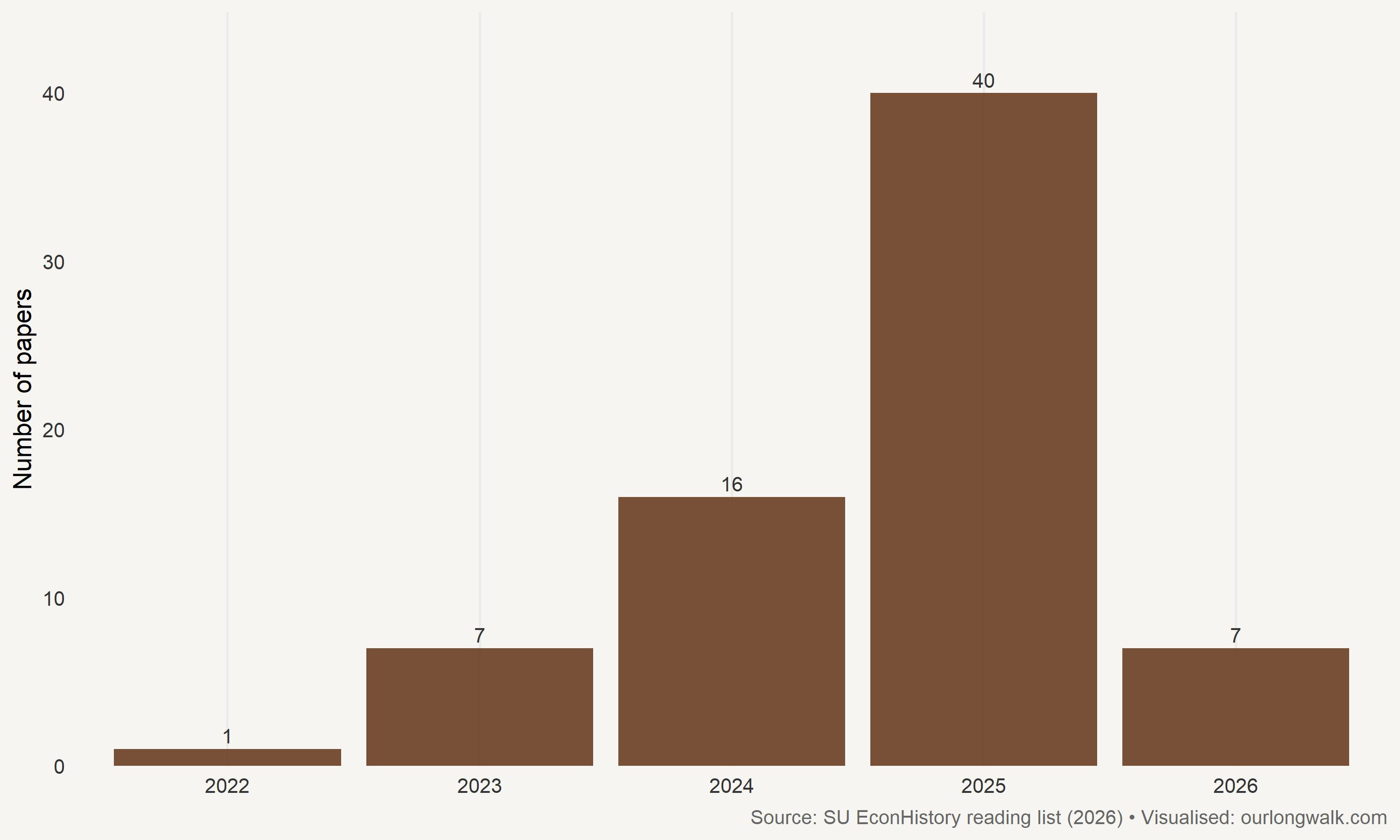
In total, there are 72 papers on the list, with 182 unique authors. (The list of authors is much longer than in previous years, because of the inclusion of this paper.) As the image above shows, I have a strong preference for recently published papers; I don’t think that recent necessarily means the best, but this preference does two things: it forces me to stay up to date with what is new in the field, and it shows students that economic history is, well, not history.
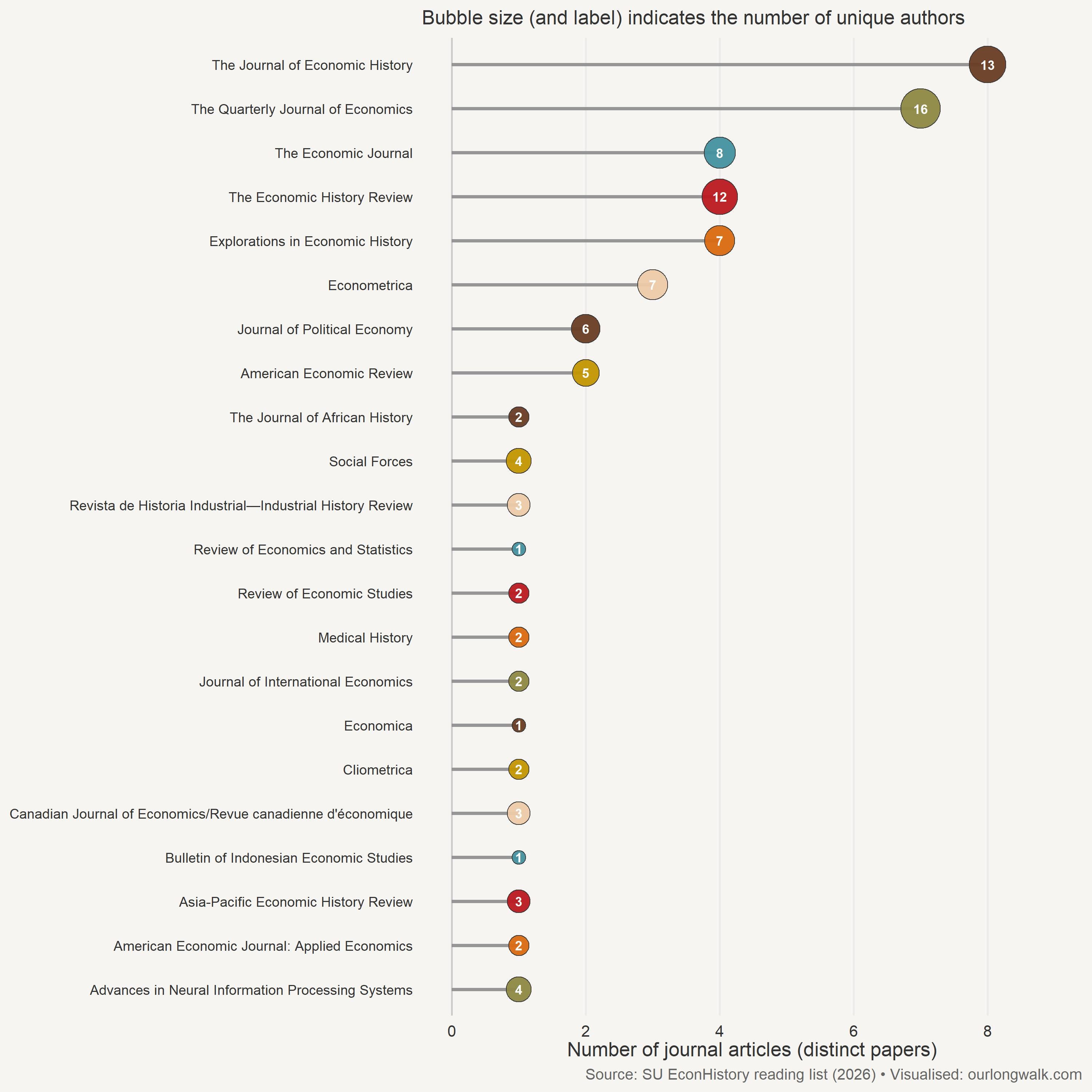
Those 72 papers are mostly published in the top economic history journals – the Journal of Economic History sits at the top with 8 papers – and top economics journals. (I’ve excluded NBER Working Papers, which would sit at the top.) It’s interesting to see where the top economic history is being published: The QJE and EJ (and to some extent Econometrica) are clearly more likely to publish econ history than, say, the other top five. I suspect that has to do with editors: Nathan Nunn at QJE and Sascha Becker at EJ.
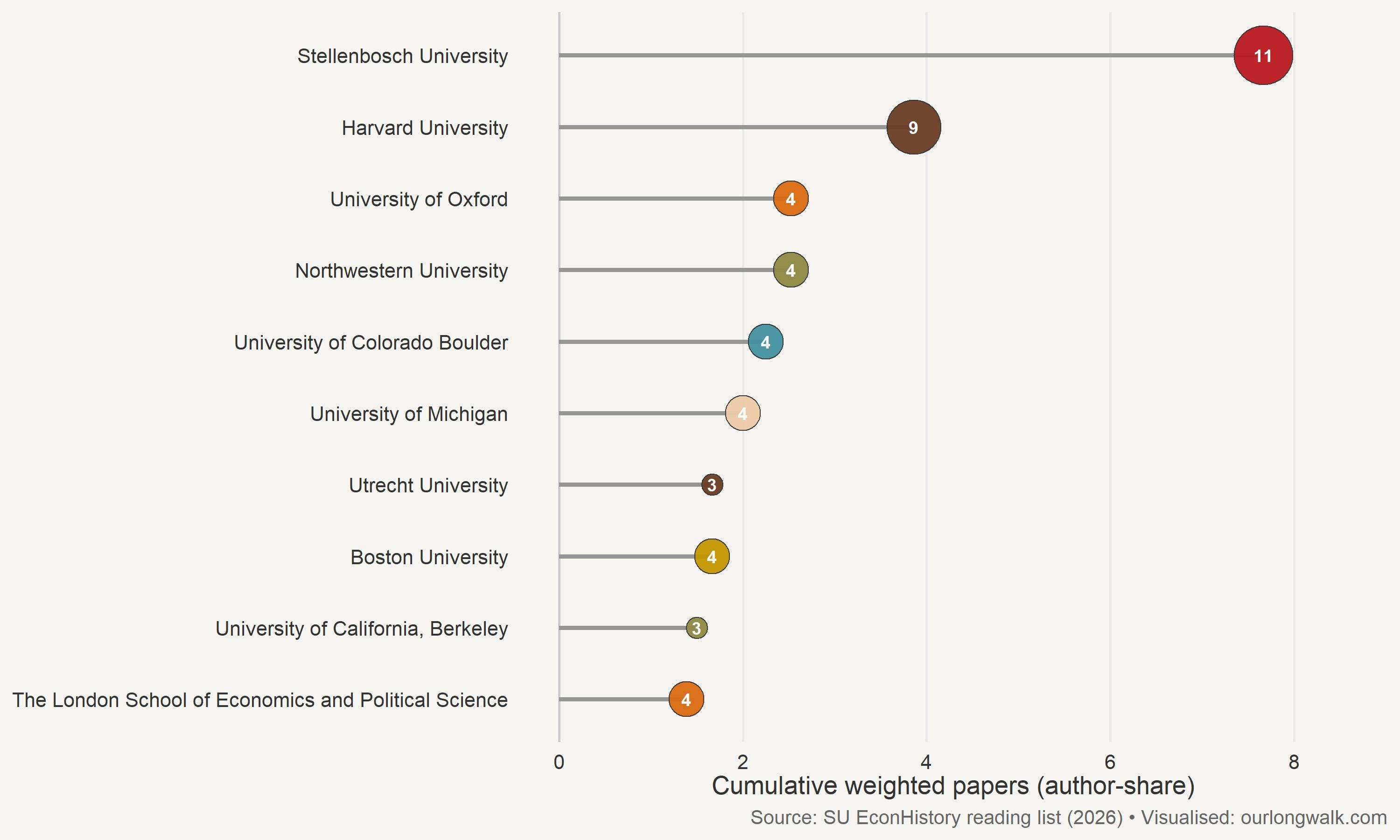
Finally, university affiliation is also interesting. Given that this is a Stellenbosch course, you’d expect that I have a slight bias in choosing Stellenbosch papers. That said, it’s nice to see that we also make up the largest number of unique authors, with 11. The others are no surprise, I guess. I’ll write more about these rankings in a future post.
For students considering selecting EconHistory as their elective, here’s my honest advice: it is a tough course, but, based on student feedback over the years, it is one that students both enjoy and find very useful. This year we’ll also play around with a fun new AI assignment, but more on that later.
So, without further delay, here are, according to me, the latest, greatest papers in economic history:
Intro: The Rise of African Economic History
Hopkins, A.G. (2019) “Fifty years of African economic history”. Economic History of Developing Regions.
Frankema, E. and van Waijenburg, M. (2023) “Bridging the Gap with the ‘New’ Economic History of Africa”. The Journal of African History.
Frederick, K., Juif, D. and zu Selhausen, F.M. (2024) “The revival of African economic history in the 21st century: a bibliometric analysis”. Revista de Historia Industrial—Industrial History Review.
Fourie, J. (2025) “Make African Economic History great again”. Working Paper.
Historical Episodes: The Neolithic Revolution
Matranga, A. (2024) “The ant and the grasshopper: seasonality and the invention of agriculture”. The Quarterly Journal of Economics.
Flückiger, M., Larch, M., Ludwig, M. and Pascali, L. (2024) “The dawn of civilization: metal trade and the rise of hierarchy”. Working Paper.
D’Amato, M. and Russo, F.F. (2025) “Ancient Technological Diffusion and Comparative Development: The Case of Pottery”. Working Paper.
Obikili, N. (2022) “Tubers and its role in historic political fragmentation in Africa”. Working Paper.
Historical Episodes: Slavery
Althoff, L. and Reichardt, H. (2024) “Jim Crow and Black economic progress after slavery”. The Quarterly Journal of Economics.
Bleakley, H. and Rhode, P. (2024) “The economic effects of American slavery: tests at the border”. Working Paper.
Allen, T., Chen, W. and Naidu, S. (2025) “The Economic Geography of American Slavery”. Working Paper.
Bergemann, K., Brown, G. and Fourie, J. (2026) “Running towards: Labour market incentives for enslaved runaways in the British Cape Colony, 1830–8”. Asia-Pacific Economic History Review.
Historical Episodes: Industrialisation
Kelly, M., Mokyr, J. and Ó Gráda, C. (2023) “The mechanics of the Industrial Revolution”. Journal of Political Economy.
Hanlon, W.W. (2025) “The rise of the engineer: Inventing the professional inventor during the Industrial Revolution”. The Economic Journal.
Rosenberger, L., Hanlon, W.W. and Hallmann, C. (2024) “Innovation networks in the Industrial Revolution”. Working Paper.
Lane, N. (2025) “Manufacturing revolutions: Industrial policy and industrialization in South Korea”. The Quarterly Journal of Economics.
Historical Episodes: Colonialism
Kampanelis, S., Elizalde, A. and Ioannides, Y.M. (2025) “Songlines”. Working Paper.
Faguet, J.P., Matajira, C. and Sánchez, F. (2025) “Encomienda, the colonial state, and long-run development in Colombia”. The Economic Journal.
Paik, C. and Vechbanyongratana, J. (2024) “Reform, Rails, and Rice: Political Railroads and Local Development in Thailand”. The Journal of Economic History.
Chiovelli, G., Michalopoulos, S. and Papaioannou, E. (2025) “Landmines and spatial development”. Econometrica.
The Roots of Growth: Ideas and Innovation
Posch, M., Schulz, J. and Henrich, J. (2026) “How Social Structure Drives Innovation: Surname Diversity and Patents in US History”. Journal of Political Economy.
Cinnirella, F., Hornung, E. and Koschnick, J. (2025) “Flow of ideas: Economic societies and the rise of useful knowledge”. The Economic Journal.
Chiopris, C. (2025) “The Diffusion of Ideas”. Working Paper.
Creanza, P. (2026) “Factories of Ideas? Big Business and the Golden Age of American Innovation”. Working Paper.
The Roots of Growth: Technology
Pascali, L. and Miotto, M. (2025) “Solving the longitude puzzle: A story of clocks, ships and cities”. Journal of International Economics.
Feigenbaum, J. and Gross, D.P. (2024) “Answering the call of automation: how the labor market adjusted to mechanizing telephone operation”. The Quarterly Journal of Economics.
Eli, S., Hausman, J.K. and Rhode, P.W. (2025) “The Model T”. The Journal of Economic History.
Ager, P., Goñi, M. and Salvanes, K.G. (2026) “Gender-biased technological change: Milking machines and the exodus of women from farming”. American Economic Review.
The Roots of Growth: The State
Broadberry, S. and Wallis, J.J. (2025) “Growing, shrinking, and long-run economic performance: historical perspectives on economic development”. The Journal of Economic History.
Ottinger, S. and Voigtländer, N. (2025) “History’s Masters: The Effect of European Monarchs on State Performance”. Econometrica.
Henn, S.J. and Robinson, J.A. (2025) “Africa as a Success Story: Political Organization in Pre-Colonial Africa”. Working Paper.
Aneja, A. and Xu, G. (2024) “Strengthening state capacity: civil service reform and public sector performance during the Gilded Age”. American Economic Review.
The Roots of Growth: Human Capital
Curtis, M., De la Croix, D., Manfredini, F. and Vitale, M. (2025) “Academic human capital in european countries and regions, 1200–1793”. Working Paper.
Milner, B. (2025) “The impact of state-provided education: Evidence from the 1870 Education Act”. The Economic Journal.
Atack, J., Margo, R.A. and Rhode, P.W. (2023) “De-skilling: evidence from late nineteenth century American manufacturing”. Explorations in Economic History.
Frankema, E. and van Waijenburg, M. (2023) “What about the race between education and technology in the Global South? Comparing skill premiums in colonial Africa and Asia”. The Economic History Review.
The Roots of Growth: Trade and Globalisation
Carlos, A.M., Green, E., Links, C. and Redish, A. (2024) “Early modern globalization and the extent of indigenous agency: trade, commodities and ecology”. The Economic History Review.
Tadei, F., Aslanidis, N. and Martinez, O. (2024) “Trade costs and the integration of British West Africa in the global economy, c. 1840–1940”. The Economic History Review.
Saleh, M. (2024) “Trade, slavery, and state coercion of labor: Egypt during the first globalization era”. The Journal of Economic History.
Irwin, D.A. (2025) “Trade Policy, Exchange Rates, and the Globalization Surge of the 1990s”. The Journal of Economic History.
Hot Topics: Politics
Anderson, S., du Plessis, S., Parsa, S. and Robinson, J.A. (2025) “The Persistence of Female Political Power in Africa”. Working Paper.
Wang, T. (2025) “The Electric Telegraph, News Coverage, and Political Participation”. The Journal of Economic History.
Cagé, J. and Dewitte, E. (2025) “It Takes Money to Make MPs: Evidence from 160 Years of British Campaign Spending”. The Journal of Economic History.
Machielsen, B. (2025) “Democratization, personal wealth of politicians and voting behavior”. Explorations in Economic History.
Hot Topics: Gender and Demography
Blanc, G. and Wacziarg, R. (2025) “Malthusian Migrations”. Working Paper.
Kim, S. and Moser, P. (2025) “Women in science. Lessons from the baby boom”. Econometrica.
Humphries, J. (2024) “Careworn: the economic history of caring labor”. The Journal of Economic History.
Goldin, C. (2025) “Babies and the macroeconomy”. Economica.
Hot Topics: Health
Bolt, J. and Cilliers, J. (2025) “The expansion of colonial state healthcare in twentieth-century British Africa”. Medical History.
Goehring, G. and Hanlon, W.W. (2024) “How successful public health interventions fail: regulating prostitution in nineteenth-century Britain”. Working Paper.
Antman, F.M. (2023) “For want of a cup: the rise of tea in England and the impact of water quality on mortality”. Review of Economics and Statistics.
Fourie, J., Lemon, K. and Pretorius, J-H. (2026) “Infrastructure, infant mortality and inequality”. Working Paper.
Hot Topics: Mobility and Migration
Ward, Z., Buckles, K. and Price, J. (2025) “Like Great-Grandparent, Like Great-Grandchild? Multigenerational Mobility in American History”. Working Paper.
Boustan, L., Jensen, M.F., Abramitzky, R., Jácome, E., Manning, A., Pérez, S., Watley, A., Adermon, A., Arellano-Bover, J., Åslund, O. and Connolly, M. (2025) “Intergenerational Mobility of Immigrants in 15 Destination Countries”. Working Paper.
Michalopoulos, S., Murard, E., Papaioannou, E. and Sakalli, S.O. (2025) “Uprootedness, human capital, and skill transferability”. Working Paper.
Diebolt, C. and Huesler, J. (2025) “France’s economic wound: how the Huguenot exodus-shaped regional development”. Cliometrica.
Hot Topics: Race, Segregation and Discrimination
Ngalande, T. and Fourie, J. (2026) “Quantifying Apartheid: The impact of labour market discrimination in twentieth-century South African manufacturing”. Working Paper.
Testa, P.A. and Williams, J. (2025) “Political foundations of racial violence in the post-reconstruction south”. The Quarterly Journal of Economics.
Cook, L.D., Jones, M.E., Logan, T.D. and Rosé, D. (2023) “The evolution of access to public accommodations in the United States”. The Quarterly Journal of Economics.
Chan, J., Essaji, A. and Gillezeau, R. (2025) “Railroads, land cessions and Indigenous nations: Evidence from Canada”. Canadian Journal of Economics/Revue canadienne d’économique.
Hot Topics: Violence and War
Archibong, B. and Obikili, N. (2023) “Prison labor: the price of prisons and the lasting effects of incarceration”. Working Paper.
Jaworski, T. and Yang, D. (2025) “Did war mobilization cause aggregate and regional growth?”. Explorations in Economic History.
McGuirk, E.F. and Nunn, N. (2025) “Transhumant pastoralism, climate change, and conflict in Africa”. Review of Economic Studies.
Ochsner, C. and Roesel, F. (2024) “Activated history: the case of the Turkish sieges of Vienna”. American Economic Journal: Applied Economics.
Hot Topics: Culture and Religion
Becker, S., Hsiao, Y., Pfaff, S. and Rubin, J. (2025) “Competing social influence in contested diffusion: contention and the spread of the early reformation”. Social Forces.
Brown, G. (2026) “The Persistent Effects of Bible Translations in Africa”. Working Paper.
Bazzi, S. (2025) “How to Build a Diverse Nation: Lessons from the Indonesian Experience”. Bulletin of Indonesian Economic Studies.
Lagakos, D., Michalopoulos, S. and Voth, H.J. (2025) “American Life Histories”. Working Paper.
Hot Topics: New Sources in Economic History
Silcock, E., Arora, A., D’Amico-Wong, L. and Dell, M. (2024) “Newswire: A large-scale structured database of a century of historical news”. Working Paper.
Xue, M.M. (2025) “Crowd-sourced Chinese genealogies as data for demographic and economic history”. Explorations in Economic History.
Lyons, R.C., Shertzer, A., Gray, R. and Agorastos, D. (2025) “The price of housing in the United States, 1890–2006”. The Quarterly Journal of Economics.
Kerby, E., Moradi, A. and Odendaal, H. (2025) “African time travellers: What can we learn from 500 years of written accounts?”. The Economic History Review.
Given my AI "obsession", I can't wait for more info on this! "This year we’ll also play around with a fun new AI assignment, but more on that later."
Thank you for sharing, Johan! It's a privilege to have access to this catalogue. I'm doing my Masters in Helsinki and can't take a course like this on Econ. History so it's helpful for my own research.