

The invisible hand at the crease
Why Gautam Gambhir's favourite cricket strategy is a myth

The Indian Premier League starts this weekend. Franchises have spent over $200 million in the auction. Analysts have dissected every squad. And somewhere in a Mumbai dressing room, a team strategist is almost certainly arranging his batting order to alternate left-handers and right-handers – because everyone knows that a left-right combination unsettles bowlers.
India’s head coach Gautam Gambhir is a true believer. His assistant, Ryan ten Doeschate, recently explained the philosophy: maintaining a left-right combination throughout the batting order ‘is a big part of how he likes the set-up … we do believe that it’s a big part of strategy in these games.’ Gambhir is not alone. Former South Africa captain Graeme Smith recalled that ‘bowling to the two of us [referring to right-hander Herschelle Gibbs] in a partnership was sometimes very difficult because bowlers had to adapt … to a left-hand-right-hand combination.’ Cricket writers, commentators and fans treat the advantage as obvious.
There is an obvious logic to it: When a left-hander replaces a right-hander at the crease, the bowler must adjust line, length and field placement. The off stump shifts to the opposite side of the pitch. It is not a minor tweak – it is a geometric reconfiguration. Every time the batsmen rotate strike, the bowler supposedly loses rhythm. More disruption, more runs.
But is any of this actually true?
I recently teamed up with my colleague Krige Siebrits to find out. (Our full paper – Invisible Handedness: The Myth of Left-Right Batting Partnerships – is available here.) We downloaded ball-by-ball data from Cricsheet.org covering every men’s international cricket match across Tests, ODIs and T20Is – 96,686 partnerships and roughly 3.4 million deliveries spanning 2001 to 2025. With Claude Code, we ran every econometric test we could think of: regressions with match-by-innings fixed effects, ball-level mechanism tests, survival analysis, quantile regressions and randomisation inference.
The result? Nothing.
The effect of a mixed-hand partnership on runs scored is precisely zero. In our preferred specification, the point estimates are –0.04 in Tests, –0.10 in ODIs and 0.19 in T20Is. None is even close to statistically significant, and we can rule out effects larger than about one run in either direction – roughly 3% of average partnership runs.
Take a look at the first graph. It shows mean partnership runs by hand combination across all three formats. The pattern is striking, but not in the way you might expect. The ordering is LL (both left-handed) greater than LR (mixed) greater than RR (both right-handed). If the switching-cost theory were correct, mixed partnerships should outperform both same-hand types. They do not. Instead, the more left-handers in a partnership, the higher the score. The pattern points to left-hander quality, not left-right hand complementarity.
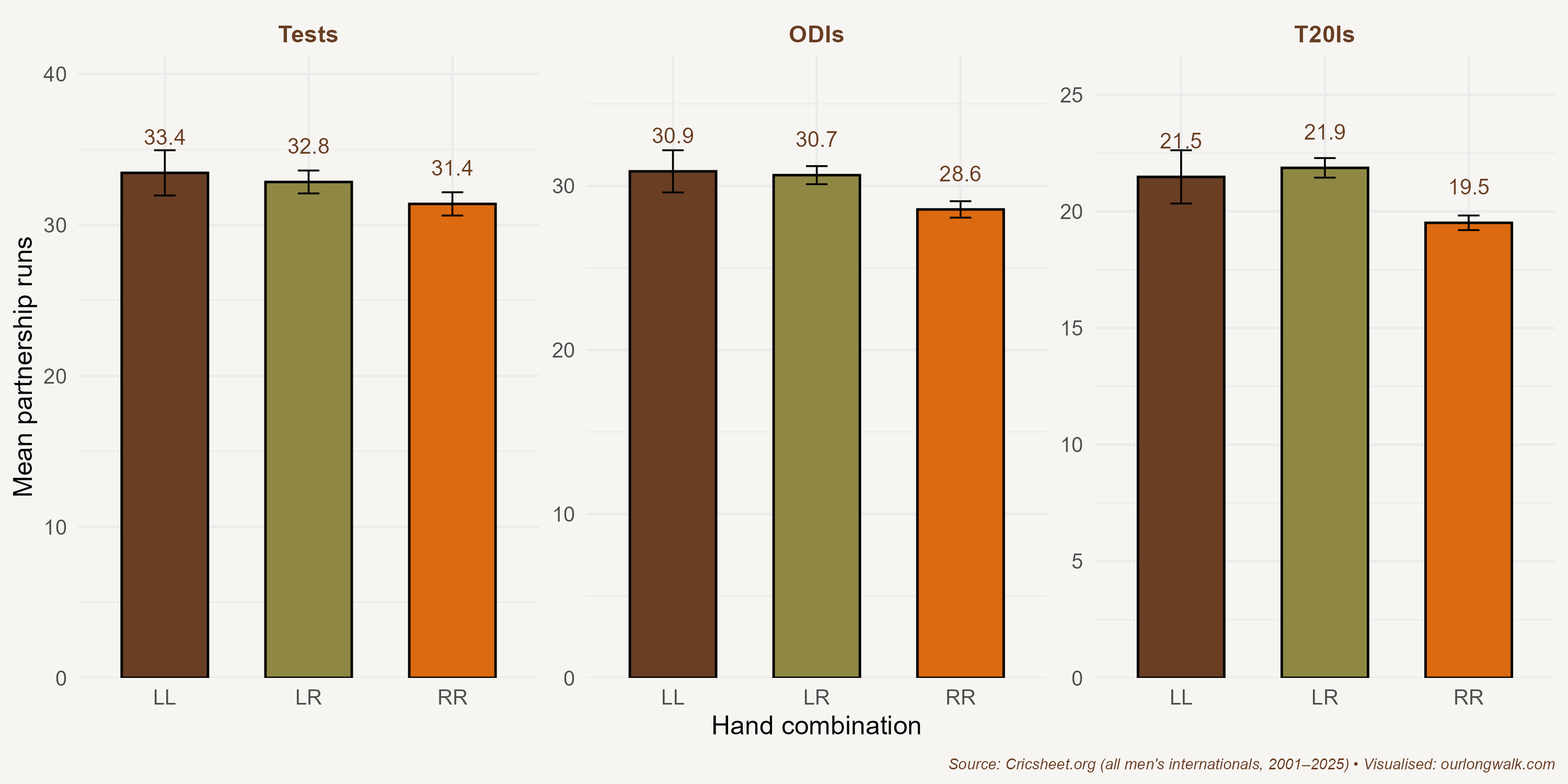
Here’s how to think about it: Left-handed batsmen are scarce at the international level – only 25 to 30% of rosters – but those who make it are positively selected on ability. They benefit from what psychologists call negative frequency dependence: bowlers face them less often, have less practice against them, and find it harder to settle into a rhythm. The raw advantage of mixed partnerships is real in the data. What is false is the causal attribution. It is not the combination that helps, but simply the quality of left-handed batsmen.
An Oaxaca-Blinder decomposition – a technique economists use to separate composition effects from genuine group differences – confirms this. In Tests, the quality of left-handers explains 130% of the raw gap between mixed and same-hand partnerships. Yes, more than 100%. Left-handers’ superior ability more than accounts for the observed difference.
But we went further.
