

The faith of coins
What half a million ancient coins tell us about trust

By the third century of the Common Era, Roman emperors had been stripping silver out of their coins for two hundred years. The denarius that once held three grams of silver held barely a smear by the time Diocletian came to the throne. And yet Romans kept paying with it. They kept accepting it. Long after the silver had largely vanished, ordinary people still trusted the stamp on the face of it. Why?
That has been a puzzle for more than a century. The archaeologist Kim Bowes, on a recent Conversations with Tyler episode, said she now finds it the single strangest feature of the late Roman economy. People knew the coins were debased. They still used them. Even when inflation reached the high triple digits, they kept paying in coin.
A new working paper by Johannes Boehm and Thomas Chaney – titled, plainly, Trade and the End of Antiquity – suggests an answer. The connective tissue of pre-modern commerce was not metal but belief.
Boehm and Chaney have done something remarkable. They have assembled a database of nearly half a million ancient coins, found in more than five thousand hoards buried across Europe, North Africa and the Middle East between AD 325 and AD 950. For each coin they record where it was minted, when it was minted, where it ended up, and roughly when its owner buried it. They then fit those half-million observations to a dynamic model of trade and money, and use the model to recover regional trade flows and consumption over more than six centuries.
They find that the Mediterranean’s relative decline began earlier than the standard story allows. Henri Pirenne, in a famous thesis, dated the rupture to the seventh century, when the Arab conquests sliced the old Roman world in two. Boehm and Chaney push the start date back at least a century, into the 500s, when the Western Roman state was already fraying. The Arab conquests of the seventh century then did something different. They redrew trade. North–south flows across the Mediterranean collapsed at the new frontier between Islam and Christianity. South–south flows, within the Caliphate, flourished. And by the late ninth century, the wealthiest stretch of the ancient Western world had become the Atlantic rim: al-Andalus, Frankish Gaul, the lands that would later become the engine of European commerce.
To put it into perspective: the centre of economic gravity in the Western world shifted northwest seven hundred years before Columbus.
But what does it mean to say a coin ‘flowed’? A bronze follis is inert. Someone trusted it enough to take it in payment, and someone else trusted that person enough to take it in turn. A coin, in this sense, is a token of trust. The economic historian Deirdre McCloskey reminds us that the English word credit comes from the Latin creditus, meaning ‘believed’. To extend credit is to extend belief. Aquinas listed faith as the sixth of seven virtues – above the four pagan virtues of prudence, temperance, justice and courage, and just below love and hope. Romans called it fides, and they treated it as the rule by which alliances were kept and oaths honoured. Carthage, McCloskey notes, was a commercial republic that distributed state revenues to its citizens. Rome ran on fides. Rome won.
When Bowes describes Romans accepting near-worthless silver coins, she is describing fides in action. The denarius worked because people believed the next person would take it. And the next person did. The Roman state was, as she puts it elsewhere in the interview, ‘a mask for an empire of friends and family’ – a network of personal trust, anchored at one end by the mint’s stamp.
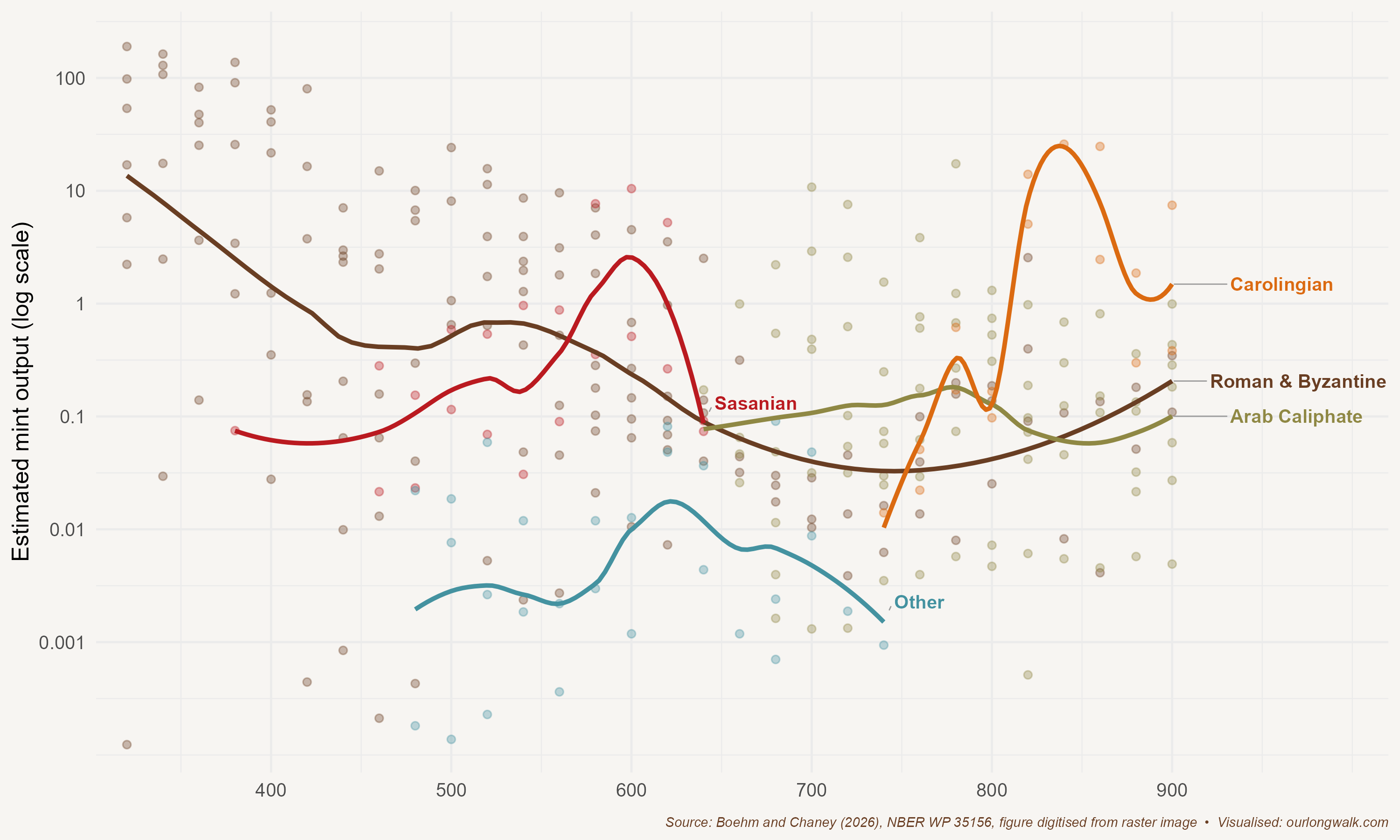
This is what Boehm and Chaney’s data measure. Their estimates of mint output across regions and centuries – the figure above – map where that trust held and where it broke. The faith migrated. Mints in Carthage and Constantinople remained highly productive through the fifth century. Italian mints faded earlier than anyone had thought. The Sasanians sustained a steady silver output until the Arab armies overran them. After the conquests, a new mint network emerged across the Caliphate – Damascus, Cordoba, eventually Baghdad – while the Byzantines pulled production back behind their walls. By the late eighth century the Carolingian mints joined in, a sharp Frankish spike in the data.
Which brings us to a question Boehm and Chaney’s coin data cannot answer. What about a state that minted no coins at all?
Consider the kingdom of medieval Ethiopia.
In a new working paper, Mattia Bertazzini and Andrés Martignano use a regression discontinuity design at the fourteenth-century boundary of the Solomonic state to show that long exposure to centralised Ethiopian institutions raises literacy and urbanisation today, more than five hundred years on. The mechanism, they argue, is property rights – the gult system of feudal grants, under which the king parcelled out the right to collect tribute and the holder owed military service in return – combined with an early structural transformation out of subsistence farming.
What is striking about this state, for our purposes, is what it did not have. There was no professional civil service. There was no fixed royal capital; the Negus toured the realm with his court. And, the authors observe, ‘there was no minting of coins.’ Medieval Ethiopia administered a substantial territory across a difficult plateau for three centuries without striking a single piece of currency.
So what carried credit, in the literal sense, when there were no coins to carry it? The Coptic Church carried it. Royal chronicles in Ge’ez script carried it. The grants of gult land, recorded in monastic archives, carried it. The Negus’s annual circuit of judgement carried it. In Ethiopia, belief was registered in script and ritual. As the historian Isaac Samuel has documented, Ge’ez was one of a number of endogenous African scripts – Meroitic in ancient Kush, the Arabic-derived Ajami along Saharan trade routes – that emerged in dialogue with foreign writing systems but served local purposes: recording grants, asserting authority, keeping count.
Bertazzini and Martignano show that the institutions built on that belief are still producing measurable differences in the 1994 and 2007 censuses – eight percentage points more literate, nine percentage points more urban, on the inside of a line drawn in 1340.
The lesson? The End of Antiquity is, in the end, a story about belief migrating – to new mints in the Caliphate, to new courts and chronicles on the Ethiopian plateau, and eventually to the Atlantic rim that would, much later, come to dominate the world. Coins and chronicles did the same job. They asked one stranger to trust another. Where that trust held, economies functioned. Where it broke, empires followed.
McCloskey would say bourgeois prosperity is the eventual heir to all this. She is right. The long walk to modern wealth begins fifteen hundred years earlier, when a Roman shopkeeper looked at a silver-thin denarius and decided, against the evidence, to trust it.
And sadly, that type of trust is being eroded day after day in South Africa. Who still trusts the current government? Fewer and fewer citizens. Fewer and fewer national and international investors. Hence our inablity to ahieve economic growth, create employment and alleviate mass poverty.
Trust is not gained through policy uncertainty. Trust is totally eroded when politicians in power are corrupt; if they are incompetent and don't keep their side of the social contract by protecting it's citizens, providing them with basic services, and giving their children proper education. A state you can trust look well after the health if it's poorer citizens by means of well functioning health services and facilities.