

The economy under your skin
What ancient DNA can reveal about economic history – and us

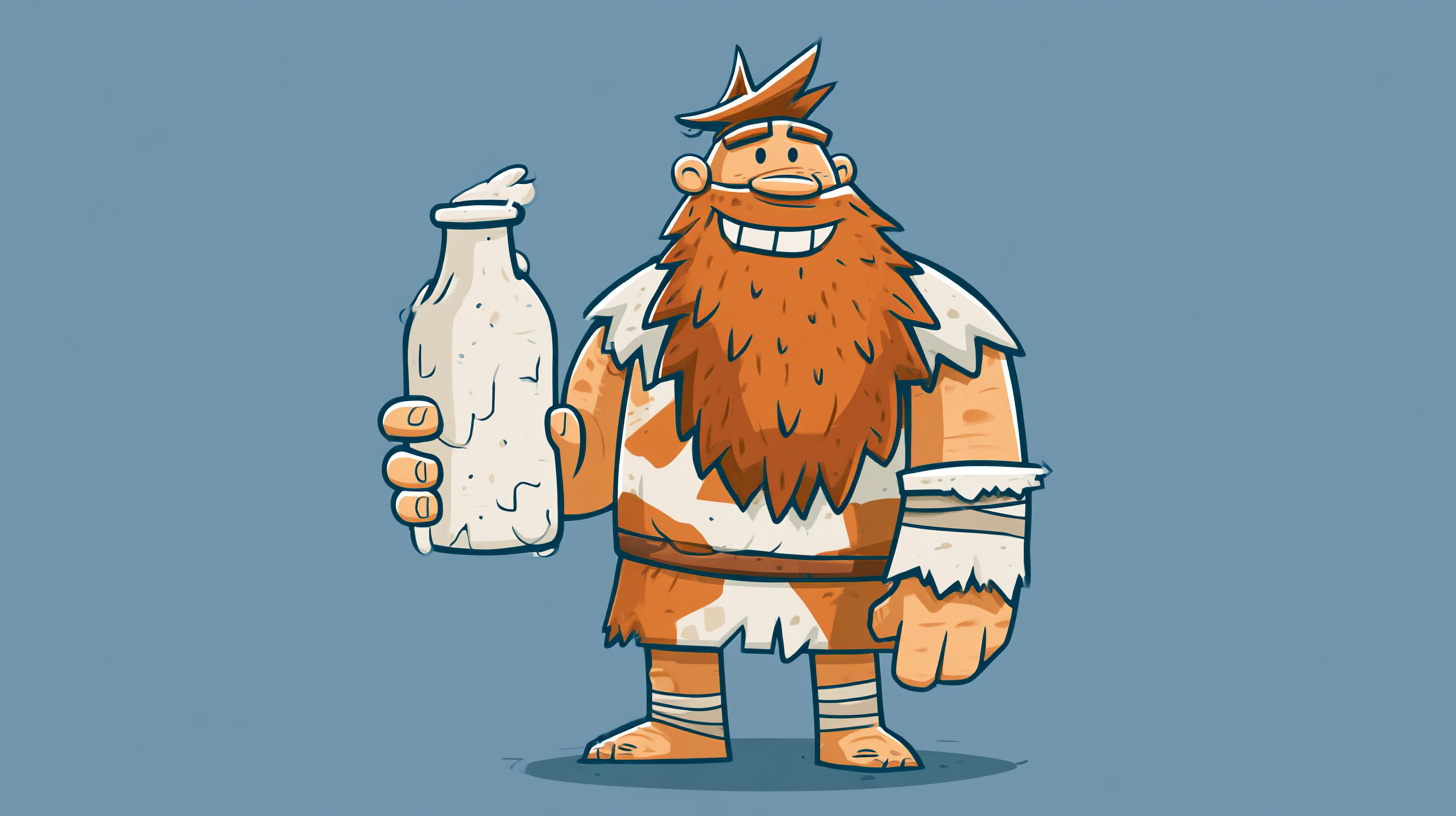
Pour yourself a glass of milk. Whether your body can handle it – whether the sugar in it passes through you or leaves you doubled over by mid-afternoon – was largely settled by an economic decision your ancestors made around six thousand years ago. Somewhere in western Eurasia, people started keeping cattle for their milk as well as their meat, drawing on it day after day through the lean months. Those who could still digest that milk as adults had a little more food, a little more calcium, a slightly better chance of raising children who could do the same. A single change in the DNA near a gene called LCT began to spread. It is still spreading. Most adults on the planet cannot drink milk comfortably; if you can, you are carrying the result of that ancient shift to dairy farming in your DNA.
We do not usually think of the economy as something that changes our bodies. Economics is supposed to work on top of biology: we are born with fixed bodies and fixed appetites, and history is the story of what we do with them. Three papers published this year, all using ancient DNA, show that the biology itself has been changing – and that what changed it was the economy, meaning how people fed themselves.
Today, for the first time, we can measure human evolution as it happened, generation by generation, in the DNA of people who died thousands of years ago. Ali Akbari, David Reich and their colleagues assembled DNA from 15,836 ancient West Eurasians and looked for alleles – individual versions of a gene – whose frequency rose steadily over thousands of years. A steady, one-way rise is what natural selection looks like in the data: a version of a gene becoming more common, generation after generation, because the people who carried it survived and had more children. The old assumption was that human evolution more or less stopped once culture took over. The opposite turns out to be true. Over the past ten millennia it sped up. Their method flagged roughly 479 regions of the genome bearing the mark of strong natural selection – about twenty times as many as earlier studies could detect.
Back up first to the economy before farming. As the economist Ola Olsson put it on the Our Long Walk podcast last year, human prehistory runs in a slow pulse: in warm periods people spread out and their numbers grew, in cold periods they fell back into a few fertile refuges. When the last such cold reversal, the Younger Dryas, forced people in the Fertile Crescent to crowd around shrinking patches of wild grain, some began, half by accident, to cultivate it. The first farms were a response to scarcity.
The ability to digest lactose in adulthood appears to fit the same pattern. Milk-fat residue found in clay pots indicates that humans were likely consuming dairy before lactase persistence was widespread. Fermenting dairy – making cheese and yoghurt, for instance – reduces its lactose content, making it easier to digest. But it was in marginal regions where crops were hard to rely on – high latitudes, high altitudes and drought-prone areas – that dairy became an important ‘fallback’ food. In 2023, Stock and Wells postulated that selection for lactase persistence may have been particularly strong in northwestern Europe because the cold climate inhibited fermentation, making it more likely that raw milk was consumed in periods of famine and disease.
Yet this is just one of the many ways farming changed us. This is the heart of the story, and the figure below, drawn from a new Nature Genetics paper, lays it out plainly enough. Each block is a piece of DNA that changed because of how people lived; the deeper the colour, the stronger the change; time runs left to right, from big-game hunting to the present.
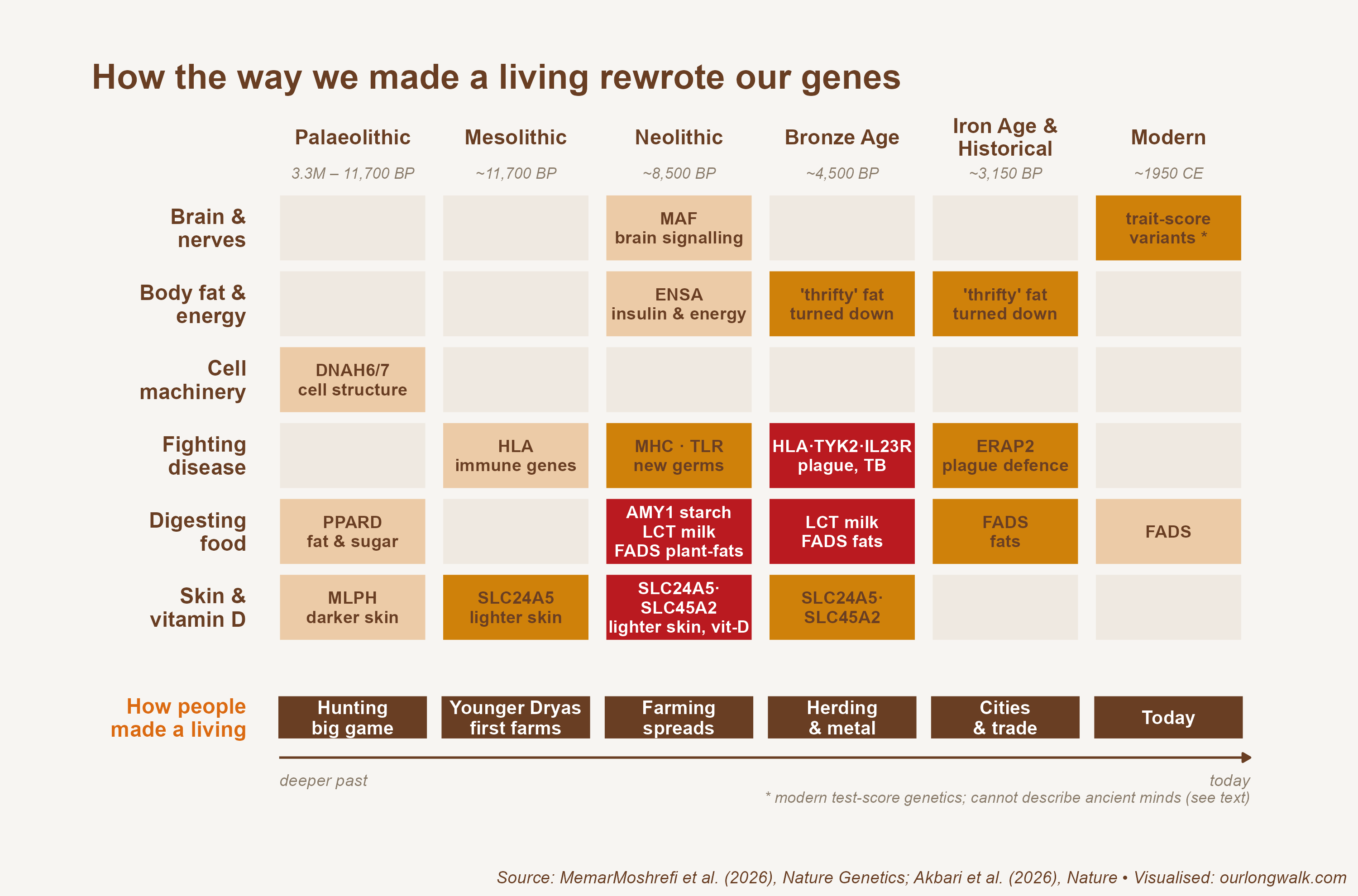
Read it from the bottom up and the argument tells itself. New foods called for new digestion: AMY1 to break down starchy grain, FADS to make scarce fatty acids from a plant-heavy diet, LCT for milk. Farming reduced dietary sources of vitamin D. For humans living under weak European skies, lighter skin improved the body’s ability to synthesise vitamin D, and so genes for lighter skin, such as SLC24A5, became common across the north until they were almost universal. Then people crowded together in villages and, later, cities, living close to their animals – and the immune system came under intense new pressure. Alleles that gave protection against tuberculosis and, later, plague rose and fell as the diseases themselves came and went. One variant, ERAP2, became more common after the Black Death. The coloured blocks cluster exactly where the economic revolutions cluster: at the Neolithic and the Bronze Age. The genome, in other words, is itself a record of economic history.
All of this evidence – the figure included – relates, of course, to West Eurasia: Europe and the Near East, where we have the best ancient DNA evidence. The particular genes are a regional story. Light skin was favoured under cloudy northern skies, and the European milk mutation is only one of several. East African cattle-herders evolved their own, independent lactase persistence; across malarial Africa it was blood variants such as sickle-cell that rose and fell. As Madeleine Bleasdale and others wrote in 2021, though Africa hosts the greatest diversity of genetic lactase persistence, a lack of ancient genomic data means it remains ‘vastly understudied’. Our species’ deep roots are African – the out-of-Africa journey began in refuges like the Cape coast, as Olsson reminds us – yet the ancient genomes we can read best so far belong to the north. The economic logic is universal; the specific genes it changed differ from place to place.
There is a second twist, and it is the one that should most interest economic historians. If the economy shaped our DNA, then that DNA is now a record economists can read back. In a new NBER working paper, Peter Huybers, Marco Tabellini, Charles Taylor and Francesco Toti measure prehistoric migration from genetics alone. When two people buried far apart share a long identical stretch of DNA – what geneticists call identity-by-descent, a segment inherited intact from a shared ancestor – someone in that family line must have made the journey between them. Counting those shared segments across seven thousand ancient individuals, they reconstruct who moved where over ten thousand years, the average genetic link spanning some 1,550 kilometres.
They find that people sorted themselves across the map according to the kind of knowledge they carried. Their model treats subsistence skill – knowing how to grow this crop in this growing season, or graze this herd through this rainy season – as a form of human capital that loses its value the further you carry it from the climate it was learned in. Migration falls off sharply with ecological distance: a standard-deviation difference in temperature, rainfall or soil cuts the flow of people by a fifth or so. And the binding constraint depends on how you make your living. Farmers move to match temperature and soil, and barely care about rain; herders match rain, and barely care about soil. When the world warms, farmers advance; when it cools, herders spread. Maria Elena Castiello and colleagues, using machine learning on 3,416 Neolithic sites, find the same logic at ground level: as the climate shifted, farmers rebalanced their crop portfolios and climbed to ever higher, cooler ground. These are households managing risk and reallocating their effort – ordinary economic behaviour – six thousand years before anyone wrote a price down.
So what is the lesson? We inherit the deep past in two forms at once. The first is knowledge and institutions – the reason, as Olsson and Christopher Paik have shown (and as chapter three of Our Long Walk to Economic Freedom recounts), that where farming and states first appeared still shapes national incomes today. The second is our own DNA. Both were produced by the same thing: the daily work of making a living. Economics usually treats the human body as fixed – the unchanging background against which its story plays out. These findings show that the background itself was changing all along. Which brings us back to that glass of milk. Whether or not you can drink it is a small, personal record of an economic revolution – evidence that the way our ancestors made their living shaped the bodies we still carry today.