

Why sports betting is taking off
'Teeming and lading', again

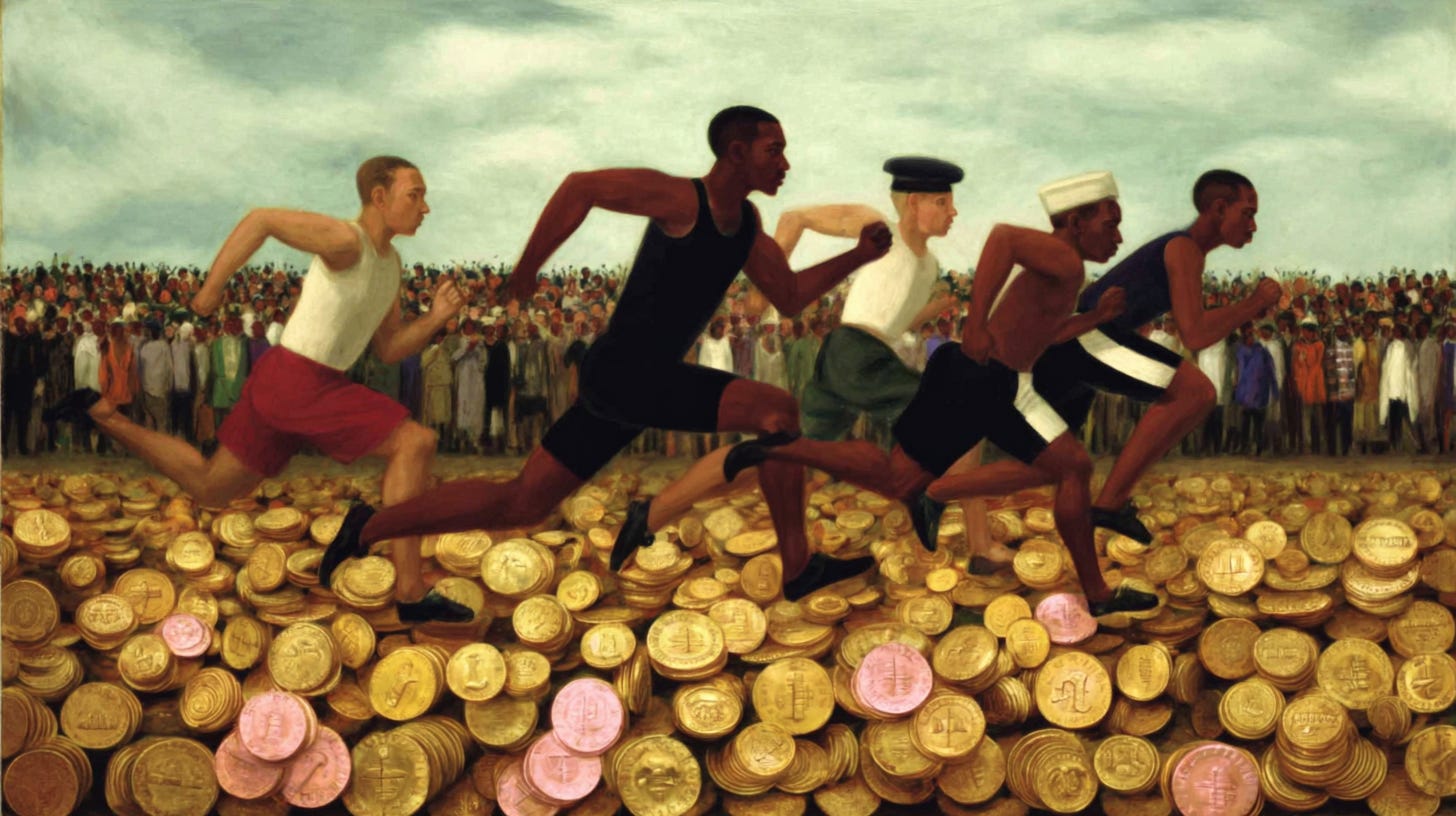
‘Here everyone bets’, explained a London club steward to a racing journalist around 1890, ‘everyone from the City to the West End; the cabman who brought you from the railway station, the porter who took your hat, the man who sold you that copy of the special Standard, all bet.’ Historian Ross McKibbin uses the story to mark a moment when gambling moved from the preserve of the aristocracy and became a mass working-class pastime in Britain. The electric telegraph, cheap racing papers and a clearer division between work and leisure made it possible – and the steady rise of wages made it affordable.
By the turn of the twentieth century, sports betting had become part of everyday life in England. Bets had, of course, long been a hobby of the leisure classes, but the spread of shift work and the Saturday half-day suddenly afforded working-class people the time to stand in queues at the track, crowd around street bookies, and pore over racing form. Betting also offered more than entertainment: it was a way for people with irregular, insecure incomes to dream of a lump sum large enough to buy furniture or clear their debts.
Today, a similar revolution is happening in South Africa. Fly into Johannesburg’s OR Tambo International Airport, as many of the G20 delegates did late last year, and you’ll see giant posters of betting companies, with celebrity sports stars selling the dream of instant wealth. It is easy to dismiss this as advertising excess, but the numbers behind it tell a different story. South Africa’s National Gambling Board reports that in the latest financial year sports bets worth about R1.25 trillion were placed – a turnover equivalent to almost 40% of what households spend in a year. That figure double-counts the same money as it is wagered again and again, so it overstates how much really leaves family budgets. But we can compare spending on sports betting to other items, as reported by South Africa’s statistical agency Stats SA. South Africans spend ten times more on gambling than on gym fees, twenty-three times more than on books, and almost eighty times more than on video games or movie tickets. Or compare what the industry actually earns. Bookmaker and online gambling services generated R152.6 billion in 2023, roughly a third of all revenue in the personal services industry and almost as much as the entire health-services sector.
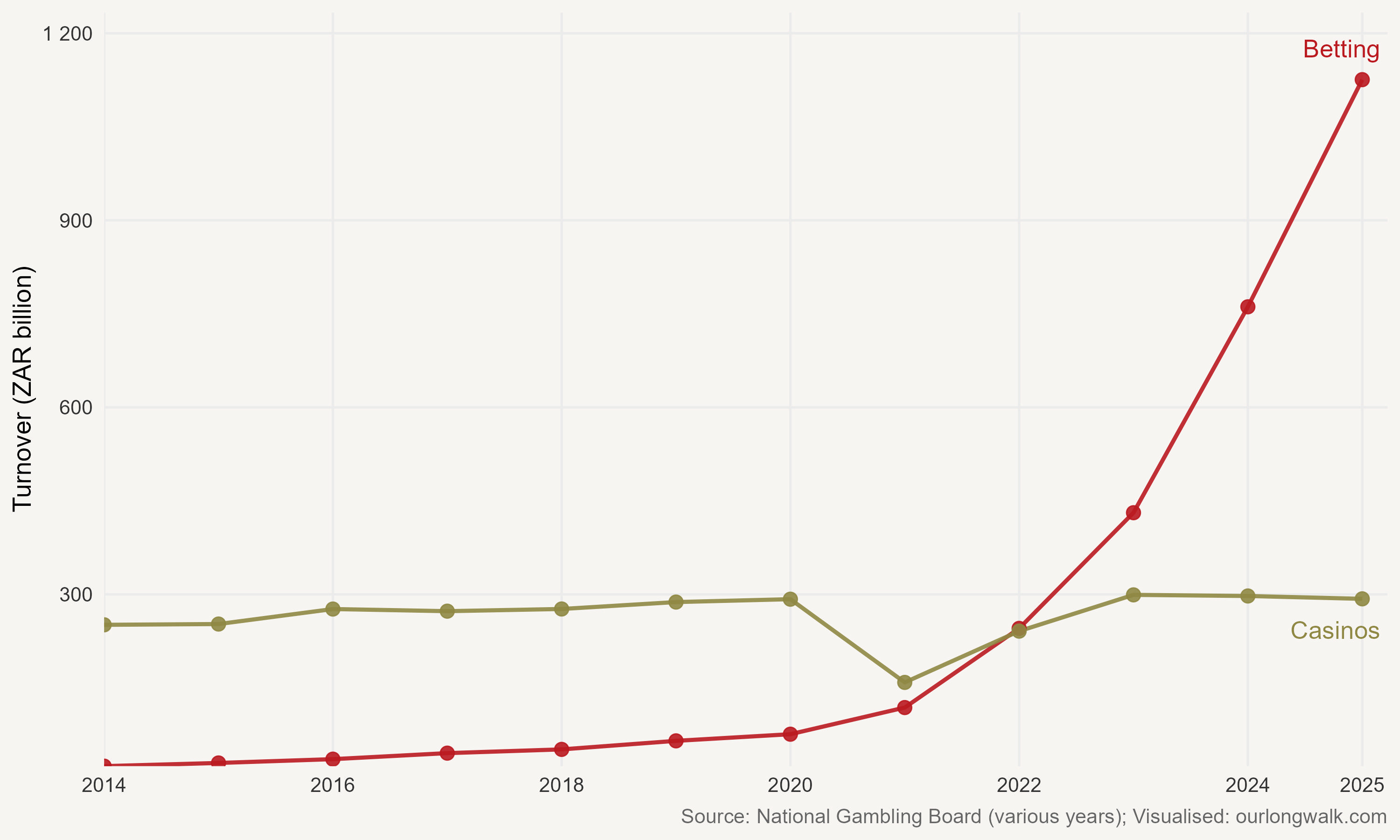
It is hard to grasp just how quickly this has happened. In 2018, gambling services generated just R10 billion, implying a fifteen-fold increase in five years. Over the same period, casino turnover has remained roughly constant just below R300 billion, while sports betting turnover rose from R51 billion in 2018 to the R1.25 trillion I mentioned earlier – an annual increase of about 55%. And, as the graph below shows, the trend does not seem to be abating. Quite the opposite. In November last year, South Africa’s National Treasury acknowledged this boom by releasing a draft discussion paper on a national tax on online gambling. The paper proposes a national levy on the gross gambling revenue of online betting, sitting alongside existing provincial taxes, to bring private profits closer to the social costs of problem gambling. It invites public comments until the end of January 2026.
This pattern is not unique to South Africa. Across the African continent – and, in truth, globally – sports betting is gaining popularity at a remarkable pace. The question is why.
One obvious answer is technology. A smartphone, a mobile-money account and a betting app now allow a 20-year-old in Nairobi, Lagos or Soweto to place a live bet on a Champions League game, with no bookmaker and no cash, and then share it with friends over WhatsApp. Economist Laura Barasa’s recent lab-in-the-field experiment with Kenyan gamblers shows how powerful this combination is: warning messages on a betting interface can reduce the amount wagered by about 8% and the number of rounds played by 4%, but once peers are involved – talking through odds together – that restraint weakens and people play more rounds again. Technology has made betting both frictionless and social.
But technology is only the proximate cause. The deeper story looks remarkably like the one McKibbin told about Britain. Sports betting thrives where incomes are volatile, formal saving is hard, and big, ‘lumpy’ expenses – school fees, a new roof, a car – are out of reach of most people. In Kampala, economist Sylvan Herskowitz followed more than 1 700 sports bettors. He shows that their targeted payouts match the size of upcoming lumpy expenditures and that when they do win, they disproportionately spend the money on those big items rather than on everyday consumption. When he gave a randomly chosen group simple savings boxes and budgeting tools, their demand for betting fell.
Betting, in other words, functions as a second-best savings instrument: an expensive, risky way of generating liquidity when other options are worse.
A new American study by economist Scott Baker and co-authors suggests that this is not just an African phenomenon. Using millions of transaction records around the staggered legalisation of online sports betting in US states, they show that when betting apps arrive, households do not cut back on other gambling or on restaurant spending; instead, they reduce deposits into investment accounts and run up more credit-card debt and overdrafts. The crowding-out of saving is strongest among financially constrained households.
So we have three pieces of evidence that fit together. Historically, in Britain, working-class gambling emerged as wages rose just enough to create disposable income, but not enough to eliminate insecurity. Betting became, in McKibbin’s words, part of the ‘teeming and lading’ of working-class finance: money going round and round in an informal cycle of debt, credit and occasional relief.
But winnings also circulate in another currency: status. McKibbin quotes an inter-war observer who noted that a man ‘who has been lucky enough to win money in the pool acquires thereby a definite social standing, and his views on very different matters are heard with respect’. The same is true now. Listening to students at the South African university where I teach, I realised that sports betting has become a status game: groups of friends go out at night, each placing their bets; the winner pays for the evening’s drinks. On campus, the one who lands a big multi-bet is briefly the cleverest person in the classroom.
Barasa’s Kenyan experiment confirms such anecdotes. Once friends start swapping tips and arguing about odds, betting begins to feel ordinary, even respectable, and the sober warnings about addiction fade into the background. The adverts at OR Tambo tap into exactly that status impulse: it’s not necessarily about the money, but about the wish to be the one who calls it right, to rise above your circumstances, even if only for a moment, and have everyone look your way.
Where does this leave policy? It is tempting to treat sports betting purely as an irrational addiction and to respond with prohibition or moral panic. The historical and contemporary evidence suggests a more uncomfortable conclusion. The rapid rise of sports betting in much of the developing world is a symptom, just as in early twentieth century, of deeper confluences: new technologies, thin savings instruments and, most importantly, rising aspirations of upward mobility. In that context, a R50 bet on a seven-leg accumulator is a shot at jumping a queue that seems to be moving too slowly.
An edited version of this article was published on News24. Support more such writing by signing up for a paid subscription. The image was created with Midjourney v7.