

Running towards
How economics can help us understand even the bleakest of histories


Meet Carel. In February 1834, on a farm outside Worcester, a 55-year-old enslaved coppersmith slipped his owner’s grip and disappeared. He had done it before. Sometime, somewhere along the way, he had picked up an Irish-sounding alias: ‘Mr Paddy’. Under that Irish pseudonym he hired himself out to one employer after another – a forge here, a building site there – living and working as if the law had never named him another man’s property. His owner, Schalk Willem van der Merwe, eventually placed an advert in the Government Gazette of 7 March 1834. It listed Carel’s height, his bald head, the burn marks on his arm, the fluency of his Dutch. Van der Merwe never recovered him. The next entry in his slave register simply ends.
Why did Carel run when he did? You can answer that with cruelty. You can answer it with longing. Both answers are true, and both are insufficient.
In a paper just published in the Asia-Pacific Economic History Review, Karl Bergemann, Gabriel Brown and I offer a third answer that sits alongside those other two. Carel ran when he did because the labour market had shifted under his feet – and he was the kind of man best placed to take advantage of the shift. Here’s why it matters: even under the most brutal of institutions, people still respond to economic incentives. Histories that ignore those incentives end up underselling the agency of the very people they want to honour. Economics, used carefully, gives us a lens onto choices that the archive otherwise leaves dark.
Start with a simple question. Why does anyone bother to coerce labour at all? It is, after all, expensive. You have to pay for overseers, walls, advertisements, recapture. The economist Daron Acemoglu and Alexander Wolitzky asked exactly this in a 2011 paper, and their answer is short: coercion pays only when workers have nowhere better to go. The moment a worker’s outside option – the wage they could earn somewhere else, the place they could blend in, the legal crack they could slip through – improves, the maths of coercion changes. The cost of holding people in place rises. People start to leave. Owners start to look for cheaper ways to get the work done.
That gave us a sharp, testable prediction for the Cape in the 1830s. Britain’s Slavery Abolition Act came into force at the Cape in December 1834, but it did not deliver freedom on that day. Instead, it began a four-year apprenticeship: the legal status changed, but the work continued. Wage labour, however, started to expand. Free Black and Khoe workers were already moving across the colony as masons, harvesters, wagon drivers, smiths. Recaptured Africans were finishing their indentures. Punishment books and guardian offices were chipping away at owners’ arbitrary power. None of this added up to liberation. It did, however, add up to a real improvement in the outside option for someone bold enough to try the wage economy without permission.
If the model is right, the most skilled enslaved people should have been the ones who ran first after December 1834. They had the most to gain by selling their hands as free workers. The least skilled, by contrast, should not have run any more than before – and might even have run a little less, since full freedom was now only four years away.
Testing this needed two pieces of data that nobody had ever combined before.
The first was a hand-built dataset of 689 runaway adverts placed between 1830 and 1838 in the colony’s two leading newspapers, De Zuid Afrikaan and the Cape of Good Hope Government Gazette. These adverts are not perfect. Owners only paid to advertise the runaways they thought worth recovering. But for the people they did describe, they described in detail: name, age, skills, clothing, the names of farmers who had hired them, even the pseudonyms they used.
The second was the Cape’s slave emancipation dataset, compiled from valuation rolls drawn up in 1834 to calculate the compensation paid to owners. Every enslaved person on it has an official price. That price was set by assessors using auction records: skilled workers were valued more, unskilled less, the sick and elderly less again. Imperfect, yes. But for our purposes, valuation is a usable proxy for the wage someone could plausibly earn outside slavery. We matched 344 of the runaway adverts to individuals in the emancipation dataset.
That gave us the building blocks of a difference-in-differences design – a workhorse tool of empirical economics. The idea is straightforward. Take two groups: one expected to respond to the change (high-valuation enslaved people) and one not (low-valuation). Compare how their escape rates moved before and after December 1834. The ‘high minus low’ comparison sweeps out anything common to both groups – weather, harvest cycles, the colony’s wider unrest. What remains is the differential response. That residual is what the model says should jump.
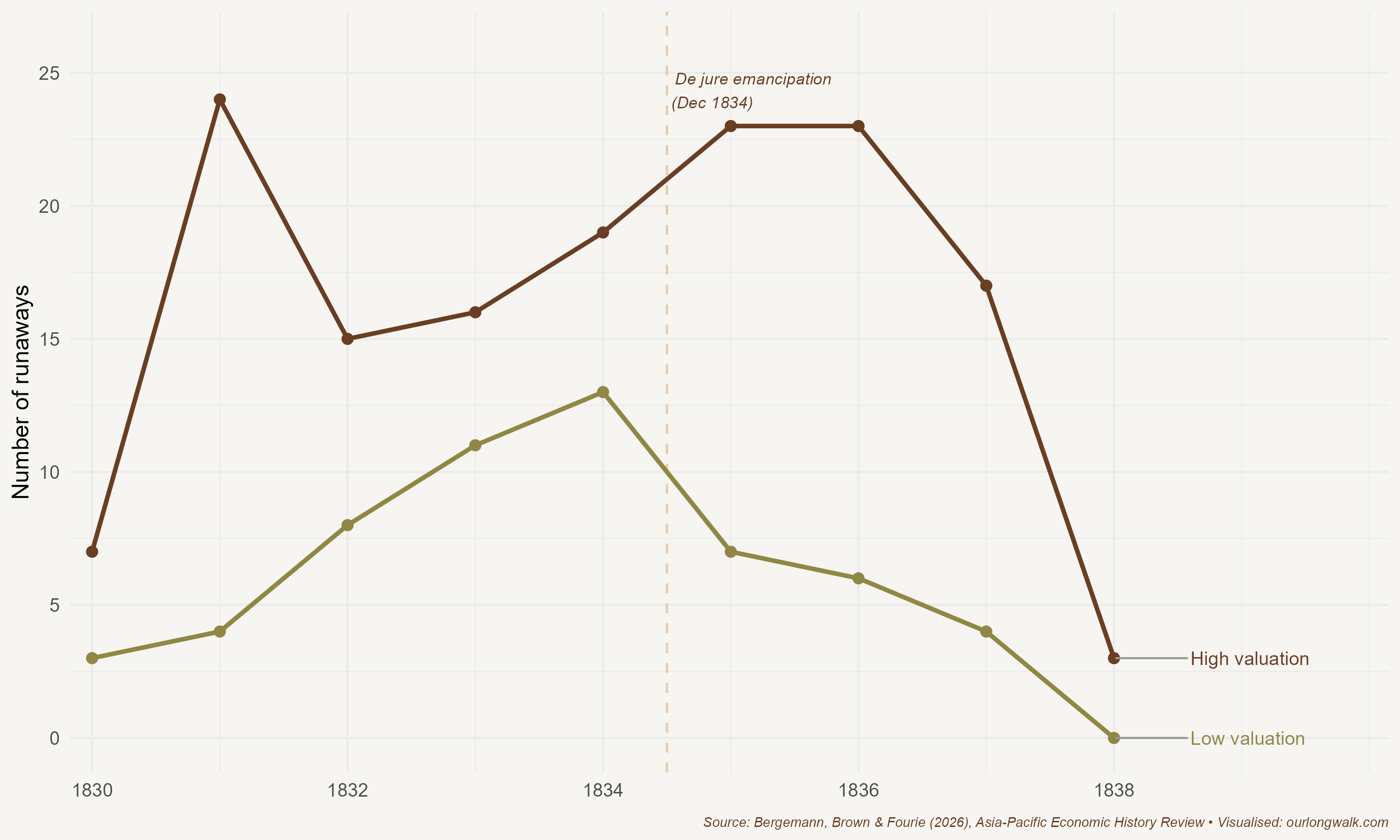
The picture is the argument. Before 1834, the two lines move roughly together. Both rise as the 1830s wear on. After December 1834, they separate. Escapes among low-valuation enslaved people drop sharply: they no longer have much to gain from a dangerous flight when legal freedom is only a few years away. Escapes among high-valuation enslaved people, however, stay high for two more years – before falling again as 1838, the date of full emancipation, comes within sight.
Translated into numbers: across the full 1830–1838 window, the diff-in-differences estimate is a 38 to 61 per cent rise in escapes for the higher-valued group, depending on the specification. But this average understates the moment itself. When we zoom in tightly on the months either side of December 1834 – using a separate technique called regression discontinuity in time, designed precisely to catch sharp breaks – the high-valuation jump is over 100 per cent above the pre-emancipation mean. The effect then fades, gradually, as full freedom approaches and the gain from running early shrinks back to nothing.
In short: when freedom-on-paper arrived in December 1834, the people best placed to earn a wage outside slavery moved first. The model called the shot.
It is entirely reasonable to push back here. Does this mean cruelty did not matter? Of course it does not. The sheer number of low-valuation runaways – women, children, the elderly, the unskilled – is testament to the desperation that drove flight throughout the colony’s history. Our estimates capture only the marginal response to a change in incentives. They do not, and cannot, explain every flight. The data have their limits too: adverts only record runaways their owners thought worth advertising; valuations capture skill imperfectly; and we cannot cleanly separate the channels through which outside options improved – legal reform, expanded wage demand, easier passing as free.
What the result does say is that even under chains, the calculus of the labour market reached the people inside it. Carel’s flight was not random. It was the choice of a man with rare skills, walking towards the place those skills could feed him.
Economics is often accused of speaking only about prices and markets, and of having little to say about the parts of life that actually weigh on us. Slavery is the hardest case. And yet here it is the economic lens – outside options, incentives, marginal response – that lets us read a fragment of the lives of people the colonial archive usually buries beneath the words of their owners. Those people noticed when their world changed. They acted on the change.
That is the discipline at its best: a way of taking seriously the choices of people in markets, including the people the law refused to count as people. We have many of these stories still to tell. Karl is currently writing a book that will tell more of them.
This article is extremely well-written, and insightful in its reading, to say the least.
The vectors prior and post Dec 1834 [de jure emancipation] until Dec 1838 (de facto emancipation) has a strong cognitive-retention-echoing-effect once one reads the article in the Asia-Pacific Economic History Review. The arguments being made, enforces a point of distinct reflection, especially when encompassing the vector birthed between the stratification of de jure and de facto.
The vector image from the ‘Runaway by year and valuation’ graph (FIGURE 2, page 14), reminds one of the Michael Zibulevsky analogy in a recent article (1), which could (potentially) be analogous to the 'Carel-narrative' in the ‘Running Towards’ article with a much deeper resonating context in today’s not-so-objective space of many ill-constructed world views. In Michael’s article, an effective analogy is deployed to describe the composite reflective nature of the mirrors produced on a nano-scale by Carl Zeiss SMT in Oberkochen, Germany:
‘’Imagine a mirror the size of a dinner plate, polished so perfectly that if you scaled its surface to the size of Germany, the tallest imperfection would be less than a millimeter high. It must reflect 13.5-nanometer extreme ultraviolet light without absorbing or scattering a single photon. Each one takes 18 to 24 months to produce. Only a handful of people on Earth know how to make them.
These mirrors come from Carl Zeiss SMT in Oberkochen, Germany. They are the irreplaceable heart of every ASML EUV lithography machine — the machines that print the 2-nanometer transistors powering AI chips, Tesla’s Full Self-Driving computers, Optimus robots, and the coming wave of orbital AI satellites. Without Zeiss optics, ASML’s machines do not work. And without ASML’s machines, the entire modern semiconductor industry stalls. ‘’
It is my sincere view, that a self imposed standstill by any modern leader within the boundaries of such Runaway-vector – being equipped with self-reflective mirrors – is diagnostically well suited as catalyst for identifying a weakness of argument, when allowing opportunity for long aperture. A mere reading of ‘Carel’ or, ‘Marthinus’, or any others in this story and not allowing oneself as reader to pause, would be unjust to the gist of the related article, as it demands such pause. This article provides a mirror for cognitive introspection, though it certainly would require a blend of intent and a will, in order to do so – which regrettably, in a South African context, is often glaringly amiss in many aspects.
In the main article, many aspects stood out, and if one may mention a few:
• “...coercive rights are rooted in deeper power structures...”,
• ‘‘...endogenous shifts in marker conditions contributed to the erosion of coercion over time....”,
• “... Our findings challenge the familiar narrative that frames escapes solely as acts of resistance to cruelty or poor treatment...”,
• “Enslaved labour was more than a source of labour for agricultural production; it was also the backbone of the entire colonial credit and financial system. Slaves were often used as collateral in private credit markets, becoming a crucial capital asset that underwrote loans and investments, thereby facilitating the expansion of settler agriculture and the broader colonial economy”
Stemming from just these excerpts (and there are many more deductions), the much larger narrative engulfing the 1830-1838 time frame, bridges constraints of time and space. The answers are entrenched in the highly perceptive ‘vector space’ arising from the building blocks in the empirical economics analysis, and some deductions can clearly be made relevant to modern spaces as well, namely -
• Embedded power lives in structures.
• Embedded power lives in market conditions.
• Embedded power lives in sensible healthy analysis, and can alter trajectories.
Years before, I was invited to attend a Board meeting of a JSE-listed entity in the capacity as acting Public Officer - which yields the impetus to one’s frames-of-mind in this writing.
In the Afrikaans-language, there is a well-known saying “Die vreemdeling wat by julle vertoef, moet vir julle wees soos ‘n kind van die land wat onder julle is. En jy moet hom liefhê soos jouself, want julle was vreemdelinge in Egipteland..” My deduction always was, such ‘vreemdeling’ would include a person in any space and at any time, and such ‘’parallel’ should not be strange as one of many considerations towards spaces employed in logic cognitive reasoning, and hence not be excluded from secular spaces in its application, and in particular with reference to spheres of apparently democratic values, free economic markets and impartial judiciary frameworks.
And without specifying details, I realised – and learned - that none of its Board Members or Senior Management, past or then present or now present, ever truly had subjected the ‘will’ to walk into footsteps of the past, or had envisaged the 'self' as if standing within the boundaries of de jure and de facto stratifications. On paper, a Board may seem to have a fully-fledged BEE-imprint; in ‘auditory terms’, the conversations and presentations may echo a polished and sophisticated elegance of intelligence and thought; in ‘visual terms’, the visible may follow the auditory with near-perfect synchronisation; but coming from the ‘Evidence Room in Titanic’s-Belly’ on a plant level far removed from ‘Sandton Board Room talk’, the pace can be too fast for a Maiden voyage of Transformation: skill sets are not built overnight, or in a week or two, or in certain aspects in a year or two or even five or ten in unique aspects; decision making cannot be based on the weather only, but on information from a captain willing to visit all tiers of the ship, including the engine room, and the outer posts on the ship, and doing so quite often.
Leaders unwilling to learn lessons from the world in the past – whilst economic indicators are prophetic signals – will only learn when history transmutes into ‘vector mirrors’ as large as Germany, once a Damascus-Light with blinding force exposes ill-equipped spaces-of-cognitive-of-function, with a total disregard towards images overflowing from 'vet beursies' and many lucrative management-share-option-incentives being deployed to 'retain' skill sets etc. And a long list of concerns may find themselves within the walls of this alphabetic framing: "etc.".
This lingering thought accompanied me for many years – post that Board Meeting years ago and others as well : “How is it possible that, despite the tremendous draconian effect of egregious LAW of many years bygone and in the latter years post 1994, having prima-facie evidence of the most harmful psychological and physical effects towards economic disadvantaged groups, that powerful leaders from the ‘new dawn’ – often being the victims of such laws for many years themselves- refuse to learn the lessons echoing from history in order not to walk in its ways, and seem to be most unwilling to yield to the wisdom of a wide-lens-of-education ?”
Is 'oppressed' turning into 'oppressor'? Are the invisible factors assigning power of weight to non-economic-alignment mechanisms with extremely destructive outcomes, even known?
Dario Amodei, CEO of Anthropic, made a well-known remark in 2025, that they understood about three percent of how their Claude chatbot actually worked, and that its abilities seem to emerge far more from abstract constructs, which are hard for one’s heads to put around.
Modern AI models are in essence vast neural networks made of billions or trillions of parameters being fed immense quantities of data. Bit-by-bit, they are pushing parameters within these models in order to grow the models to generate improved outcomes. With trillions of parameters and data points, it is not easy to grasp the complete minds inside these models.
One would (or should) not infer a similar view with respect to human-signals, when such view is based on criteria of cohesion and a solid and broad-understanding of a factual research on any undertaking. However, one’s experience is that many environments (i.e. leaders themselves from many spheres) in the South African context, may in fact, voice a type of ’stochastic parrot' being fed with incomplete or even poisoned data sets, and one says that with great concern.
Will a major intervention of political will and thought, be able to stop the current trajectory? It is doubtful. But I am no ‘seer’.
There is nothing as destructive, as a refusal to learn from history, and to learn from an encompassing and broad history, and a refusal to turn the mirror to the ‘self ‘ in the first instance. The mind should be permitted to learn not to unlearn the lesson, and to change the course based on what it has learned. But such level of learning, is costly and should not be a free-handout to unwilling minds not committed to fare the stormy seas of mindfulness.
Legend:
(1), “The Mirror War: Can Elon Musk and America Duplicate Europe’s Irreplaceable Chipmaking Crown Jewel” by Michael Zibulevsky, dated 14 April 14, 2026
Pieter Cloete. Which Pieter? PJ Cloete, father to Judge Henry Cloete.
I can’t find Theal, Records, vol 29 online