

Migrants vs natives vs machines
On the economic consequences of South Africa's recent anti-immigrant protests

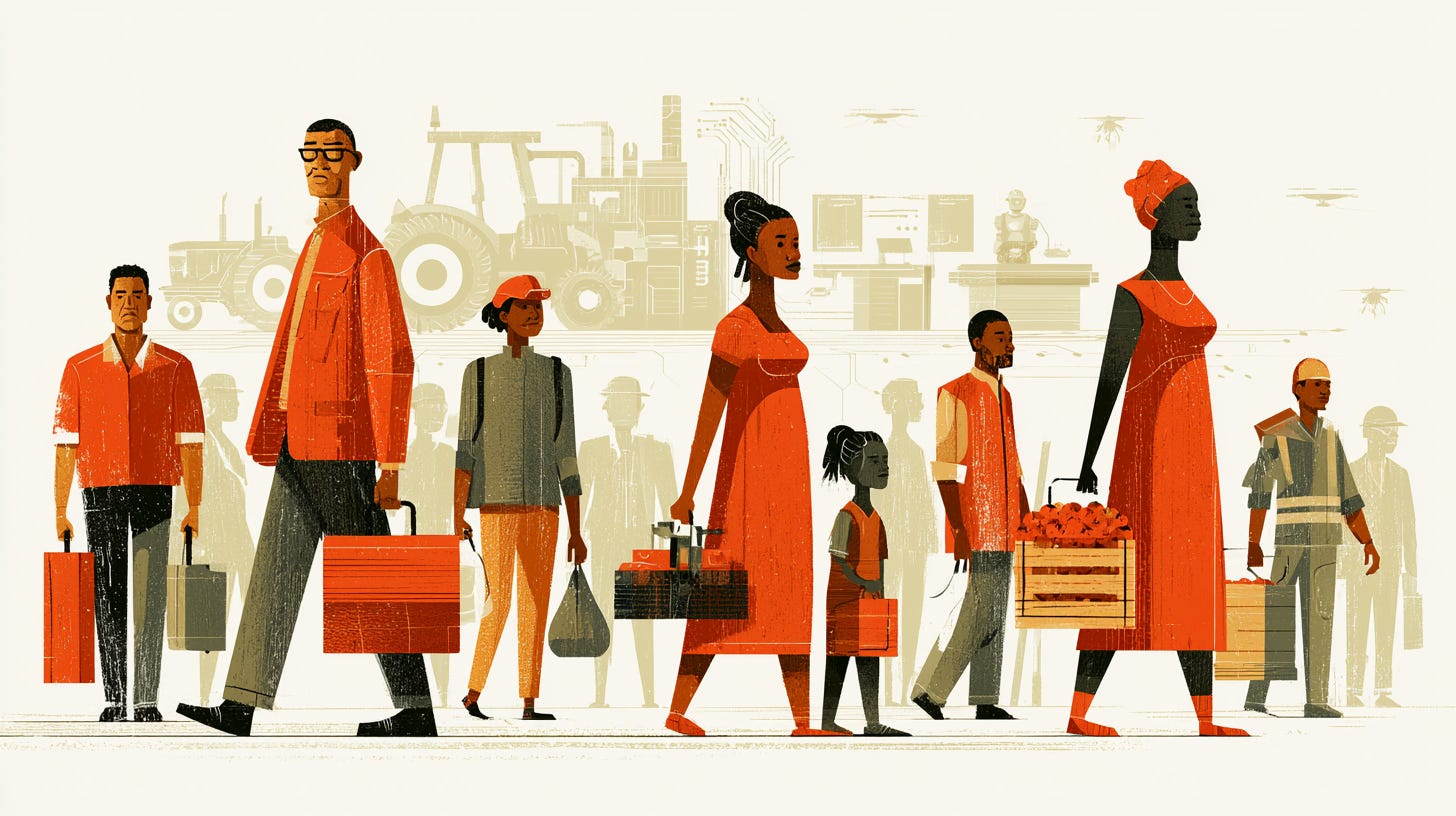
In the autumn of 1965, something was missing from the tomato fields of California. For two decades, close to half a million Mexican men had crossed the border each year to pick the crops that Americans ate. They were called braceros – hired hands, brought in under a government programme that had started during the war. Then, on the last day of 1964, Washington closed the programme down. The braceros went home.
Politicians had promised this would be good news for American workers. Take away the foreigners, the argument ran, and farmers would have no choice but to offer better wages to the locals who stayed behind. It was sold, in the language of the day, as an ‘active labour market policy’: remove the migrants, lift up the natives. The logic felt like common sense. Fewer workers chasing the same jobs should mean higher pay.
It did not work out that way.
Three economists – Michael Clemens, Ethan Lewis and Hannah Postel – went back to the archives and measured what actually happened after the braceros left. If kicking out foreign workers really did raise wages for the people who remained, we should see it most clearly here, in the states that had leaned hardest on Mexican labour. Their own model predicted that farm wages in those states ought to jump by around 12 per cent.
They jumped by almost nothing. Wages barely moved. Employment of domestic farm workers barely moved. The promised gain to American workers never came.
Where did the adjustment go instead? Into machines and into crops. In tomatoes, growers bought the Blackwelder mechanical harvester and let it do the stooping. In cotton and sugar beet, the same story – more machinery, fewer hands. Where a crop could not be mechanised, farmers often switched to one that could, or grew less of it. Wages stood still. The work itself was engineered away.
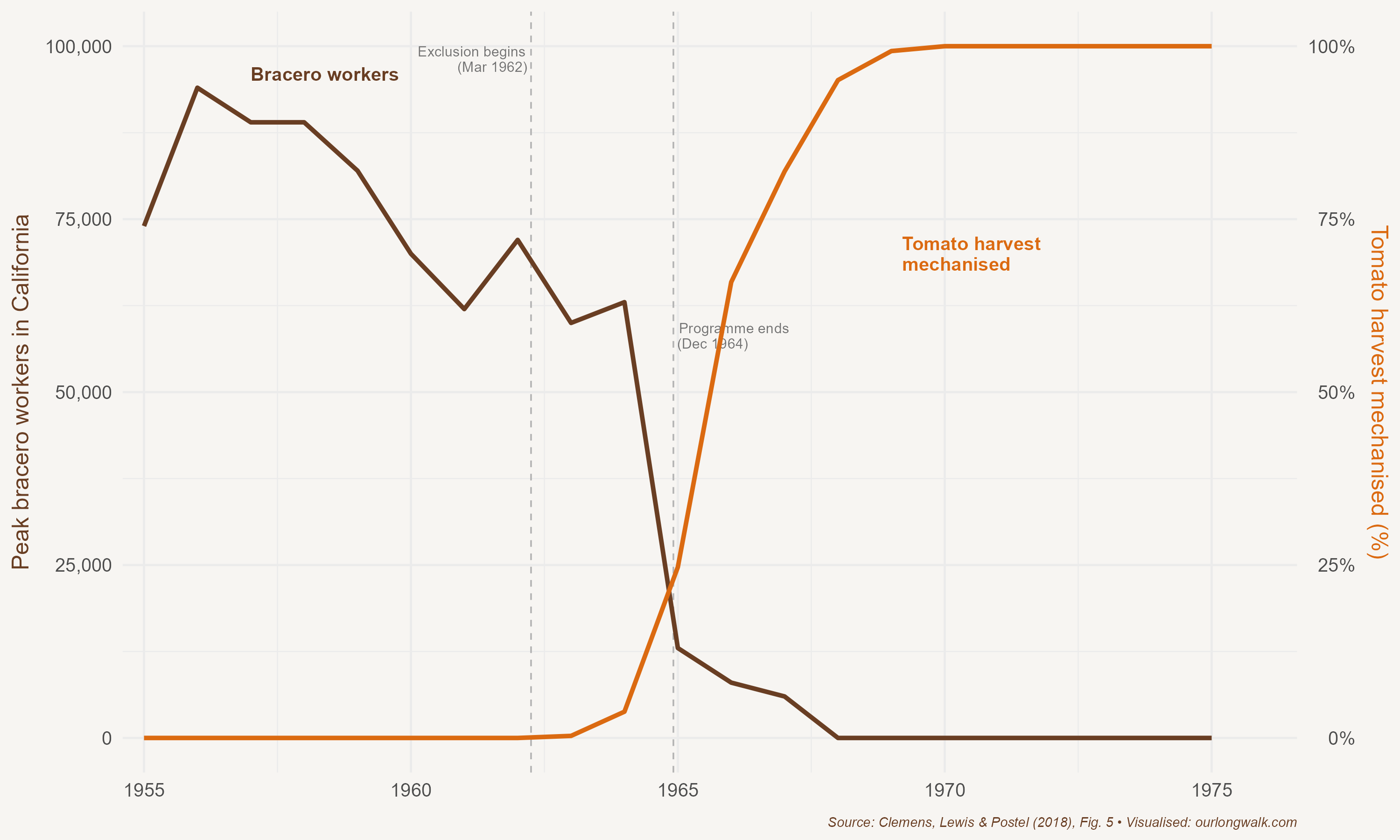
This is the first lesson, and it holds well beyond California: an economy that loses workers adapts. The gains its planners promised to the people left behind tend to flow instead to whatever does the job more cheaply – often a machine.
Back to the present, and a little closer to home.
South Africa has seen another wave of anger at foreigners – marches, threats, men turned away from clinic doors and spaza shops, the now-familiar demand that ‘illegal’ foreigners be rounded up and removed. The cause, we are told, is obvious. Foreigners are taking South African jobs. Foreigners are driving crime. Get rid of them and ordinary South Africans will breathe easier.
These are confident claims, but the evidence behind them is thinner than the confidence suggests. We have little solid proof that foreign workers are the reason South Africans cannot find jobs, or that removing them would open those jobs to anyone else. What economics can speak to with more assurance is the other side of the ledger: the measurable consequences of acting on the anger.
Begin with our own history, because South Africa has run a version of the bracero experiment before. For much of the twentieth century, apartheid policy shaped the supply and price of black labour – through influx control, job reservation, and, from the 1970s, rising wage pressure as black workers organised. As that labour grew scarcer and dearer in the formal economy, employers in mining, farming and manufacturing did what the Californian growers did: they mechanised. Machines replaced unskilled workers, and the economy settled onto a path that created steadily fewer jobs for the least skilled. The structural unemployment we live with today is partly its inheritance.
Migrants are, of course, not only producers. A migrant is a worker who competes for jobs – but also a customer who helps create them, someone who buys bread, pays rent, takes a taxi, sends children to a crèche. A 2026 study from Norway, by Sigurd Galaasen and colleagues, measured this second channel directly, tracking the electronic payments of an entire country. Workers more exposed to migrants’ spending saw their own incomes rise, strongly and persistently. By spending what they earn, migrants help pull native wages up.
This is what economists mean when they say migrants and locals are usually complements, not substitutes: each makes the other more productive. Some of that is the spending we have just seen. Much of it is what migrants bring to the work itself – education, a trade, business experience, and the ideas, capital and networks that come with them. A Congolese electrician or an Ethiopian shopkeeper builds something that was not there before, and hires people to run it. A second 2026 study, by Angel Aguiar and Stephen Devadoss, put a number on what cutting that link costs: deporting just 30 per cent of America’s undocumented workers, they estimate, would shrink United States output by more than 128 billion dollars, with the deepest losses in agriculture, food processing and construction.
It is true that perhaps this mutual benefit is weaker in a country like ours, with millions of unskilled workers already searching for jobs, than in a rich, labour-scarce economy like Norway; the effect may well be smaller here. And what is probably also true is that the gains from immigration and its costs fall on different South Africans. Those of us who never meet a migrant at the hiring queue – who employ them, at most, as domestic workers, or merely read essays like this one – enjoy the upside while seldom feeling the competition. The people who feel it are not us, and their anger is not simply prejudice.
Yet the case runs deeper than any wage calculation. Many of these migrants have lived here for decades – their children in South African schools, their spouses South African, often speaking the languages we speak. They have built lives and businesses inside an economy where they are active participants, and a deportation drive would tear at all of it.
It would tear, too, at a future we cannot yet see. Every threat and every removal tells the migrants who have not arrived – the ones who might have opened a business and taken on a few employees – that they are not welcome. The firms that fear keeps away are firms we never get to count.
And come they would, despite everything, because South Africa, for all its troubles, is still the richest economy for thousands of kilometres – the place where a life can be built. That is precisely why this is harder for us than for Canada or Australia, who draw their migrants from across oceans, with no long, unpoliced border onto a poorer world. We cannot wish our geography away.
So what should we do? If the problem is really that too many people are here illegally, the economist’s answer is almost embarrassingly plain: make them legal. South Africa has so many undocumented migrants largely because Home Affairs spent years as one of the state’s worst-run departments, where a lawful visa could take longer to obtain than a child takes to be born. The department is improving, but too slowly. Fix the queue and much of the ‘illegality’ simply dissolves.
Readers may hear an argument for open borders here. But that is not what I’m arguing for. A country is entitled to know who crosses into it, and our long, porous frontier is a real problem that deserves a real answer: a properly policed border, so that future migrants come through the front door and fewer are ever forced into the shadows. Legal status serves that same end. A person on the books can be taxed, counted and, where someone proves dangerous, traced and removed – provided we also build the capable police service we still lack.
The country does not need fewer people. It needs more of them here legally – starting businesses, paying taxes and employing the South Africans who badly need the work. Shipping thousands back – worse, leaving it to crowds at the clinic door and the spaza counter to decide who belongs – would leave the South Africans who stay poorer, and it would be inhumane besides.
Sending foreign workers home did not raise a single American farm wage in 1965, when replacing a picker meant buying an expensive new machine. Today, when a task can be handed to a machine – or a line of code – faster and more cheaply than ever, the gains from any deportation are even likelier to flow to capital than to the workers left behind. There is little reason to expect it would do more for us.
Johan, our massive social grant reality will even exacerbate the potential impact of a mass forced outmigration. Who wants to fill a "vacancy" left by an immigrant chased away when it is much easier to simply keep on receiving government largesse?
I am also very sceptical about the prospect of locals now filling the voids left by many of those forced out, for another reason. My practical experience of township economies is that the productive immigrants, be they legal or illegal, are often resented by native competitors who can't compete or resent competing. The resentment often stems from the immigrant's willingness, through force of circumstances, to work harder, longer hours, with lower margins or for lower wages, while living a very frugal lifestyle. Of course that gives the immigrant a competitive advantage, as we economists know. The native competitor sees that and resents it. Instead of being willing to compete, or find an alternative way of earning a living, the native then resorts to violence in order to harm or chase away the competitor, or destroy his or her spaza. Often not personally, but through hired help. This is not fiction; it is a township reality.
Where did the locals/natives learn those strategies? Look at the national picture of how the SA government and its cronies manage the economy. If your cronies fail to become competitive (NOT because of historical reasons like the Apartheid of 32 years ago!), you help them as government by passing legislation giving you as the crony the competitive advantage. B-BBEE is the prime example of that strategy, but there is a lot more. Government procurement processes/policies have the same effect. So do the racial employment quotas. I can go on...
What is the result of our national policies described above? Check out the economic growth rates and unemployment figures.
Back to the townships where most of the immigrants live who are now being chased away. Will the outcome there be any different from the national outcome? Of course not...
I think this article illustrates the problem of using a rich country example in a developing country context. In the USA there were (and still are) millions of manual labour jobs that Americans did not want. It is also a country with close to full employment. In that context, the deportation of illegal immigrants failed to address the fact that Americans don't want to pick fruit. The hope was that this process would force farmers to raise wages and thus attract American workers while at the same time inevitably increasing the price of fruit.
In South Africa, the reality is completely different. We have many millions of South Africans desperate for any job, including manual labour work. Similarly, they don't require higher wages to be convinced to take up those jobs. The tensions we are seeing in SA are partly driven by unemployed youth seeing undocumented immigrants working in jobs that they want - it has been quite common to visit a restaurant where all waiters are foreign nationals. Ditto for many other industries and domestic work.
It seems like it would be realistic and fair to expect the Dept of Labour to ensure that employees in formal jobs are legal.
There is a different category of undocumented immigrant, namely the entrepreneurs. These immigrants definitely create jobs in their shops and the other businesses they run. In each of our small Eastern Cape towns there are dozens of new hardware stores and retailers who employ hundreds of people. If they are forced to leave this will cause the loss of many jobs and result in higher income and profits for the large national retailers.
A nuanced debate on this topic would have allowed us to differentiate undocumented foreign workers from foreign entrepreneurs and allowed us to prohibit the former while encouraging the latter to the benefit of everyone.
But the simplistic application of OECD narratives of "the net benefits of immigration" to our poverty-stricken context has alienated activists who dismiss these narratives as typical of wealthy people "benefitting from slave labour". Everyone is now talking past each other with no obvious middle ground possible.