

How (South) Africans use AI
The latest evidence from Google, Microsoft, Anthropic and OpenAI

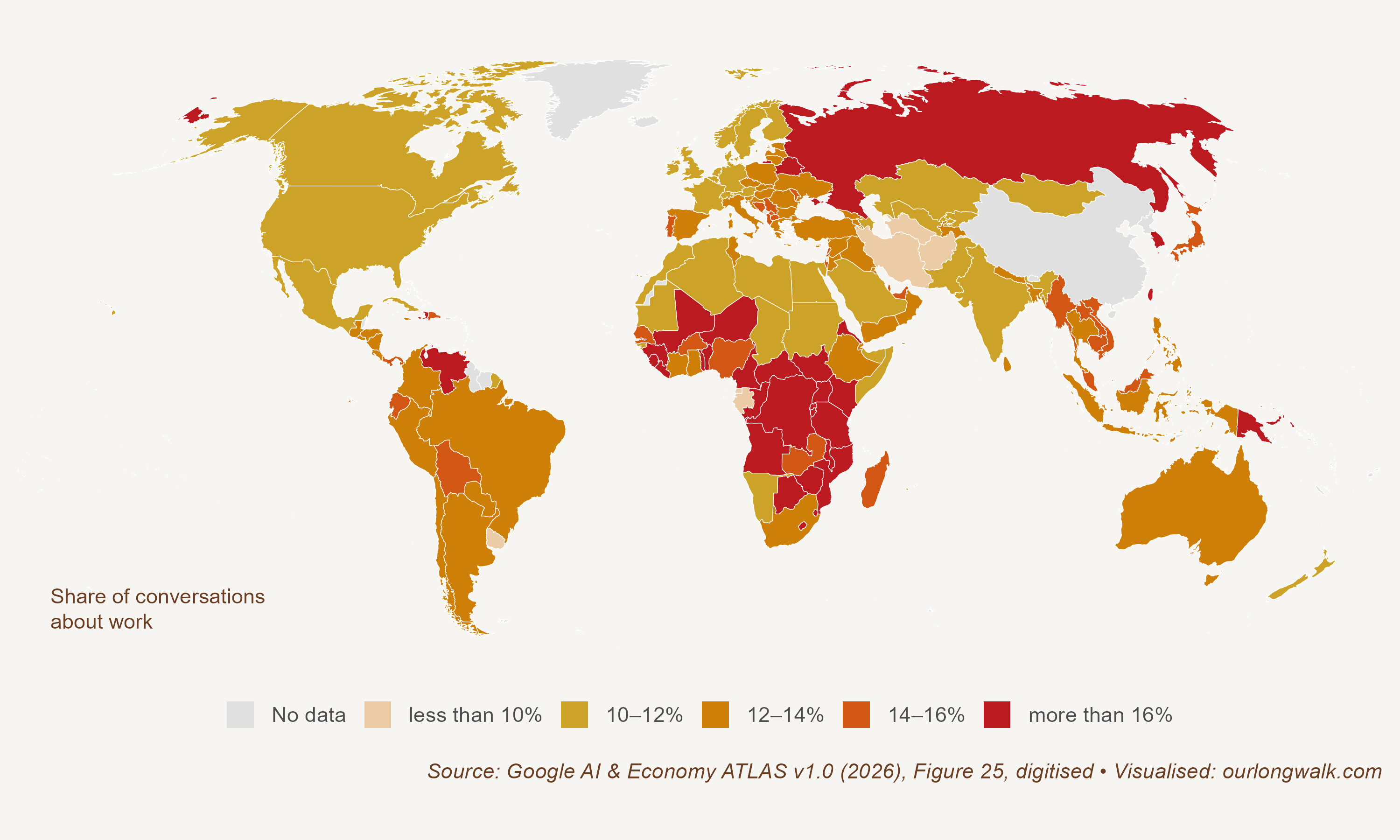
On page 53 of the 100-page atlas Google published this week sits a map that would have puzzled the cartographers of empire. It colours each country by the share of its AI conversations that are about work. The United States is pale. Western Europe is pale. Africa is the darkest continent on the map – and, for once, for the right reason.
The atlas is Google’s first serious attempt to chart what people actually do with its Gemini models: 15 million anonymised conversations from a two-week window in April, spanning 150 countries and 140 languages. Globally, 13.5 per cent of conversations are work-related. In the United States and the European Union the share falls below that. Across a broad swathe of Africa – from Mali to Mozambique – it exceeds 16 per cent. Google’s economists call it ‘a surprising inversion’ and offer an explanation: professionals in developing economies ‘could be leveraging it more intensely as a productivity multiplier to bypass traditional business constraints’. A survey by Ipsos and Google puts the same point more bluntly: 91 per cent of Nigerian AI users say they use it to assist with their work – the highest share of the emerging markets surveyed, ahead of the UAE, India and Brazil.
Below, I combine Google’s map with newly released usage data from Microsoft, OpenAI and Anthropic to work out where South Africa stands. Among the things you will learn: why one in four working-age South Africans now uses AI (a higher share than in Japan); which South African number has not moved once in OpenAI’s rankings in five quarters; which province uses Claude more intensively than Gauteng; and why nearly half of the Eastern Cape’s AI conversations are about coursework. Also: what AI assistance with household tasks is worth...
