

Economists in the newsroom
Why digital newspapers are struggling – and what to do about it


What, really, is the job of a columnist?
This week marks four years since I moved to Substack. I arrived in July 2022 with about 400 subscribers, carried over from my decade-old WordPress blog. Today there are more than six and a half thousand of you. Over the years I have experimented with length, frequency, subject and tone, and have now settled into a rhythm: a free column on Mondays and one behind the paywall on Thursdays, though I still think of it as my Friday column.
Sometimes people ask me why I write. I do not have a very good answer. I like writing. I like sharing ideas. I like the discipline of having to make sense of something in public twice a week. Other times I am asked why it has been ‘successful’. But I am not sure what success looks like. Likes? Some of my best posts attract only a handful, and social media traction is too idiosyncratic to read much into. Subscribers? Better, perhaps, but even that does not quite answer the question. I do not depend on these columns for my daily bread, not yet at least, which makes it easier to write what I like. But the question stands: what is the column actually for?
There is, of course, always a recent economics working paper with an answer…
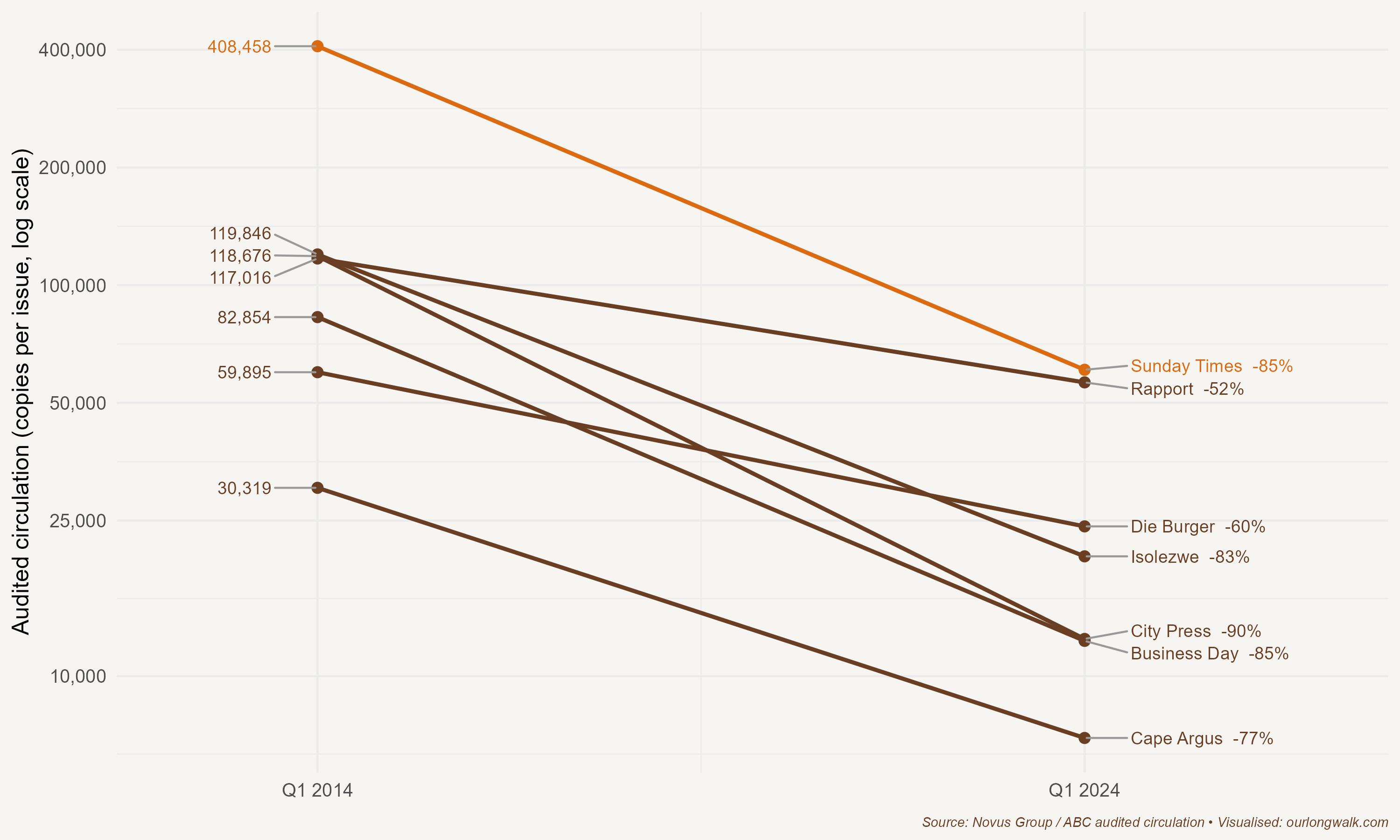
Consider the graph above. In the first quarter of 2014, the Sunday Times sold 408,458 audited copies per issue. A decade later: 60,759. City Press lost 90 per cent of its circulation; Business Day, 85 per cent. Die Burger is now South Africa’s highest-selling daily, at 24,161 copies, about a fifth of what PE Express, a free community paper in Gqeberha, hands out per issue. The Weekend Post closed in 2024, after 77 years.
The decline of journalism is a long story, bound up with the internet, though it does not begin there. It might surprise you to learn that the modern columnist was born out of an earlier attempt to save the industry.
The 1960s were a tough time for newspapers. In America, new media like television and the tabloid press threatened advertising revenue, accelerating consolidation across the industry. New York’s newspapers were especially badly hit. In 1962, some 17,000 newspaper workers went on a 114-day strike, bringing the city’s six daily newspapers to a standstill. While the dispute centred largely on wages and contracts, the strike is remembered as a battle against automation. From the 1930s, teletypesetting, machines that set type automatically from a coded tape, and later film- and computer-based systems had been making their way into newspaper composing rooms, where they threatened to displace skilled labour. The strike was ultimately resolved, but by the end of the decade four of New York’s dailies had shuttered.
Having survived the strike, the New York Times attempted something new: it introduced the op-ed page, short for ‘opposite the editorial’, a page of outside commentary facing the paper’s own editorials. Of the new section, the editorial team wrote: ‘We hope that a contribution may be made toward stimulating new thought and provoking new discussion on public problems.’ Fine sentiments. But, as it turned out, it was an economically shrewd move too.
The Times’ version of the op-ed page combined elements of existing opinion pages, namely regular writers alongside guest authors contributing a mix of commentary, opinion and analysis. But, unlike the existing opinion pages, the Times reserved something like a quarter of this precious real estate for premium advertising.
According to Michael J. Socolow, a media historian, the op-ed model proved highly profitable, even in the recessionary climate of the early 1970s. Part of this lay in how cheaply the section could be run: attract high-profile writers, pay them no more than $150 per piece, and use existing employees to run the department. Surveys found it was among the most read pages in the paper.
So, if the column saved journalism once, could it do it again?
Today, with the advent of the internet, and its gobbling up of ad revenue, the only viable option for journalism seems to be the subscription model. News24, for instance, crossed 100,000 digital subscribers a year or so ago to become Africa’s largest subscription news publication.
The newsroom of the future, in short, will be paid for by its readers.
Which raises an awkward question: what, exactly, are modern readers paying for?
Enter the paper: ‘What do news readers want?’ by Gregory Martin, Cameron Pfiffer and Shoshana Vasserman. They obtained something close to the perfect dataset: the complete digital history of a large American metropolitan newspaper from 2020 to 2023. That is 605 million article visits and more than 55 million encounters with its paywall.
The paywall is the clever part. Like most news sites, the paper allows a few free articles in a rolling window before demanding payment. But the meter is invisible. Readers cannot see how many free reads they have left; the limits changed repeatedly; the system glitched at random. The paywall arrives unannounced, and its quasi-random arrival lets the authors measure, article by article, what readers will pay to keep reading.
What readers click on and what they pay for, it turns out, are two very different things. The site’s biggest traffic drivers were syndicated advice columns, the agony-aunt kind that runs in a hundred papers at once. Subscriptions were triggered by hard news: public health, the economy, local politics. Willingness to pay for an average local-news article was roughly double that for an average entertainment piece. And the most-clicked articles attracted the window-shoppers least likely ever to subscribe.
My favourite detail is what happens after readers subscribe. Once articles are effectively free, they drift towards entertainment and the advice columns; while rationing scarce free reads, they spend them on hard news.
This is the kind of finding readers should be able to carry to a braai, a coffee urn or a dinner table and say: you will not believe what I read the other day. People click on the light stuff, but they pay for the serious stuff. They arrive for one kind of content and renew because of another.
The implications for strategy follow. A newsroom chasing traffic should hire entertainment writers and cut local news; a newsroom chasing subscriptions should do the reverse. Since digital advertising has collapsed anyway, and AI search summaries are expected to shrink what click traffic remains, the subscription logic wins by default. The content that keeps a subscription newsroom alive is the serious, civic, expensive kind: the very journalism the click era taught editors to doubt.
So where does that leave the columnist?
Consider one more finding. The revenue-maximising introductory price for a subscription is zero. The newspaper charges $0.99, essentially to capture your card details. And no pay-per-article price could recover more than about 61 per cent of the revenue of the standard bundle. The money is in the renewal: the monthly decision of an existing subscriber to keep paying.
That changes the columnist’s job description. Hard news breaks irregularly and brings subscribers in. The columnist writes to a rhythm. The column’s job is not to be read; it is to be renewed.
Comments measure attention; cancellations measure value.
But retention is only half the brief. The other half is which columnists earn it.
Noah Smith, an economist who left Bloomberg Opinion for Substack, where he now has more than 450,000 subscribers, asks the right question: ‘Why would people pay $10 a month for a single writer, when they could pay $25 a month for the entire New York Times?’ I charge $75 a year, about R110 a month, a shade less than a full News24 subscription at R119. So, the same question Smith puts to the Times, now closer to home: why pay me rather than all of News24?
Here is Smith’s answer: legacy opinion pages misunderstand their own product. They commission opinions, short, punchy polemics, when readers want analysis: forecasts, assessments, explanations grounded in evidence. Newsrooms treat their own opinion writers, he notes, as ‘tawdry entertainers rather than as respected analysts’. His Bloomberg editors pushed him to be more subjective, more politicised. Paul Krugman has described his New York Times column as 800 words through three levels of editing, ‘intolerable’, and he was barred from using charts. Krugman now writes on Substack, too, sending out a weekly piece to more than 580,000 readers. Both Smith and Krugman likely earn more than $1 million per year from paid subscribers; not bad for a mere columnist.
But it should not be that surprising, really. Opinions are abundant. Everyone has one, social media distributes them free, and generative AI now manufactures confident polemic at zero marginal cost: the information pollution I have written about before. No reader needs to pay for outrage. Analysis remains scarce.
Jasmine Sun, a writer covering AI and Silicon Valley, takes the argument a step further. As machine-generated content floods every channel, she argues, the value of summary collapses and the value of secrets rises: ‘reporting is the act of taking private knowledge and making it public’. And trust follows the messenger: ‘it’s not about the sentence. It’s about who says it and their track record.’
Which brings us back to economists. We hold the kind of secrets Sun describes. The research frontier circulates in working papers years before it reaches journals, let alone the public; a columnist who can translate that private knowledge into public knowledge is doing reporting, from an archive most journalists cannot access. And our training is precisely the analysis Smith says readers pay for: mechanisms, trade-offs, testable predictions.
Of course, columnists alone will not save the newsroom. Martin et al.’s most sobering result is that every newsroom loses money at the margin, that is, for each extra article it runs; even the best-performing desks generate less subscription revenue than a journalist’s salary, and expanding investigative reporting would need a subsidy of roughly $11,000 per additional article per year. James Hamilton argued two decades ago that newsrooms produced more accountability journalism than readers wanted. The new evidence says readers value it far more than their clicks reveal, yet still less than it costs.
The lesson? Columns can help a newsroom survive. They have done it before. They are cheap relative to investigative reporting, and they build the habit of renewal that holds the bundle together. But that only works if editors solicit the right kind of writer. The column’s job is to earn the next month’s subscription, and what earns it is scarce analysis from a voice the reader trusts. That is the brief the economist is built for: privileged access to the research frontier, training in mechanisms and trade-offs, and a track record readers can check. Hire that writer, and judge the work by whether readers return.
A century ago, Walter Lippmann complained that the newspaper reader ‘expects the fountains of truth to bubble, but he enters into no contract, legal or moral, involving any risk, cost, or trouble to himself’. The subscription era has finally produced that contract: renewable monthly, and easy to cancel with a click.
The columnist’s job is to give the reader a reason not to cancel.