



I don’t remember the exact date I became an Arsenal supporter. I think it must have been in 2010, around the time of the FIFA World Cup in South Africa. All my friends who followed English football are Chelsea or, worse, Man City supporters. I guess it was a combination of Arsene Wenger, who had studied economics, and his philosophy of investing in young, promising players and playing an attractive brand of attacking football. And the creative midfielder Cesc Fabregas (whom I had seen playing live in South Africa, a dull win in Johannesburg). And the Dutch striker Robin van Persie (also live, a much more lively quarter-final against Brazil). I was an avid rugby supporter (less now, with kids, though I’ll watch every Bok game) and especially cricket supporter – see this post.
But football drew me in, and I suspect a large part of that is the community. I’ve been reading Andrew Mangan’s Arsenal blog almost daily since 2010. A quick sum: Andrew has published at least 10,000 daily posts since I first read his blog, and I’m confident I must have read at minimum two-thirds of those. That excludes all the news articles and player ratings after every game, and the two weekly podcasts. In short, Arsenal, through the eyes of Andrew (and his team), has been a big part of my life for the last fifteen years.
There have been some ups. Arsenal have won four FA Cups (2014, 2015, 2017 and 2020). The most memorable was the 3-2 win against Hull City in 2014 – 0-2 down after eight minutes, level by half-time, then Aaron Ramsey – one of my favourite all-time Arsenal players – winning it in extra time. (Other favourites: Diaby, Ozil, Odegaard. I have a thing for a passing midfielder.)
But there have been many, many downs. It’s been the Premier League that’s been the biggest unclaimed prize. We finished second in 2016, a year we really should have won it, but until 2023, we never really looked like winning it. And then something changed.
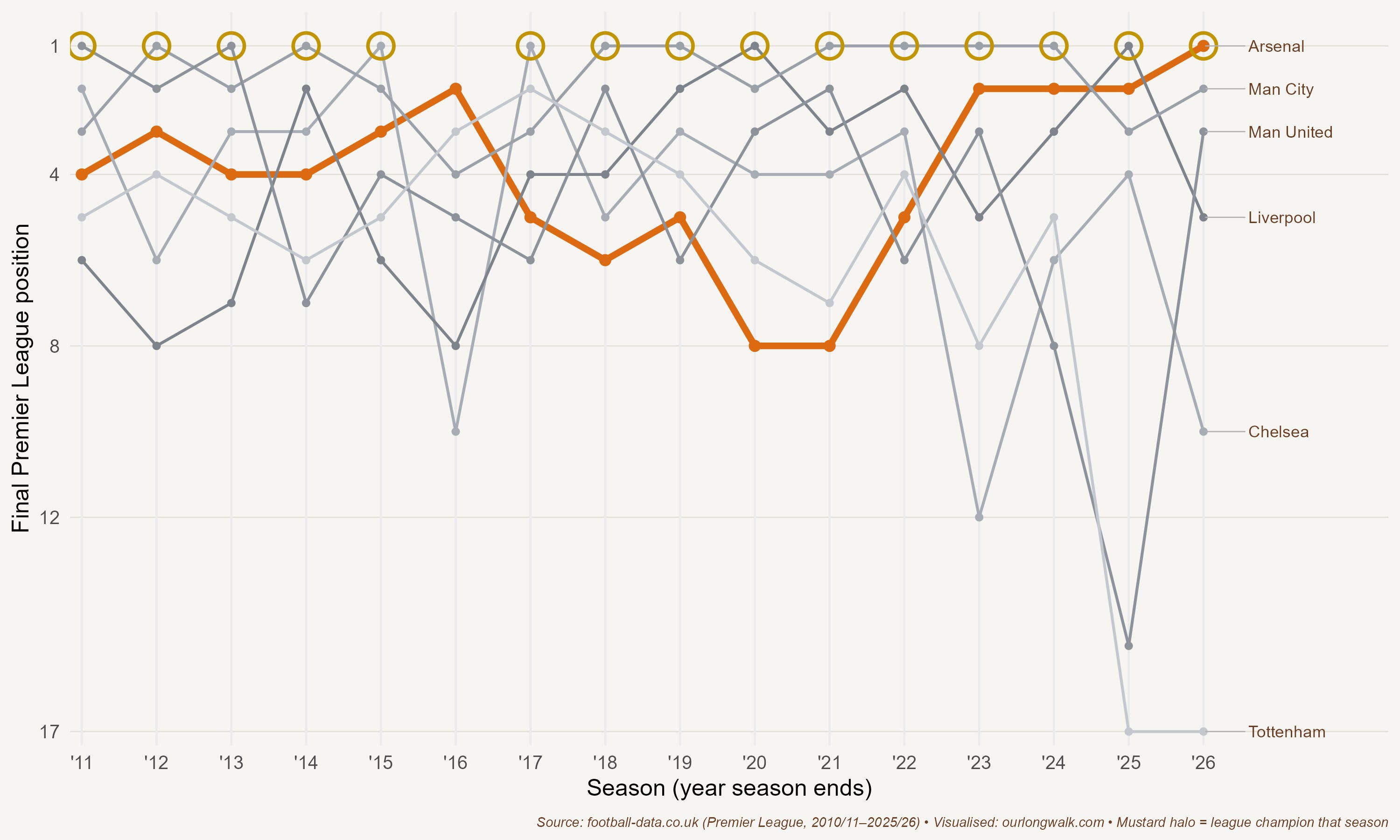
The change had happened earlier, when a young Mikel Arteta became the new head coach in December 2019. He soon won the FA Cup, but his project was a process rather than a quick piece of silverware: bold decisions, big-name players sold, young stars promoted through the system, and – just like Wenger before him – sustained investment in youth.

It took a while, but success came. First qualification for Europe’s second competition (the Europa League), then, finally, the Champions League. In the Premier League, Arsenal began to move up the table, finishing second three years in a row. But for many, success only means one thing: winning silverware.
And, so, on Wednesday last week, as Man City scraped to a one-all draw with Bournemouth, Arsenal became champions of England. I was crouched on the cold cement floor of a rondavel in the Kruger Park, watching the last ten minutes on my phone, trying not to wake the kids. And then the utter relief at the final whistle. The deathly silence of the Kruger rondavel – interspersed, perhaps, by a distant howl of a hyena – juxtaposed against the wild celebrations on the streets of London and across the world. Perfection.
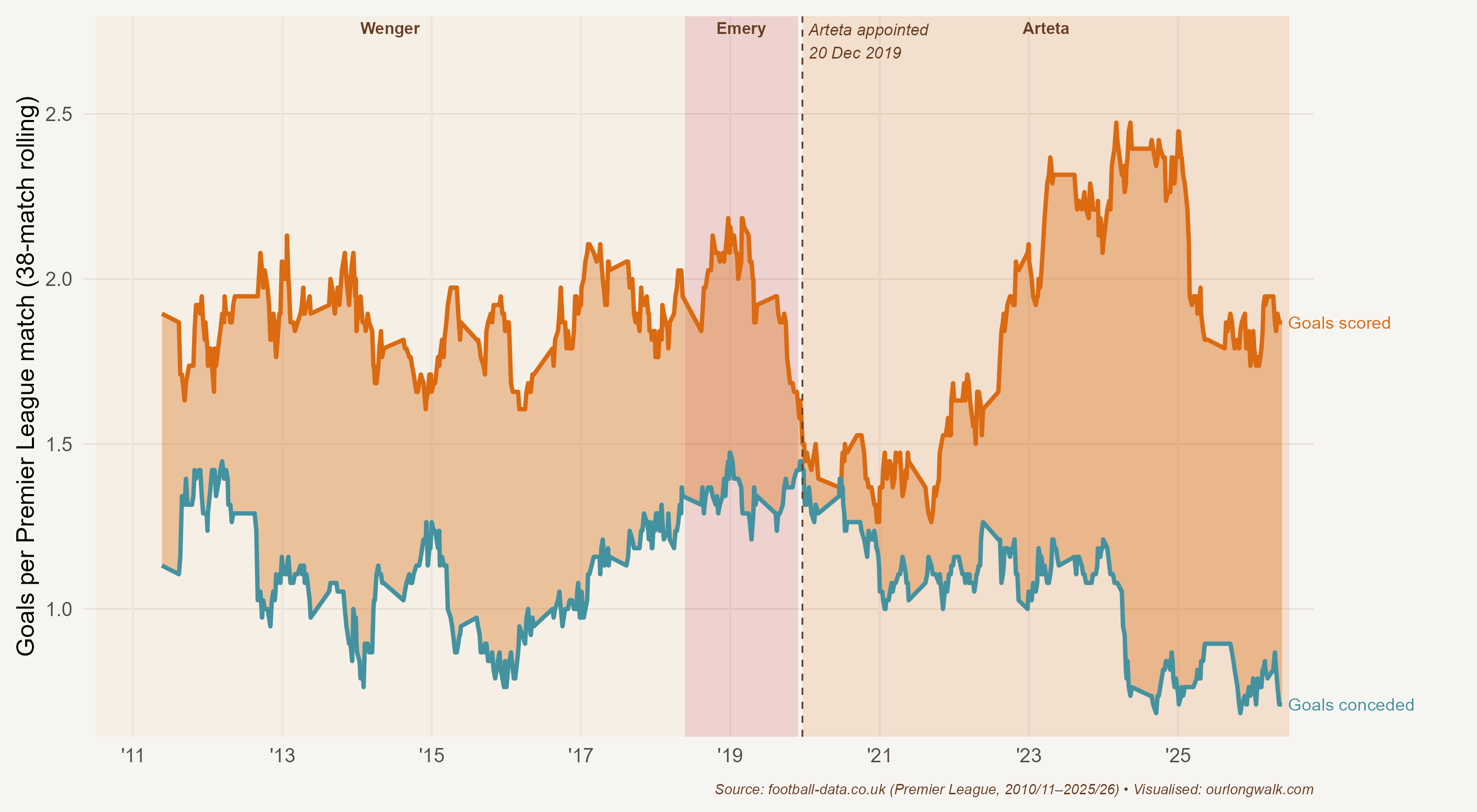
Why Arsenal won this year will be a topic of analysis for weeks on blogs and podcasts. I present one piece of evidence, comparing the late-Wenger era to the Emery and Arteta eras. Arsenal did not score more goals this past season (compared to the Wenger and Emery eras), but we did concede far fewer goals on a consistent basis. Winning is as much about defense as attack.
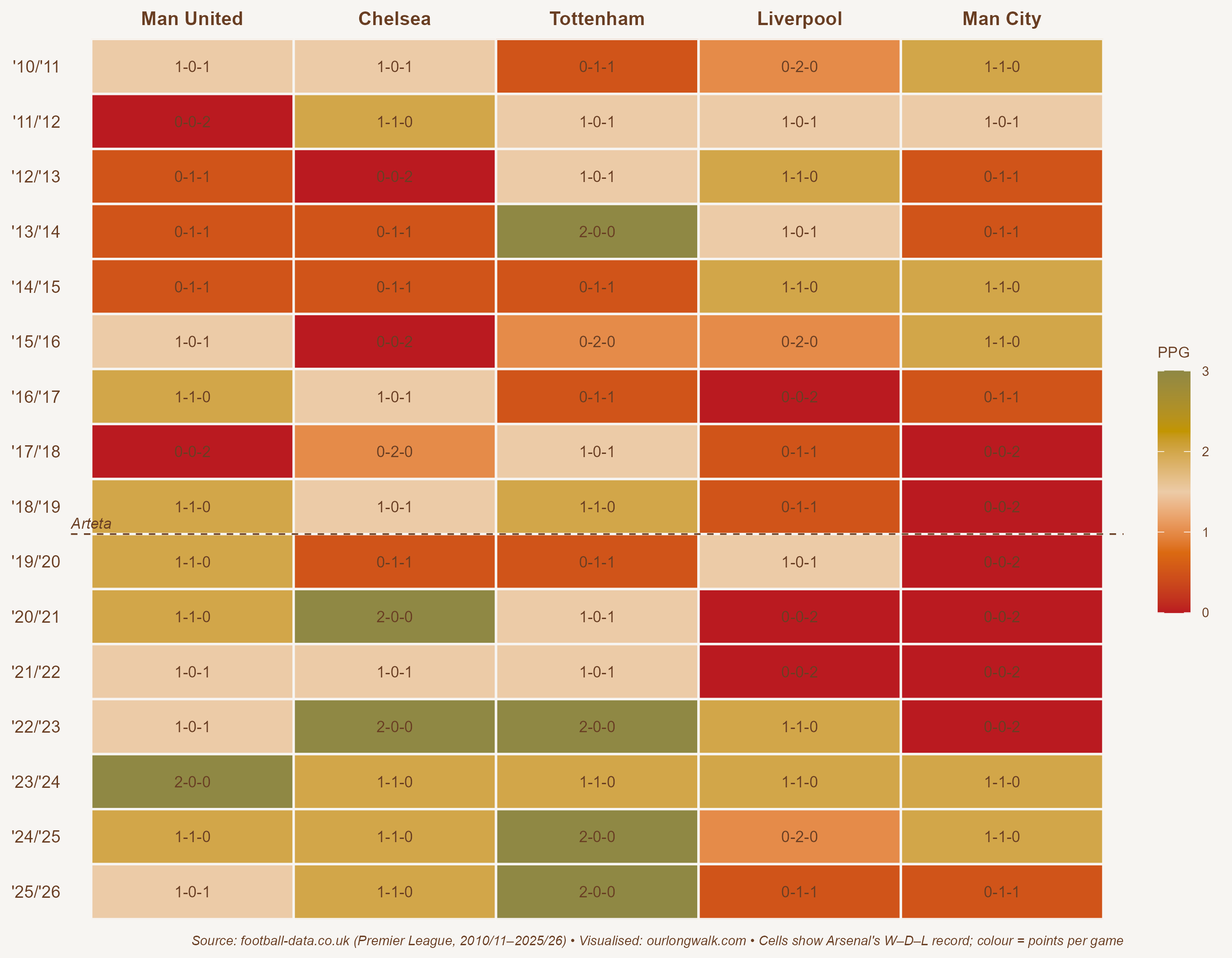
We’ve also been doing better against our main rivals over the last few seasons: for the last three seasons, we’ve not lost twice against the same rival.
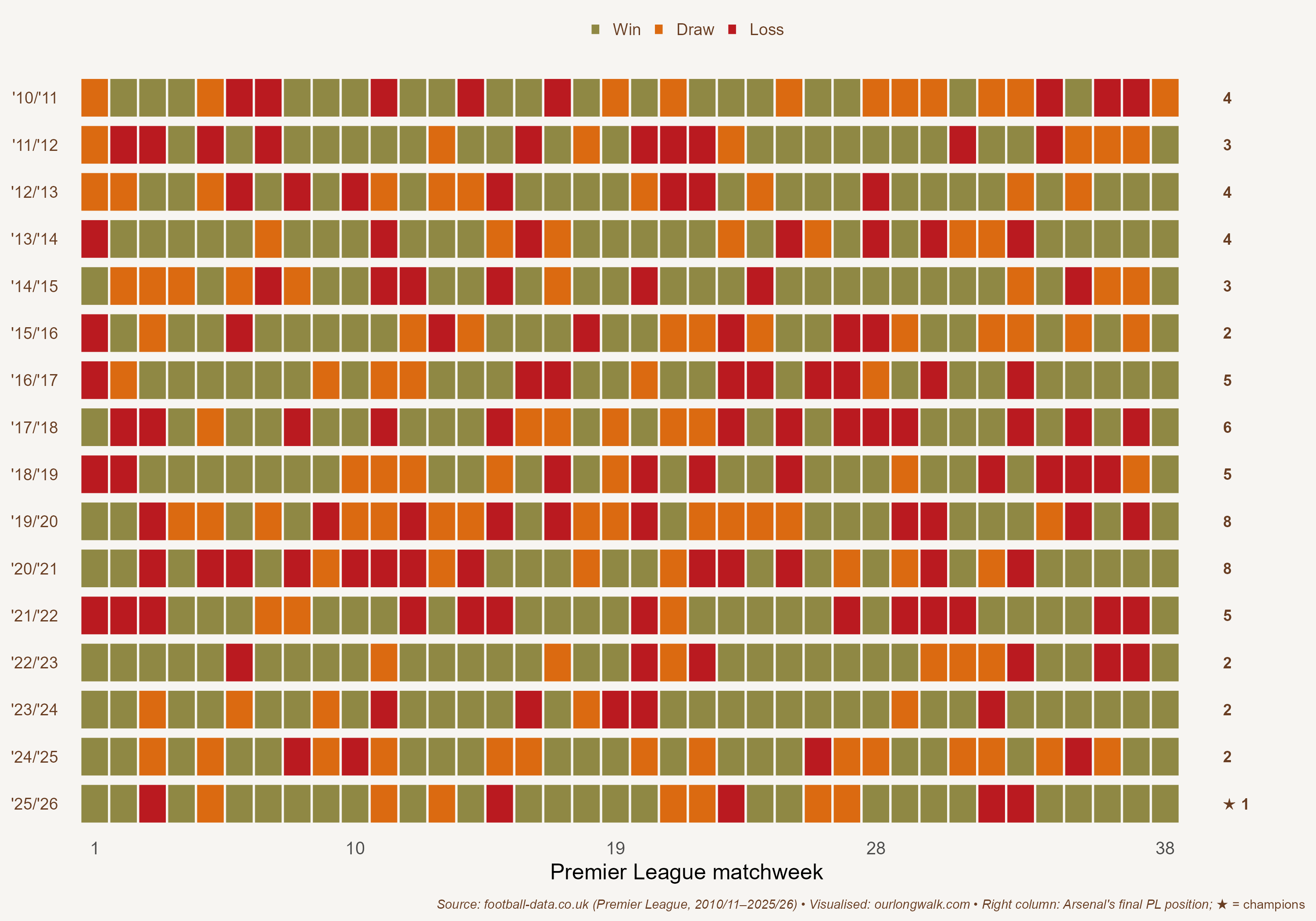
And compared to last season, even though we lost more games, we managed to turn draws into wins. Arsenal had eight one-nil wins this season; five of the eight came on the road.
But though the numbers will tell their own story, this season will be remembered for one thing: anxiety. Sixteen years (for me) of waiting. Three years of being runners-up, of bottling (I’m a Protea fan, I understand, see the above-mentioned post), of being good-but-never-great. By May, we were not so much hopeful as battle-fatigued – shellshocked from leading the table into spring twice and being overhauled, punch-drunk from a third long (Northern Hemisphere) autumn of holding our nerve, hollowed out by the slow attrition of caring this much for this long. Arsenal – and here I include everyone: the manager, players, fans – simply could not afford another second-place, another close-but-no-cigar. We simply had to win, especially being ahead in the title race since game week seven.
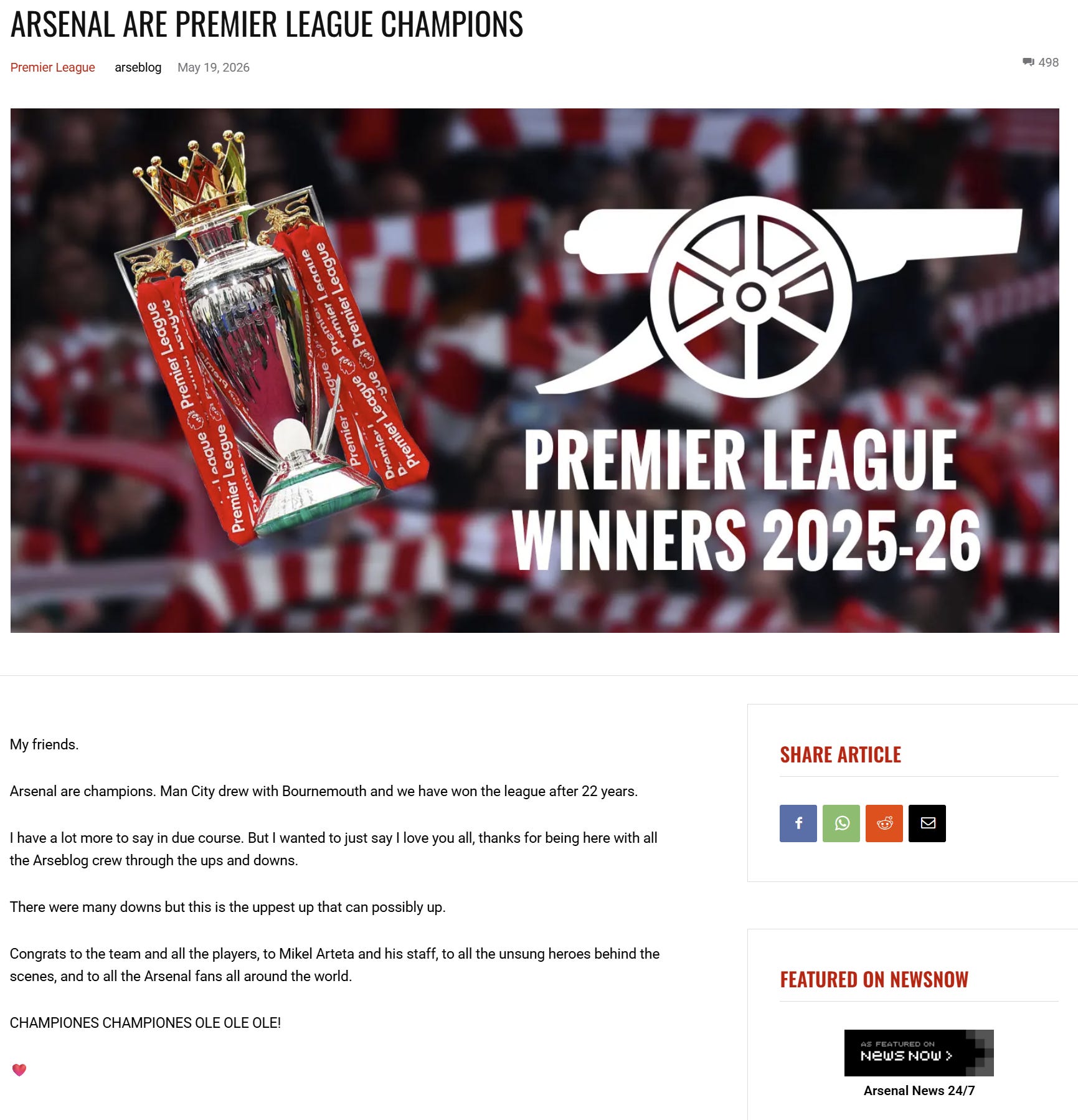
And then the release that came on Wednesday. Like all fans, I enjoyed all the celebration videos. But the most special moment – the one that had me in tears – was this short post following the news:
Before my trip to Kruger, I sent Andrew a mail to ask if I could analyse Arseblog’s text (despite the anxiety, I never stopped believing we’d win this year). Andrew responded with a kind, supportive message. So I asked Claude Code to help me create a few graphs. Enjoy.
But first: How incredible is it to post about a single football team daily for more than two decades? Arseblog and the team running it is entirely supported by reader contributions. They have a Patreon account. I joined them recently – long overdue – and, if you’re an Arsenal supporter, I hope you do too.
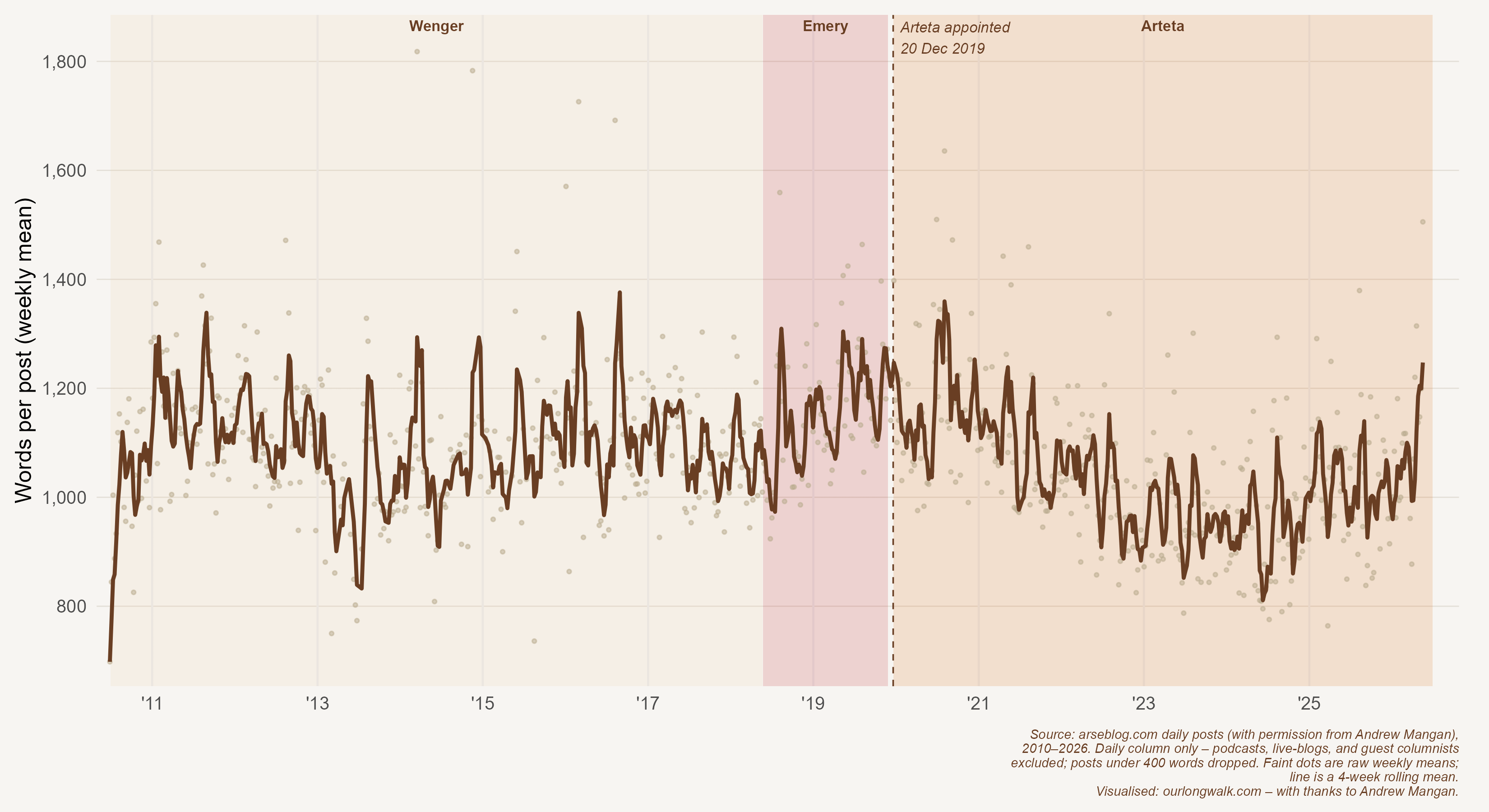
Andrew’s daily blog posts can be analysed in multiple ways. I’ve only done it since July 2010, around the time I started reading, because I did not want the Wenger era to dominate the analysis.1 The first thing I did was analyse the length of the posts. The length has shortened somewhat in recent years to around 1,000 words, though with the notable exception of the very recent run-in. (The day after Arsenal became champions, Andrew wrote a 2,000+ word post.)
I then had Claude do a sentiment analysis of Andrew’s posts and compared it to a rolling average of the points per game. Below it, I then plot the difference. Above zero (in teal shading) means that the blog mood is higher than results would predict; Andrew was more bullish than the team deserved. Below zero means the opposite.
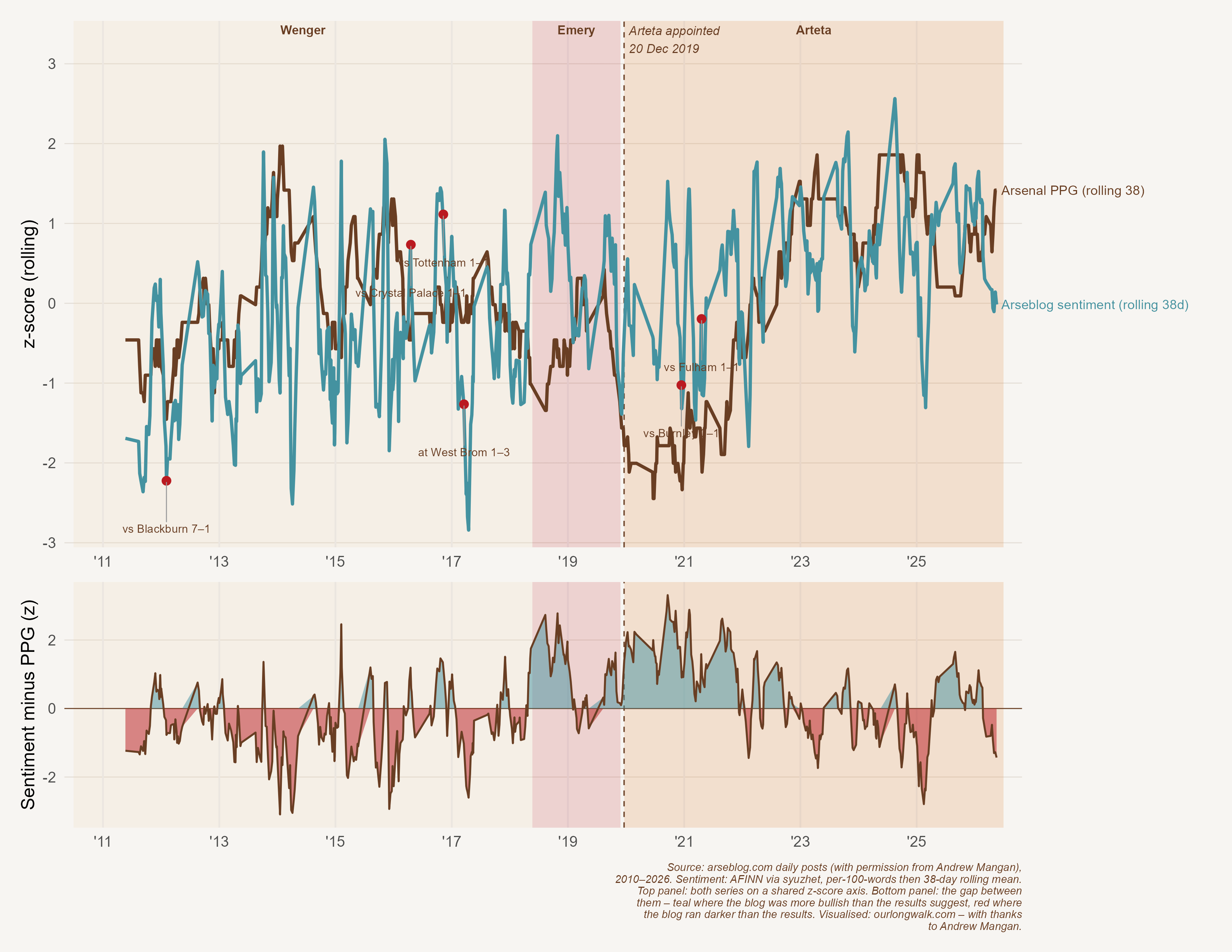
I find the results fascinating. In the Wenger years, Andrew was more pessimistic than Wenger’s results perhaps deserved. This turned around significantly after Emery’s appointment; the blog was consistently more optimistic than the results deserved. And so, too, for the start of the Arteta era, though his sentiment became more ‘balanced’ later.
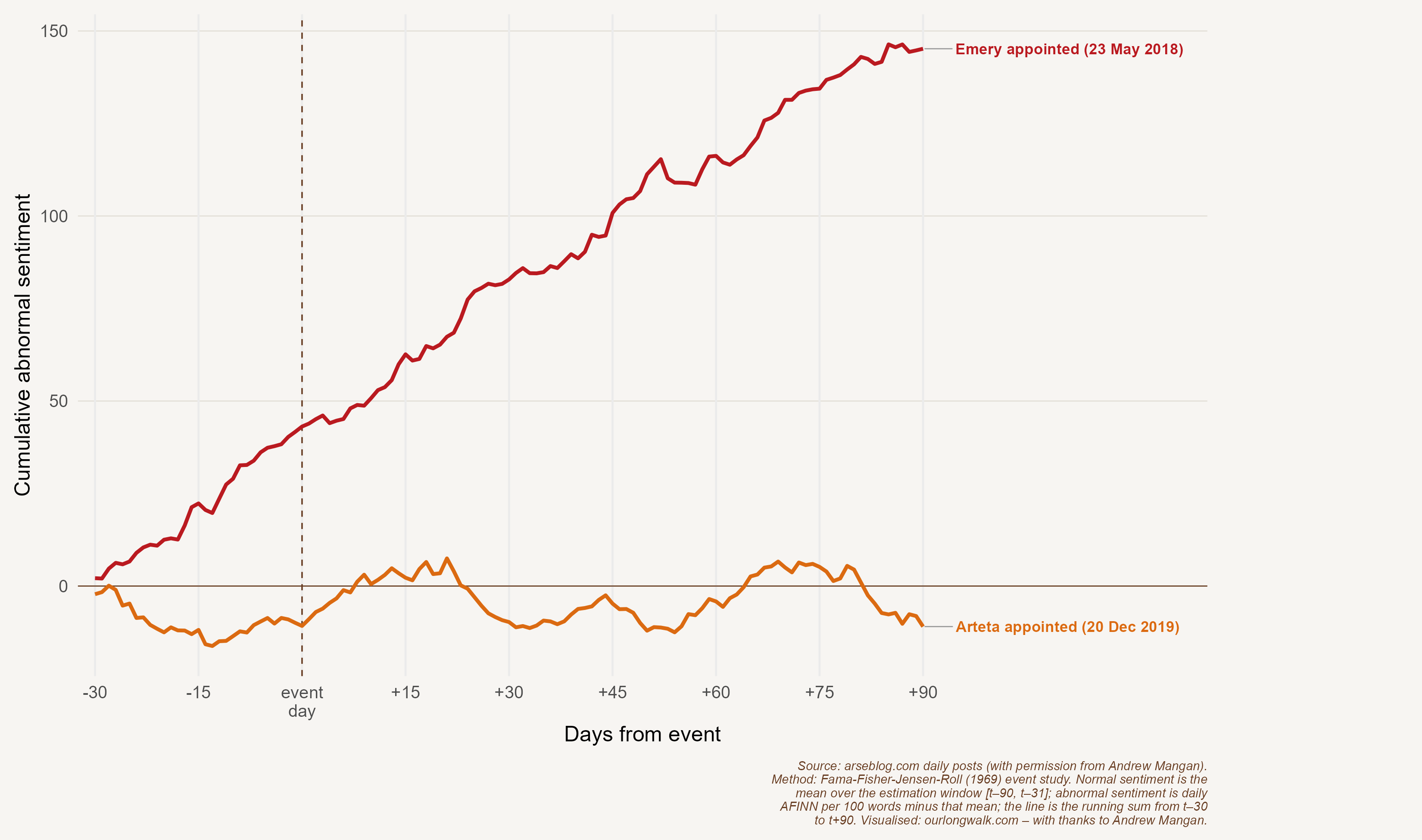
The difference hides the variation in Arsenal’s performance, though. The large, positive difference at the start of the Arteta era was not an outlandish belief in Arteta’s ability; it was simply the result of Arsenal’s poor performance. The following graph illustrates this best. I plot an ‘event study’ type graph of sentiment before and after Emery and Arteta’s appointments. Andrew was clearly eager to see Wenger’s successor succeed; by the time Arteta was appointed, the future looked bleak, and the new manager received little ‘additional’ support from fans.
Why would I read about a faraway football club on an almost daily basis? I find Andrew’s pieces thoughtful and funny, a rare combination. He calls a spade a spade without the need to create artificial clickbait rage; the benefit, perhaps, of becoming a blogger before the era of social media. So how could I visualise this combination of wit, wisdom and, well, the willingness to call a spade a spade? Let’s count the ‘swear words’ per 1,000 words over the period.2
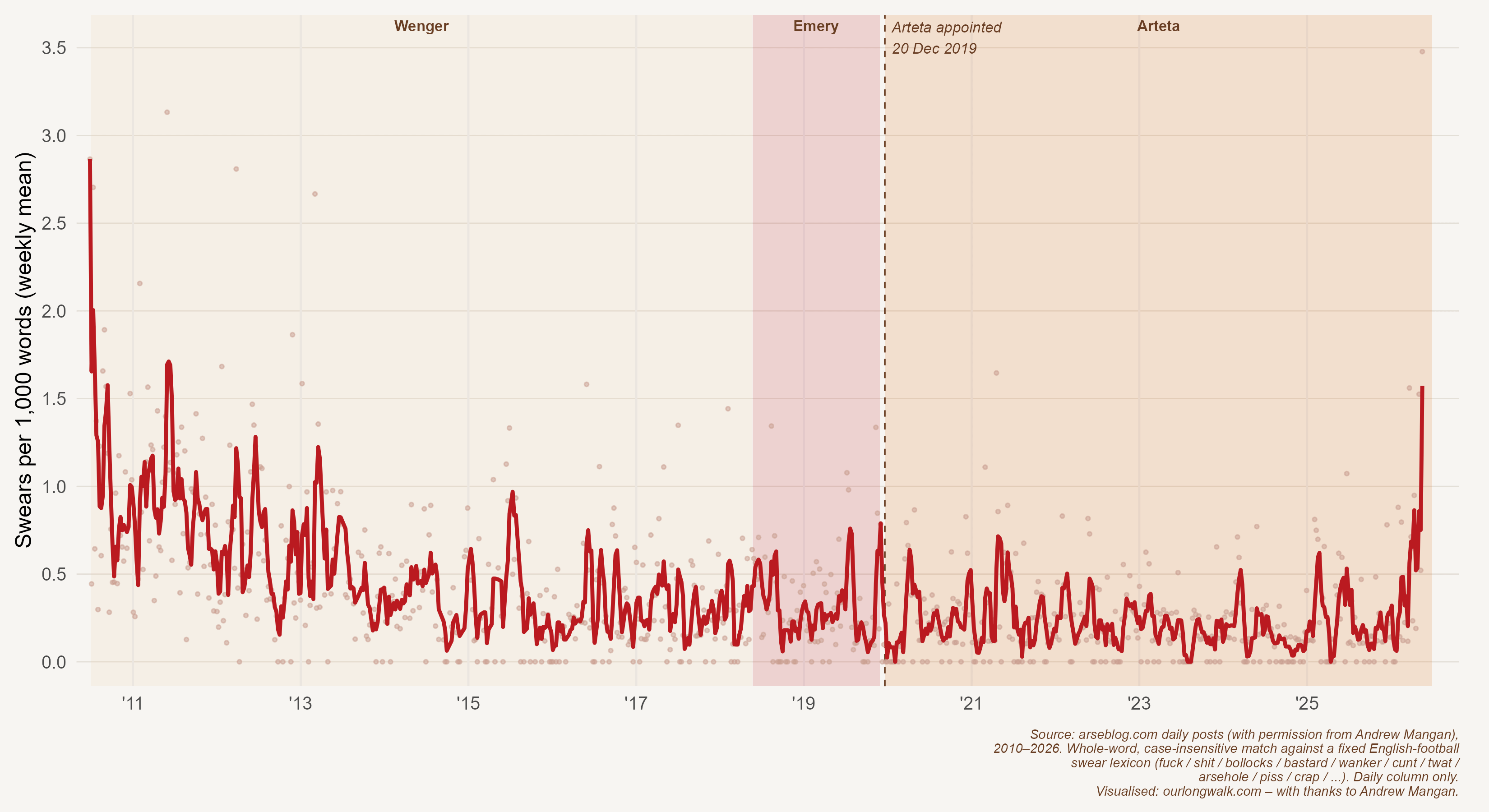
There is a clear downward trend from the start of the analysis to around 2014. Andrew did note in his email to me that:
Perhaps one thing to note/consider is that there’s likely to be a change in language/vocab over such a long time period by virtue of the author growing older/maturing along the way. But I'll leave that for you to think about!
The evidence seems to suggest he matured around 2014. He was then roughly the same age as I am now, which is good news, I guess.3
There is something faintly absurd about a South African economic historian crouched on the cement floor of a Kruger rondavel in the middle of the night weeping at the result of a London football match. There is also, I have decided, nothing more human than it. Arsenal finally gave me a trophy. Andrew, unknowingly, gave me sixteen years of company while I waited. I owe both.
The figures in this post draw on every post Andrew Mangan published on arseblog.com between 1 July 2010 and 23 May 2026 – 10,240 posts in total. After filtering down to his daily column only – excluding the Arsecast podcast notes, live-match blogs, the satirical “Arsenal Gentleman” guest series, the weekly tactics column, and other guest writers – 7,025 posts remain. Across the three managerial eras: 3,674 posts and 3.99 million words under Wenger (2010–2018), 639 posts and 0.74 million words under Emery (2018–2019), and 2,688 posts and 2.79 million words under Arteta (2019–2026). Median post length is just over 1,000 words.
Swear words: fuck, fucking, fucked, fucker, fuckers, fucks, motherfucker, shit, shitty, shite, shitting, bullshit, bollocks, bollox, bastard, bastards, wank, wanker, wankers, arsehole, arseholes, asshole, assholes, cunt, cunts, prick, pricks, twat, twats, piss, pissed, pissing, crap, crappy, bugger, buggered, knob, knobhead, tosser, tossers
Though perhaps he’s just more selective. The single highest week for profanity in the entire archive is this past week, 18–24 May 2026, the week Arsenal clinched the title – 3.48 swears per 1,000 words, narrowly ahead of the May 2011 ‘final-game-of-the-season’ rant week (3.13 per 1,000).
Congratulations from one Arsenal fan to another. Thierry Henry and Patrick Vierra, among the other legends, were my introduction to Arsenal.
Such excellent writing!
Kudos for Arsenal’s win! Regardless to a person’s club-or-sports-inclination, a particular frame-of-mind for wider application from extracted data pertaining to teams in the Premier League, or any other league, in a vector period – if persistently sought - may widen a lens to indicate ‘patterns’ of inquisitive thought processes not considered before. And such process, if confound within justly boundaries, is not to alienate incumbents, but an endeavour to understand the ‘mind of the thought’ – and yes, the linguistic order in the phraseology is intended. Myself have a highly impoverished knowledge of football in general, though decided many years ago in the early 2000’s– despite any particular rationale to justify one’s peculiar notions – to be a Manchester United (‘MU’) supporter, and still is; the deductions with respect to the ‘MU underdog Premier League positioning’ in this regard, post 2013, with Claude’s ‘’Final Premier League Season Position/Season (year season ends)-graph’’ indicates a nearly-unbelievable-high coefficient of synchronism to one’s own journey, and uncanny so, to say the least.
It is the first time I read about ‘Arseblog’, and was quite surprised by its content, for e.g. a columnist-contributor to this site, Tim Stillman, who wrote on April 22, 2026 in [https://arseblog.com/2026/04/the-limits-of-perception/], ’’The Limits of Perception’’, inter alias: “...a critical thinking error that all humans make is that once we become convinced of a criticism or a weakness in a person, leader, government or sports team, we start to see it everywhere. Once the critique is formed, even if it does indeed has a sound basis, we see the criticism first and retrofit events to it afterwards. We lose perspective easily....” and “...Detectives and investigators are taught to keep an open mind when working on cases and let the facts lead them rather than allowing their theories to lead them to evidence. I both think it is true that Arsenal might have some regrets about not ‘taking the handbrake off’ at points this season but also think there are a lot of circumstances where that criticism can be met with context.” Highly perceptive indeed.
The game of football leaves no room for a player who ignores the rules of the game, or who have no regard for the team mates, or believes to be the one kingpin and not acknowledging the defences and play of fellow team mates or view them not equitably on par in the same path-of-conduit to achieve success, or who have a disregard for the coach and his strategies, or the manager, or even worse, have contempt for the owners of the football club, or its sponsors. And it ought to work both ways from latter aforementioned spheres to the player as well. The irony is, that such ‘unity of spirit’ one recently saw, and that one often see in these high-intensity-matches, is rarely found in other secular spaces, where the ‘self’ mostly strives against ‘unity of objectives’. Arsenal – and other teams in the Premier League – reverberates excellence of skills on so many levels, and it is a pity a similar mind frame resonates not in many spaces in the business and political frames of today. The devastatingly clear evidence in the short term and long term results in these non-football environments, indicates a highly deceptive ‘playing the game’ far detached from levels found in the Premier League, and in a sense, is echoing in deafening defiance from many platforms - every day and night on Television , Newspapers, Social Media, in Town Ships, in City Suburbs, in Towns, in farms - the collapsing nature of infrastructures within a nation's decision making processes and literally the structures themselves which are the life-transmuting-veins of an economy to support its environment; ‘Commissions/Inquiries’ propelled by a State Organ’s own contempt towards the rule of Law it refuses to follow, exposes the Organ itself in spectacular form. Etc.
One finds increasingly in the modern world, cognitive incremental models of ‘spurious correlations’ clothed with (illicit) insights of causative relationships between parameters, and such ‘lawfully legal’ construction vectors, are easily sold to ‘thought consortiums’ of the highest bidder, without having any actual and comprehensive knowledge to any of the underlying foundations and functions on the x-and y-axis.
An excellent footballer is not ‘made’ overnight, but formed by years of training and many other factors. Similar is valid for any group of people, a nation, etc.
I must be honest though, I had a bit of (a good) laugh - chuckle perhaps more appropriate - at the humorous writing from “https://arseblog.com/2026/05/the-2025-26-premier-league-champions-arsenal-get-the-trophy/“. The writer has a tremendous sense of humour in general, and a person having some kind of biblical knowledge – with no detrimental view to the writer at all, or intended - cannot but ponder whether or not some of these ‘names /words’ in this particular vector setting, might have some greater future situational modern relevance within a greater narrative, but such ‘conversation’ would be limited to those who (perhaps) deduce far less 'inherent spurious correlations' from data presented, even if such 'spurious connections' may presents themselves unintentionally:
“CRYSTAL PALACE 1-2 ARSENAL: This was certainly a team selection with more than one eye on Budapest. A start for Christian Norgaard, Martin Zubimendi at right-back, Max Dowman in midfield, and Gabriel Jesus getting the nod up front told you plenty about what was at stake in this one. To be fair though, I thought we played well. Kepa had to make a good save at one point, but otherwise the chances were all ours. To be more precise, they were all for Jesus. He hit the post, didn’t make the most of a one on one after being sent through by Noni Madueke, and headed wide at the back post. Gabriel Martinelli also had a decent sight of goal but was defended well.”